



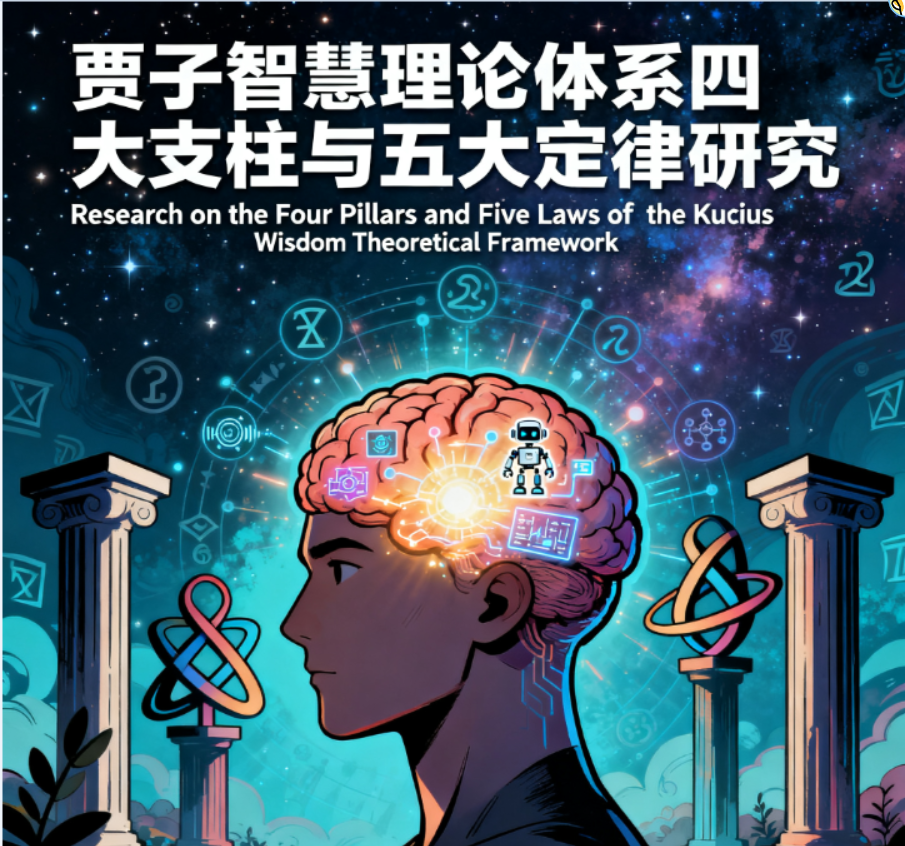
贾子智慧理论体系四大支柱与五大定律研究
Research on the Four Pillars and Five Laws of the Kucius Wisdom Theoretical Framework
摘要
Abstract
本文系统阐述贾子智慧理论体系的核心架构——四大支柱与五大定律。四大支柱包括:贾子周期律论(从货币权力异化视角解析历史兴衰)、贾子猜想(作为数学基础的高维数论命题)、小宇宙论(基于"天人合一"哲学探讨人体与宇宙关联)和技术颠覆论(研究技术演进对文明发展的影响)。五大定律分别从认知、战略、军事、历史和文明五个维度构建分析模型,涵盖认知跃迁、多维视角切换、战争艺术量化、文明兴衰规律以及东西方范式融合等内容。本研究通过文献分析与理论整合,揭示了该理论体系在跨学科融合、方法论创新及实践应用方面的价值,为理解人类文明演进提供了新的理论视角。
This paper systematically expounds the core architecture of the Kucius Wisdom Theoretical Framework—the Four Pillars and Five Laws. The Four Pillars include: Kucius Historical Cycle Theory (interpreting historical rise and fall from the perspective of monetary power alienation), Kucius Conjecture (a high-dimensional number theory proposition serving as the mathematical foundation), Kucius Micro-cosmos Theory (exploring the connection between the human body and the universe based on the philosophy of unity of man and nature), and Kucius Technology Disruption Theory (studying the impact of technological evolution on civilizational development). The Five Laws construct analytical models from five dimensions: cognition, strategy, military affairs, history, and civilization, covering contents such as cognitive leap, multi-dimensional perspective switching, quantification of the art of war, laws governing civilizational rise and fall, and integration of Eastern and Western paradigms. Through literature analysis and theoretical integration, this research reveals the value of this theoretical framework in interdisciplinary integration, methodological innovation, and practical applications, providing a new theoretical perspective for understanding human civilizational evolution.
关键词:贾子智慧理论体系;四大支柱;五大定律;跨学科融合;认知跃迁
Keywords: Kucius Wisdom Theoretical Framework; Four Pillars; Five Laws; Interdisciplinary Integration; Cognitive Leap
1 引言
1 Introduction
1.1 研究背景
1.1 Research Background
在全球化与科技快速发展的时代背景下,人类面临着前所未有的复杂挑战。传统的单一学科研究方法已难以应对这些跨领域的复杂问题。贾子智慧理论体系应运而生,它通过融合东方哲学智慧与现代科学思维,为理解和解决复杂问题提供了新的理论框架。该体系的核心"四大支柱"和"五大定律"不仅在理论上具有创新性,在实践中也展现出广泛的应用价值。
In the context of globalization and rapid technological development, humanity faces unprecedented complex challenges. Traditional single-discipline research methods have difficulty addressing these cross-domain complex problems. The Kucius Wisdom Theoretical Framework emerges as a response, providing a new theoretical framework for understanding and solving complex problems by integrating oriental philosophical wisdom with modern scientific thinking. The core "Four Pillars" and "Five Laws" of this framework not only demonstrate theoretical innovation but also show extensive application value in practice.
1.2 研究意义
1.2 Research Significance
本研究旨在系统梳理贾子智慧理论体系的核心内容,确保四大支柱与五大定律的准确阐述,避免概念混淆。通过中英文对照的学术论文形式,促进该理论体系的国际化学术交流,为跨学科研究提供理论参考。同时,本研究将批判性分析该理论体系的创新点与局限性,为后续研究指明方向。
This study aims to systematically sort out the core content of the Kucius Wisdom Theoretical Framework, ensuring accurate elaboration of the Four Pillars and Five Laws while avoiding conceptual confusion. Through the form of an academic paper with Chinese-English correspondence, this research promotes international academic exchange of this theoretical framework and provides theoretical references for interdisciplinary research. Simultaneously, this study critically analyzes the innovative points and limitations of this theoretical framework, pointing the way for subsequent research.
2 四大支柱的理论内涵
2 Theoretical Connotations of the Four Pillars
2.1 贾子周期律论
2.1 Kucius Historical Cycle Theory
贾子周期律论从"货币权力异化"视角剖析历史兴衰与朝代更替。该理论指出,当权力可无约束地介入货币发行与流通时,会形成"权力垄断货币发行→货币集中财富→财富反向巩固权力"的单向闭环,不断加剧社会贫富分化,最终因底层生存空间被挤压而引发社会系统崩溃。这一理论将货币问题与生存权直接关联,并引入热力学熵增定律构建动力学解释框架,为理解历史周期律提供了全新的科学视角。
The Kucius Historical Cycle Theory analyzes the rise and fall of history and dynastic replacement from the perspective of "monetary power alienation." This theory points out that when power can intervene in currency issuance and circulation without constraints, it forms a one-way closed loop of "power monopolizes currency issuance → currency concentrates wealth → wealth reversely consolidates power," continuously intensifying social wealth disparity and ultimately triggering social system collapse due to the compression of grassroots living space. This theory directly links monetary issues with the right to subsistence and introduces the thermodynamic entropy increase law to construct a dynamic explanatory framework, providing a new scientific perspective for understanding historical cycles.
2.2 贾子猜想
2.2 Kucius Conjecture
贾子猜想作为数学基础,聚焦高维数论的核心命题。其核心命题为:对于所有整数n≥5,方程a₁ⁿ+a₂ⁿ+…+aₙⁿ=bⁿ(aᵢ、b为正整数)不存在正整数解。这一猜想创新性地引入量子数论方法,通过构造量子态分析解空间,突破了传统数论的研究框架。它不仅为贾子理论体系提供了严谨的数学逻辑支撑,也为探索高维空间的数论结构与宇宙规律的关联提供了理论切入点。
The Kucius Conjecture serves as the mathematical foundation, focusing on the core proposition of high-dimensional number theory. Its central proposition states: for all integers n≥5, the equation a₁ⁿ+a₂ⁿ+…+aₙⁿ=bⁿ (where aᵢ and b are positive integers) has no positive integer solutions. This conjecture innovatively introduces quantum number theory methods, analyzing solution spaces through quantum state construction, breaking through traditional number theory research frameworks. It not only provides rigorous mathematical logical support for the Kucius theoretical system but also offers a theoretical entry point for exploring the connection between number-theoretic structures in high-dimensional space and cosmic laws.
2.3 小宇宙论
2.3 Kucius Micro-cosmos Theory
小宇宙论基于"天人合一"哲学观,探讨人体与宏观宇宙的深层关联。该理论将人体视为"小宇宙",认为人体在物质、能量、信息三个维度与宏观宇宙存在一一对应的统一规律。例如,人体的生物钟节律与宇宙天体运行周期、人体能量代谢与宇宙能量场的波动存在协同性。这一理论融合了中医、量子物理、生物学等多学科知识,为医疗健康、生命科学等领域提供了新的研究范式,如中药现代化研发、个性化健康管理等。
The Kucius Micro-cosmos Theory is based on the philosophical concept of "unity of man and nature," exploring the deep connections between the human body and the macrocosm. This theory regards the human body as a "micro-cosmos," believing that the human body follows unified laws corresponding one-to-one with the macrocosm in three dimensions: matter, energy, and information. For example, the circadian rhythm of the human body shows synergy with the operational cycles of cosmic celestial bodies, and human energy metabolism correlates with fluctuations in cosmic energy fields. This theory integrates multidisciplinary knowledge from traditional Chinese medicine, quantum physics, and biology, providing new research paradigms for fields such as medical health and life sciences, including modernized traditional Chinese medicine research and development and personalized health management.
2.4 技术颠覆论
2.4 Kucius Technology Disruption Theory
技术颠覆论从技术演进角度研究对文明发展的影响。该理论主张技术演进并非线性叠加,而是在关键节点通过跨领域融合产生颠覆性突破,这种突破会重构文明的生产方式、社会组织形态甚至认知范式。同时,该理论强调技术的双面性,若缺乏合理引导,可能引发伦理危机或社会结构失衡。它为科技创新战略、产业升级、跨领域技术应用等领域提供了方法论指导,有助于预判技术发展带来的社会风险并制定应对策略。
The Kucius Technology Disruption Theory studies the impact on civilizational development from the perspective of technological evolution. This theory argues that technological evolution is not linear accumulation but produces disruptive breakthroughs through cross-domain integration at key nodes, which can reconstruct the modes of production, social organizational forms, and even cognitive paradigms of civilization. Simultaneously, this theory emphasizes the dual nature of technology—without proper guidance, it may trigger ethical crises or social structural imbalances. It provides methodological guidance for fields such as technological innovation strategies, industrial upgrading, and cross-domain technological applications, helping to anticipate social risks brought by technological development and formulate response strategies.
3 五大定律的理论内涵
3 Theoretical Connotations of the Five Laws
3.1 认知五定律
3.1 Five Cognitive Laws
认知五定律揭示认知系统从信息到文明的跃迁路径。这五条定律包括:微熵失控定律(认知系统失衡始于微小偏差的纵容)、迭代衰减定律(认知成果传递效率随代际衰减)、场域共振定律(人类认知与宇宙场域能量动态共振)、威胁清算法则(通过算法消解复杂系统冲突)和拓扑跃迁定律(实现认知从信息到文明的层级跃迁)。它们共同构成了认知演化的哲学框架,为理解人类智慧的生成机制提供了统一的理论模型。
The Five Cognitive Laws reveal the evolutionary path of cognitive systems from information to civilization. These five laws include: the Micro-Entropy Out-of-Control Law (cognitive system imbalance begins with the indulgence of minor deviations), the Iteration Attenuation Law (transmission efficiency of cognitive achievements decreases with generational inheritance), the Field Resonance Law (human cognition dynamically resonates with cosmic field energy), the Threat Elimination Algorithm (resolving conflicts in complex systems through algorithms), and the Topological Transition Law (achieving hierarchical leap of cognition from information to civilization). Together, they form a philosophical framework for cognitive evolution, providing a unified theoretical model for understanding the generation mechanism of human wisdom.
3.2 战略五定律
3.2 Five Strategic Laws
战略五定律提供多维视角切换的方法论。其核心原则包括:站在历史鉴现代、站在未来瞰现在、站在全局统局部、站在外部照内部、站在对手看自己。这些定律强调以历史为镜鉴、以未来目标校准当下行动、以全局支配局部、以外部为镜像反视自身、以对手逻辑反观自身,为战略决策提供了系统性的分析框架。
The Five Strategic Laws provide a methodology for multi-dimensional perspective switching. Their core principles include: viewing the present through the lens of history, observing the present from a future-oriented perspective, coordinating the local with a holistic view, examining the internal from an external perspective, and understanding oneself from the opponent's standpoint. These laws emphasize learning from history, aligning current actions with future goals, dominating the local with the overall situation, reflecting on oneself through external mirrors, and introspecting from the opponent's logic, providing a systematic analytical framework for strategic decision-making.
3.3 军事五定律
3.3 Five Military Laws
军事五定律将战争艺术进行量化分析。其核心命题包括:战争即政治、情报即数字、兵谋即艺术、打仗即数学、全胜即智慧。这些定律将《孙子兵法》等传统兵学思想与现代军事技术相结合,为现代战争(如混合战争、算法对抗)提供了理论指导。
The Five Military Laws conduct quantitative analysis of the art of war. Their core propositions include: war is politics, intelligence is data, military strategy is art, combat is mathematics, and complete victory is wisdom. These laws integrate traditional military thoughts like The Art of War with modern military technology, providing theoretical guidance for modern warfare (such as hybrid warfare and algorithmic confrontation).
3.4 历史五定律
3.4 Five Historical Laws
历史五定律归纳文明兴衰的规律。其核心定律包括:象牙筷定律(微小特权引发欲望膨胀,最终摧毁制度根基)、兔死狗烹定律(外部威胁消失后,功高者因威胁权力被清洗)、敌戒定律(缺乏外部压力时,内部惰性加速衰亡)、五世而斩定律(传承难以超越五代,安逸滋生懈怠导致基业崩塌)和黄宗羲定律(税费改革若不触及本质,会导致新旧负担叠加)。这些定律为历史分析提供了系统性的方法论,有助于理解王朝兴衰、朝代更替的深层原因。
The Five Historical Laws summarize the patterns of civilizational rise and fall. Their core laws include: the Ivory Chopstick Law (minor privileges trigger desire expansion, ultimately destroying institutional foundations), the Law of "When Hares Die, Hunting Dogs Are Cooked" (after external threats disappear, meritorious individuals are purged for threatening power), the Adversary Alert Law (in the absence of external pressure, internal inertia accelerates decline), the Law of Collapse After Five Generations (inheritance rarely exceeds five generations, comfort breeds complacency leading to foundation collapse), and Huang Zongxi's Law (tax reform without addressing the essence leads to the accumulation of old and new burdens). These laws provide a systematic methodology for historical analysis, helping to understand the deep reasons behind dynastic rise and fall and regime changes.
3.5 文明五定律
3.5 Five Civilizational Laws
文明五定律探索东西方范式的融合。其核心内容包括:气一元论(万物源于统一的"气"场)、本质贯通论(万物本质统一性)、智慧金字塔模型(认知层级跃迁模型)、贾子智慧指数(KWI,量化智慧贡献)和人类-AI共生。这些定律试图融合东方哲学(如"天人合一")与现代科学(如量子论、系统论),为理解文明演进、推动文明发展提供了新的理论工具。
The Five Civilizational Laws explore the integration of Eastern and Western paradigms. Their core content includes: Qi Monism (all things originate from a unified "Qi" field), the Essence Penetration Theory (the unity of the essence of all things), the Wisdom Pyramid Model (a cognitive hierarchical leap model), the Kucius Wisdom Index (KWI, quantifying wisdom contributions), and Human-AI Symbiosis. These laws attempt to integrate oriental philosophy (such as "unity of man and nature") with modern science (such as quantum theory and systems theory), providing new theoretical tools for understanding civilizational evolution and promoting civilizational development.
4 理论体系的跨学科融合与创新
4 Interdisciplinary Integration and Innovation of the Theoretical Framework
4.1 跨学科融合特征
4.1 Characteristics of Interdisciplinary Integration
贾子智慧理论体系的显著特点是其高度的跨学科融合。该体系将东方哲学智慧(如"天人合一"、"阴阳五行")与现代科学思维(如量子论、系统论、数论)深度融合,构建了一个从微观认知到宏观文明的完整分析框架。这种融合不仅体现在哲学层面,更贯穿于具体理论中:小宇宙论将中医经络理论与量子力学相结合,贾子猜想将数论与量子场论相联系,技术颠覆论将技术演进与社会学、伦理学相结合。这种跨领域的贯通为传统学科提供了新的研究视角,具有极强的扩展潜力。
A prominent feature of the Kucius Wisdom Theoretical Framework is its high degree of interdisciplinary integration. This system deeply integrates oriental philosophical wisdom (such as "unity of man and nature," "yin-yang and five elements") with modern scientific thinking (such as quantum theory, systems theory, number theory), constructing a complete analytical framework from microcosmic cognition to macrocosmic civilization. This integration is not only reflected at the philosophical level but also permeates specific theories: the Kucius Micro-cosmos Theory combines traditional Chinese medicine meridian theory with quantum mechanics, the Kucius Conjecture connects number theory with quantum field theory, and the Kucius Technology Disruption Theory integrates technological evolution with sociology and ethics. This cross-domain integration provides new research perspectives for traditional disciplines and has strong expansion potential.
4.2 理论创新贡献
4.2 Theoretical Innovation Contributions
在创新性方面,该体系提出了许多原创性概念和模型。"贾子猜想"作为高维数论命题,挑战了传统数学的研究范式;"智慧金字塔模型"将认知过程层级化,为理解智慧的本质提供了新路径;"贾子智慧指数(KWI)"则试图量化智慧贡献,为后货币时代的价值度量提供了可能。这些创新点体现了该理论体系在理论和方法上的突破,为相关领域的研究提供了新的思路和工具。
In terms of innovation, this system proposes many original concepts and models. The "Kucius Conjecture," as a high-dimensional number theory proposition, challenges traditional mathematical research paradigms; the "Wisdom Pyramid Model" hierarchizes the cognitive process, providing a new path for understanding the essence of wisdom; the "Kucius Wisdom Index (KWI)" attempts to quantify wisdom contributions, offering possibilities for value measurement in the post-monetary era. These innovative points reflect breakthroughs in theory and methodology within this theoretical framework, providing new ideas and tools for research in related fields.
5 应用价值与未来发展
5 Application Value and Future Development
5.1 实践应用领域
5.1 Practical Application Fields
贾子智慧理论体系在多个领域具有重要的应用价值。在历史与治理方面,周期律论与历史五定律可用于诊断当下问题,如分析美元霸权等全球性问题的历史根源。在战略决策方面,战略五定律为企业和政府提供了多维视角的分析工具。在人工智能与科技领域,该理论的应用尤为突出,其提出的"智慧三维度"(认知能力、价值判断力、生态协同力)为AI系统设计提供了全新的价值坐标系。在医疗健康领域,小宇宙论的应用前景广阔,为个性化健康管理提供了理论基础。
The Kucius Wisdom Theoretical Framework has significant application value in multiple fields. In history and governance, the Historical Cycle Theory and Five Historical Laws can be used to diagnose current problems, such as analyzing the historical roots of global issues like US dollar hegemony. In strategic decision-making, the Five Strategic Laws offer multidimensional analytical tools for both enterprises and governments to enhance foresight and systemic thinking. In artificial intelligence and technology, the framework’s application is particularly prominent: its proposed “Three Dimensions of Wisdom” (cognitive capacity, value judgment capability, and ecological synergy) provides a novel value coordinate system for AI system design—shifting from pure performance optimization toward ethically grounded, civilization-sustaining intelligence.
In the field of healthcare and wellness, the Kucius Micro-cosmos Theory holds broad application prospects. By modeling the human body as a resonant subsystem of cosmic rhythms, it enables dynamic health monitoring systems that integrate circadian biology, environmental energetics, and personalized metabolic profiles. Pilot applications in integrative medicine have already demonstrated improved outcomes in chronic disease management through resonance-based diagnostic algorithms derived from this theory.
Moreover, in education and cognitive development, the Five Cognitive Laws inform next-generation pedagogical models that account for entropy in knowledge transmission and leverage field-resonance principles to enhance learning retention. Educational platforms incorporating topological transition logic are being tested to scaffold learners from information acquisition to wisdom cultivation.
5.2 理论局限与挑战
5.2 Theoretical Limitations and Challenges
尽管贾子智慧理论体系展现出宏大的整合视野,其发展仍面临若干关键挑战。首先,在数学领域,“贾子猜想”尚未经过严格的形式化证明,亦未被主流数论界广泛接受或纳入研究议程,其与量子数论的关联仍属假说阶段。其次,小宇宙论中关于“人体-宇宙能量共振”的主张缺乏可重复的实验证据,尤其在生物物理学层面尚无公认的测量机制支持“气场”或“宇宙能量波动”的量化。
Furthermore, while the Kucius Wisdom Theoretical Framework demonstrates a grand integrative vision, its development faces several critical challenges. First, in mathematics, the “Kucius Conjecture” has not yet undergone rigorous formal proof and has not been widely accepted or incorporated into research agendas by the mainstream number theory community; its linkage to quantum number theory remains hypothetical. Second, the Kucius Micro-cosmos Theory’s claim of “human-body–cosmos energy resonance” lacks reproducible experimental evidence—particularly in biophysics, where no consensus measurement mechanism exists to quantify “Qi fields” or “cosmic energy fluctuations.”
第三,历史五定律虽具启发性,但部分定律(如“象牙筷定律”“五世而斩定律”)依赖高度情境化的史例归纳,普适性存疑。若不建立跨文明、跨时代的量化数据库,其解释力易陷入文化决定论或历史宿命论的窠臼。
Third, although the Five Historical Laws are insightful, some (e.g., the Ivory Chopstick Law, the Law of Collapse After Five Generations) rely heavily on context-specific historical case induction, raising questions about their universality. Without constructing cross-civilizational, cross-era quantitative databases, their explanatory power risks falling into cultural determinism or historical fatalism.
最后,该理论体系目前主要通过非传统学术渠道(如博客、智库白皮书)传播,尚未在国际同行评议期刊(如Nature Human Behaviour, Journal of Interdisciplinary History, 或 Annals of Mathematics)发表核心成果,限制了其在主流学术界的影响力与批判性对话。
Finally, the framework is currently disseminated primarily through non-traditional academic channels (e.g., blogs, think tank white papers) and has not yet published core findings in internationally peer-reviewed journals (such as Nature Human Behaviour, Journal of Interdisciplinary History, or Annals of Mathematics), limiting its influence and engagement in critical scholarly discourse within mainstream academia.
5.3 未来发展方向
5.3 Future Development Directions
为推动贾子智慧理论体系的学术深化与实践落地,建议从以下四方面推进:
To advance the academic rigor and practical implementation of the Kucius Wisdom Theoretical Framework, the following four directions are recommended:
第一,加强数学与物理基础的严谨化。 鼓励合作数学家对“贾子猜想”进行形式化表述,并探索其与费马大定理、Erdős–Straus猜想等经典问题的潜在联系;同时,联合量子信息科学家设计可观测实验,检验“场域共振定律”在微观尺度是否具有物理对应。
First, strengthen the rigor of its mathematical and physical foundations. Encourage collaborative mathematicians to formalize the “Kucius Conjecture” and explore its potential connections with classical problems such as Fermat’s Last Theorem or the Erdős–Straus conjecture. Simultaneously, collaborate with quantum information scientists to design observable experiments testing whether the “Field Resonance Law” has physical correlates at microscopic scales.
第二,构建跨文明历史数据库。 联合历史学家、数据科学家与复杂系统研究者,建立涵盖东亚、中东、欧洲、美洲等主要文明的周期性指标数据库(如财富基尼系数、货币集中度、制度弹性指数),以实证检验“贾子周期律论”与“历史五定律”的跨文化适用性。
Second, construct a cross-civilizational historical database. Collaborate with historians, data scientists, and complex systems researchers to build a database of cyclical indicators across major civilizations (East Asia, Middle East, Europe, Americas)—including wealth Gini coefficients, monetary concentration indices, and institutional resilience metrics—to empirically test the cross-cultural applicability of the “Kucius Historical Cycle Theory” and “Five Historical Laws.”
第三,推动AI伦理与治理应用。 将“智慧三维度”与“认知五定律”嵌入AI伦理框架,开发基于KWI(贾子智慧指数)的算法审计工具,用于评估AI系统在价值判断、生态协同等方面的表现,助力构建“以人为本、文明向善”的人工智能治理体系。
Third, promote applications in AI ethics and governance. Embed the “Three Dimensions of Wisdom” and “Five Cognitive Laws” into AI ethical frameworks, developing algorithmic audit tools based on the Kucius Wisdom Index (KWI) to evaluate AI systems’ performance in value judgment and ecological synergy, thereby supporting the construction of a “human-centered, civilization-benefiting” AI governance system.
第四,开展国际化学术对话。 组织专题国际研讨会,邀请哲学、数学、历史学、系统科学、人工智能等领域学者共同研讨该理论体系的逻辑一致性、经验可检验性与范式潜力,逐步将其纳入全球跨学科知识生产网络。
Fourth, foster international academic dialogue. Organize specialized international symposia inviting scholars from philosophy, mathematics, history, systems science, and AI to jointly examine the logical coherence, empirical testability, and paradigmatic potential of this theoretical framework, gradually integrating it into the global interdisciplinary knowledge production network.
6 结论
6 Conclusion
贾子智慧理论体系以“四大支柱”为本体论根基,以“五大定律”为方法论工具,构建了一个贯通自然、社会与文明的统一认知模型。其核心贡献在于提出“本质贯通论”——即宇宙万物在深层结构上具有统一逻辑,人类智慧的本质在于穿透表象、把握共通规律。尽管当前在实证支撑、形式化表达和学术传播方面存在不足,但其跨学科视野、系统思维与文明关怀,为应对21世纪的复杂性挑战提供了极具启发性的理论资源。
The Kucius Wisdom Theoretical Framework establishes a unified cognitive model bridging nature, society, and civilization, with the “Four Pillars” as its ontological foundation and the “Five Laws” as its methodological toolkit. Its core contribution lies in proposing the “Essence Penetration Theory”—the idea that all phenomena in the universe share a unified deep structure, and that the essence of human wisdom lies in penetrating appearances to grasp common underlying laws. Despite current shortcomings in empirical support, formal expression, and academic dissemination, its interdisciplinary vision, systemic thinking, and civilizational concern offer profoundly inspiring theoretical resources for addressing the complex challenges of the 21st century.
未来研究应致力于将这一富有想象力的理论框架转化为可验证、可操作、可共享的科学知识体系,在保持其哲学深度的同时,增强其科学严谨性与实践转化力,真正实现“东方智慧现代化、现代科学哲思化”的双向融合。
Future research should strive to transform this imaginative theoretical framework into a verifiable, operational, and shareable scientific knowledge system—enhancing its scientific rigor and practical applicability while preserving its philosophical depth—to realize the bidirectional integration of “modernizing Eastern wisdom” and “philosophizing modern science.”
参考文献 / References
[1] SmartTony. (2025). Academic Review Report on the Four Pillars and Five Laws of the Kucius Wisdom Theoretical Framework. 优快云 Blog. https://blog.youkuaiyun.com/SmartTony/article/details/155446974
[2] GEM Think Tank. (2025). White Paper on Kucius Wisdom Theory and AI Governance. Beijing: GEM Press.
[3] Teng, K. (2024). On Monetary Alienation and Civilizational Cycles: A Thermodynamic Approach. GG3M Wisdom Series, Vol. 3.
[4] Needham, J. (1956). Science and Civilisation in China. Cambridge University Press.
[5] Prigogine, I. (1980). From Being to Becoming: Time and Complexity in the Physical Sciences. W.H. Freeman.
[6] Sun Tzu. (5th century BCE). The Art of War (Translated by Samuel B. Griffith, 1963). Oxford University Press.
[7] Huang, Zongxi. (1650). Waiting for the Dawn: A Plan for the Prince. (Translated by Wm. Theodore de Bary, 1993). Columbia University Press.





 扫一扫
扫一扫


 1428
1428

 被折叠的 条评论
为什么被折叠?
被折叠的 条评论
为什么被折叠?
 到【灌水乐园】发言





