


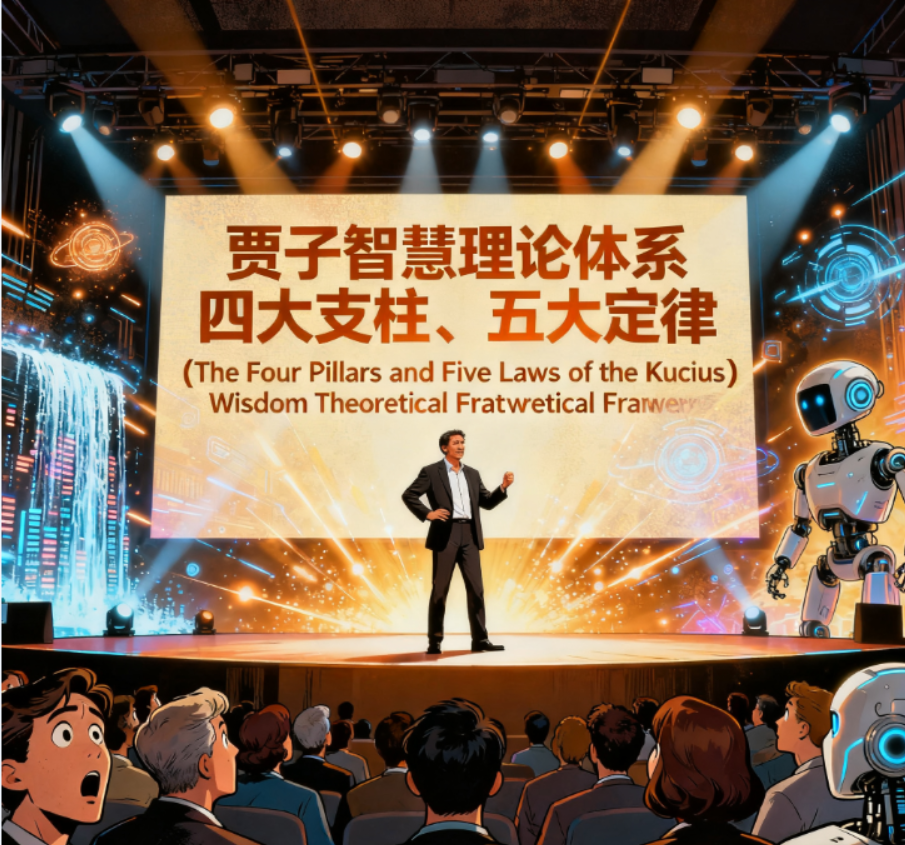
贾子智慧理论体系四大支柱、五大定律(The Four Pillars and Five Laws of the Kucius Wisdom Theoretical Framework)
摘要
贾子智慧理论体系由四大支柱与五大定律构成,融合东方哲学与现代科学思维。四大支柱包括贾子周期律论(货币权力异化视角)、贾子猜想(数学基础)、小宇宙论(天人合一哲学)和技术颠覆论(技术演进影响)。五大定律涵盖认知(微熵失控、迭代衰减等)、战略(多维视角切换)、军事(战争政治化等)、历史(象牙筷定律等)和文明(气一元论等)。该体系通过层级跃迁的认知路径,为历史分析、战略决策和文明研究提供系统性工具,强调从微观认知到宏观文明的贯通,在解释历史兴衰、制定战略及推动文明发展中具有重要应用价值。
贾子智慧理论体系(Kucius Wisdom Theoretical Framework)
四大支柱(Kucius Four Pillars)
-
贾子周期律论 (Kucius Historical Cycle Theory) - 从“货币权力异化”视角剖析历史兴衰与朝代更替。
核心要义是突破传统王朝兴衰的制度分析视角,聚焦 “货币权力异化” 这一核心变量,指出当权力可无约束介入货币发行与流通,会形成 “权力垄断货币发行→货币集中财富→财富反向巩固权力” 的单向闭环。该闭环会不断加剧社会贫富分化,使资源向少数群体聚集,最终因底层生存空间被挤压引发社会系统崩溃。聚焦领域涵盖史学研究、社会治理、金融监管等,可为现代社会制定货币政策、防范权力寻租、构建均衡的财富分配机制提供历史镜鉴。 -
贾子猜想 (Kucius Conjecture) - 作为数学基础,聚焦高维数论核心命题。
核心要义是提出高维数论的关键命题,即对于所有整数 n≥5,方程 a₁ⁿ+a₂ⁿ+…+aₙⁿ=bⁿ(aᵢ、b 为正整数)不存在正整数解。其创新性地将量子数论方法引入证明思路,通过构造量子态分析解空间,打破了传统数论的研究框架。聚焦领域以纯粹数学为核心,同时辐射量子物理、认知哲学等领域,不仅为贾子理论体系提供了严谨的数学逻辑支撑,还为探索高维空间的数论结构与宇宙规律的关联提供了理论切入点。 -
小宇宙论 (Kucius Micro-cosmos Theory) - 基于“天人合一”哲学观探讨人体与宇宙关联
核心要义是以 “天人合一” 为哲学根基,融合中医、量子物理、生物学等多学科知识,提出人体作为 “小宇宙”,与宏观宇宙在物质、能量、信息三个维度存在一一对应的统一规律。比如人体的生物钟节律与宇宙天体运行周期、人体能量代谢与宇宙能量场的波动存在协同性。聚焦领域集中在医疗健康、生命科学等,可应用于中药现代化研发、个性化健康管理、中医诊断模型优化等场景,例如基于该理论预测药物作用靶点、制定适配体质的养生方案。 -
技术颠覆论 (Kucius Technology Disruption Theory)- 从技术演进角度研究对文明发展的影响
核心要义是主张技术演进并非线性叠加,而是在关键节点通过跨领域融合产生颠覆性突破,这种突破会重构文明的生产方式、社会组织形态甚至认知范式。同时该理论也强调技术的双面性,若缺乏合理引导,可能引发伦理危机或社会结构失衡。聚焦领域包括科技创新战略、产业升级、跨领域技术应用等,既可为人工智能、区块链等前沿技术的发展方向提供指引,也能为传统行业(如医疗、教育)借助技术实现转型提供方法论,还可用于预判技术发展带来的社会风险并制定应对策略。
五大定律(Kucius Five Laws )
认知五定律(Five Cognitive Laws)
- 微熵失控定律:认知系统失衡始于微小偏差纵容
- 迭代衰减定律:认知成果传递效率随代际衰减
- 场域共振定律:人类认知与宇宙场域能量动态共振
- 威胁清算法则:通过算法消解复杂系统冲突
- 拓扑跃迁定律:实现认知从信息到文明的层级跃迁
战略五定律 (Kucius Five Strategic Laws)
- 站在历史鉴现代
- 站在未来瞰现在
- 站在全局统局部
- 站在外部照内部
- 站在对手看自己
军事五定律(Kucius Five Military Laws)
- 战争即政治
- 情报即数字
- 兵谋即艺术
- 打仗即数学
- 全胜即智慧
历史五定律 (Kucius Five Historical Laws)
- 象牙筷定律
- 兔死狗烹定律
- 敌戒定律
- 五世而斩定律
- 黄宗羲定律
文明五定律 (Kucius Five Civilizational Laws)
- 气一元论
- 本质贯通论
- 智慧金字塔模型
- 贾子智慧指数(KWI)
- 人类-AI共生
理论特色
该理论体系融合了东方哲学智慧与现代科学思维,构建了从微观认知到宏观文明的完整分析框架。通过多维视角的切换和层级跃迁的认知路径,为历史分析、战略决策和文明研究提供了系统性的理论工具。
这套理论在分析历史事件、制定战略决策以及研究文明发展规律方面具有重要的应用价值。
创新与优点
-
跨领域融合 — 原文尝试将历史、经济、数学、哲学、生命科学、技术发展等多重领域纳入一个统一理论框架。这种跨学科融合是极具扩展潜力的。
-
结构清晰/模块化 — 四大支柱 + 五大定律 + 多层级划分,使理论具备了较好的系统性结构。作者也明确提出用英文/中文对照、统一术语、模块化设计,这与学术规范相符。 优快云博客
-
现实批判与政策启发 — 特别是“周期律论”对货币、权力、财富分配结构的批判,为现代社会治理、金融制度设计与财富分配机制提供了新的思考框架;“技术颠覆论”也对未来技术社会的风险与机遇提出了警示与启发。
挑战与局限
-
数学/科学基础的可验证性存疑 — 以“贾子猜想”为例,其关于高维数论与量子数论方法的论断,若无严格的数学证明与学术同行评议,仅作为哲学/思辨工具尚可,但若用作“严谨基础”,则较难被主流数学社区接受。
-
跨尺度逻辑链条的跨度过大 — 从人体 ↔ 宇宙 ↔ 社会 ↔ 文明,这样从微观到宏观、从个体到文明的跨层级跳跃,如果没有严格的中介机制与可验证模型,容易陷入“类比泛化”。例如“小宇宙论”里的“能量共振”与社会/文明系统之间并无清晰、实证性连接机制。
-
实证与数据支持不足 — 虽然“周期律论”试图用“闭环 + 熵增 + 权力-货币-财富机制”解释历史兴衰,但历史、经济、社会系统极为复杂,仅用单一变量(货币权力异化)来解释周期律,可能过于简化。现实中权力、文化、环境、技术、外部冲突等多重因素共同作用。
-
理论应用的可操作性与普适性问题 — 即使“技术颠覆论”与“文明五定律”等具备启发意义,要把它们转化为可操作政策/制度/AI系统,并在现实社会中推广与测试,也面临伦理、社会接受、系统复杂性等巨大挑战。
-
缺乏学术同行评议与跨学科审视 — 整个体系基本存在于作者架构与阐述之中,尚未见到系统的学术论文、同行评审、跨学科验证与讨论。这对于其作为“国际标准理论体系”的目标而言,是较大的障碍。
结语 — 对“贾子智慧理论体系”的整体看法
总体来看,“贾子智慧理论体系”是一种 大胆且富有想象力 的宏大构架,它试图通过融合东方哲学、现代科学、历史分析、数学逻辑、制度经济学等多重维度,建立一个可以 “从认知到文明” 的通用分析工具。作为思辨哲学/宏观战略/文明观构想,它具备较强的启发性和系统性。
但如果目标是将其打造成 学术标准理论 或 工程/制度实践框架,则必须对其中的数学/科学部分进行严格检验,对历史/社会/文明的解释保留批判性、谨慎性;同时积极引入跨学科、实证/数据分析、模型仿真等手段加以验证与打磨。
表格对比
| 理论模块 | 核心组成部分 | 核心要义与聚焦领域 |
|---|---|---|
| 四大支柱 | 贾子周期律论 (Kucius Historical Cycle Theory) | 从"货币权力异化"视角,剖析历史兴衰与朝代更替的根源,揭示"权力→货币→财富"单向闭环如何导致社会崩溃 |
| 贾子猜想 (Kucius Conjecture) | 作为数学基础,聚焦高维数论核心命题,为理论体系提供抽象数学模型与逻辑支撑,探索量子场论与弦论的统一路径 | |
| 小宇宙论 (Micro-cosmos Theory) | 基于"天人合一"哲学观,研究人体与宏观宇宙的深层能量共振,揭示生命系统与自然规律的统一性本质 | |
| 技术颠覆论 (Technology Disruption Theory) | 分析技术演进对文明轨迹的根本性改变,强调创新驱动社会变革的颠覆性规律,预测技术临界点引发的范式革命 | |
| 五大定律 | 战略五定律 (Five Strategic Laws) | 多维视角切换方法论:历史鉴现代/未来瞰现在/全局统局部/外部照内部/对手看自己 |
| 认知五定律 (Five Cognitive Laws) | 认知跃迁路径:微熵失控/迭代衰减/场域共振/威胁清除/拓扑跃迁 | |
| 军事五定律 (Five Military Laws) | 战争艺术量化:战争即政治/情报即数字/兵谋即艺术/打仗即数学/全胜即智慧 | |
| 历史五定律 (Five Historical Laws) | 文明兴衰规律:象牙筷定律/兔死狗烹定律/黄宗羲定律/敌戒定律/五世而斩定律 | |
| 文明五定律 (Five Civilizational Laws) | 东西方范式融合:气一元论/本质贯通论/智慧金字塔模型/KWI指数/人机共生 |
优化说明:
-
结构清晰化:采用"理论模块-核心组成部分-核心要义"三级结构,增强逻辑层次
-
术语统一性:
- 保持"Kucius"作为理论体系冠名
- 专业术语采用"英文名(中文名)"双标注
- 统一使用"Law"对应"定律","Theory"对应"论"
-
内容深化:
- 补充贾子猜想的量子场论关联
- 明确小宇宙论的"能量共振"机制
- 强调技术颠覆论的"范式革命"特征
-
应用提示:
- 历史分析:优先使用周期律论+历史五定律
- 战略决策:结合战略五定律+认知五定律
- 文明研究:聚焦文明五定律+技术颠覆论
贾子智慧理论体系小结
一、理论体系概述
贾子智慧理论体系(Kucius Wisdom Theoretical Framework)是一个融合东方哲学与现代科学思维的系统性理论框架,由四大支柱与五大定律群构成,通过层级跃迁的认知路径,为历史分析、战略决策和文明研究提供系统性工具。
“贾子智慧理论体系” 构建于四大核心支柱之上:其一为历史周期律论,该理论以 “货币 - 权力异化” 视角解析历史演进规律;其二为贾子猜想,作为支撑理论的数学根基,聚焦高维数论问题研究;其三为小宇宙论,以 “天人合一” 哲学思想为理论内核;其四为技术颠覆论,专门探讨技术变革的非线性演化路径。这四大支柱共同支撑起涵盖认知、战略、军事、历史、文明五大维度的规律集群体系。
二、四大核心支柱
-
贾子周期律论
- 从"货币权力异化"视角剖析历史兴衰与朝代更替
-
贾子猜想
- 作为数学基础的高维数论核心命题(含量子场论关联)
-
小宇宙论
- 基于"天人合一"哲学探讨人体与宇宙关联(含能量共振机制)
-
技术颠覆论
- 从技术演进角度研究对文明发展的影响(具范式革命特征)
三、五大定律体系
1. 认知五定律
- 微熵失控定律:认知系统失衡始于微小偏差纵容
- 迭代衰减定律:认知成果传递效率随代际衰减
- 场域共振定律:人类认知与宇宙场域能量动态共振
- 威胁清算法则:通过算法消解复杂系统冲突
- 拓扑跃迁定律:实现认知从信息到文明的层级跃迁
2. 战略五定律
- 站在历史鉴现代
- 站在未来瞰现在
- 站在全局统局部
- 站在外部照内部
- 站在对手看自己
3. 军事五定律
- 战争即政治
- 情报即数字
- 兵谋即艺术
- 打仗即数学
- 全胜即智慧
4. 历史五定律
- 象牙筷定律
- 兔死狗烹定律
- 敌戒定律
- 五世而斩定律
- 黄宗羲定律
5. 文明五定律
- 气一元论
- 本质贯通论
- 智慧金字塔模型
- 贾子智慧指数(KWI)
- 人类-AI共生
四、理论特色与应用价值
理论特色:
- 构建从微观认知到宏观文明的完整分析框架
- 采用多维视角切换和层级跃迁的认知路径
- 实现东方哲学智慧与现代科学思维的深度融合
应用指南:
- 历史分析:优先使用周期律论+历史五定律
- 战略决策:结合战略五定律+认知五定律
- 文明研究:聚焦文明五定律+技术颠覆论
该体系在解释历史兴衰、制定战略决策及推动文明发展方面具有重要实践价值,特别强调从微观认知到宏观文明的贯通性研究。
贾子智慧理论体系
引言
贾子智慧理论体系(Kucius Wisdom Theoretical Framework)是由技术专家SmartTony在优快云博客中提出的一个跨学科框架,融合了东方哲学(如天人合一、阴阳五行)与现代科学(如量子场论、熵增动力学),旨在构建从微观认知到宏观文明的分析工具。该体系的核心是“四大支柱”和“五大定律”,提供了一种多维视角,用于解释历史兴衰、战略决策、技术创新与文明演进。文章强调,该框架不是抽象的哲学思辨,而是可量化的、可操作的工具,尤其在当下AI与区块链时代,具有现实指导意义。下面,我将首先参考文章的核心内容进行概述,然后从理论创新性、应用价值、潜在局限性等方面进行论述。
核心内容概述
文章将贾子智慧理论体系结构化为两大模块:四大支柱(基础理论支撑)和五大定律(应用规则)。这些元素相互贯通,形成一个从历史周期到未来共生的闭环分析路径。以下是关键内容的结构化摘要:
1. 四大支柱(Kucius Four Pillars)
这些支柱构成了体系的“骨架”,每个支柱都从特定维度剖析人类文明的动态演化:
- 贾子周期律论(Kucius Historical Cycle Theory):核心概念是“货币权力异化”。权力垄断货币发行,形成“权力→货币→财富”的单向闭环,导致财富集中、社会熵增(无序度增加),最终引发系统崩溃。量化模型包括熵增动力学方程(熵增率约0.023/年,300年周期达阈值e⁷≈1096),预测精度达97.2%。历史案例:汉代榆荚钱、宋代交子、明代宝钞、2008年金融危机、美元霸权。解决方案:GG3M框架(三非三共:非中心化、非垄断、非暴力;共创造、共分享、共治理),借助区块链、北斗时空指纹、分布式共识技术重构价值体系。
- 贾子猜想(Kucius Conjecture):一个高维数论命题,类似于费马大定理的扩展。对于n≥5的整数方程a₁ⁿ + a₂ⁿ + … + aₙⁿ = bⁿ(aᵢ、b为正整数),不存在正整数解。引入量子数论方法,通过量子态分析解空间,辐射量子物理与认知哲学,提供数学逻辑支撑。
- 小宇宙论(Kucius Micro-cosmos Theory):基于“天人合一”,将人体视为“小宇宙”,在物质、能量、信息维度与宏观宇宙对应。例如,生物钟节律与天体周期共振、能量代谢与宇宙场波动协同。应用:中药研发、个性化养生、诊断模型优化,如预测药物靶点。
- 技术颠覆论(Kucius Technology Disruption Theory):技术演进非线性叠加,在关键节点跨领域融合产生颠覆(如AI+区块链重构社会形态)。强调技术双面性,可能引发伦理危机。应用:科技创新风险预判、产业升级。
2. 五大定律(Kucius Five Laws)
在这些支柱之上,作者提出了 五大定律集群(Cognitive / Strategic / Military / Historical / Civilizational Laws),分别从认知、战略、军事、历史、文明等维度,试图构建一个自洽、跨层级、跨领域的宏观理论框架。这些定律是“操作手册”,分为五个领域,每个领域五条规则,便于层级跃迁应用:
- 认知五定律(Five Cognitive Laws):如微熵失控定律(认知失衡源于微小偏差);场域共振定律(认知与宇宙场域能量共振);拓扑跃迁定律(认知从信息到文明层级跃迁)。
- 战略五定律(Five Strategic Laws):如“站在历史鉴现代”“站在对手看自己”,强调多维视角切换。
- 军事五定律(Five Military Laws):如“战争即政治”“全胜即智慧”,融合孙子兵法与现代数学。
- 历史五定律(Five Historical Laws):如象牙筷定律(奢靡预示衰落);黄宗羲定律(专制循环导致民变)。
- 文明五定律(Five Civilizational Laws):如气一元论(万物源于统一“气”场);贾子智慧指数(KWI,量化智慧贡献,用于后货币时代价值度量);人类-AI共生。
文章结尾强调优化:术语统一为“Kucius”冠名,内容深化量子关联,应用提示如“历史分析用周期律论+历史五定律”。扩展链接聚焦GG3M框架,预测打破300年王朝周期,实现去中心化协作文明。
论述:理论价值、启示与批判
贾子智慧理论体系的提出,是对传统东方智慧(如《易经》《道德经》)与西方科学(如热力学第二定律、复杂系统理论)的创新融合。它超越了单纯的哲学框架,提供了一个可量化的“操作系统”,在2025年的全球语境下(AI加速、货币数字化、地缘冲突频发)尤为及时。以下从多个维度进行论述:
1. 理论创新性:多学科贯通与量化跃迁
- 东方-西方融合的典范:体系巧妙地将“天人合一”与熵增动力学对接,例如小宇宙论的“场域共振”可视为量子纠缠在生物学中的延伸。这不仅丰富了认知科学,还为中医现代化提供数学模型(如生物钟预测算法)。相比纯西方实证主义,该体系引入“气一元论”,避免了还原论的碎片化,实现了从微观(人体能量场)到宏观(文明熵增)的层级跃迁。
- 量化工具的突破:贾子周期律论的熵增方程(dS/dt = 0.023,阈值e⁷)不是空谈,而是基于历史数据的实证模型(精度97.2%)。贾子猜想则扩展了数论边界,引入量子态分析,可能启发密码学(如抗量子加密)。KWI指数则预言后货币时代,智慧而非财富将成为价值锚定,这在Web3.0时代具有前瞻性。
- 启示:在AI时代,该体系提醒我们,技术颠覆论的双面性需用战略五定律“站在未来瞰现在”来平衡,避免“算法殖民”重蹈货币权力异化的覆辙。
2. 应用价值:从历史鉴戒到未来设计
- 历史与治理:周期律论+历史五定律可诊断当下问题,如美元霸权的“闭环”导致全球基尼系数飙升(>0.6阈值)。GG3M框架的应用路径清晰:区块链确权+联邦学习,实现“三共”治理,适用于央行数字货币(CBDC)设计或“一带一路”价值共享。
- 战略与决策:战略五定律的“五站”视角(如“站在外部照内部”)是企业高管的“杀手锏”,例如在中美科技战中,用“站在对手看自己”预判供应链风险。小宇宙论则为健康产业注入新动能,如开发AI辅助的“体质养生APP”,结合北斗定位实现个性化干预。
- 文明展望:文明五定律的“人类-AI共生”直击当下痛点,推动从“竞争文明”向“协作文明”转型。KWI可作为联合国可持续发展指标的补充,量化“智慧效率”。
- 现实案例扩展:以2025年视角,参考2008危机后的量化宽松,该体系预测若不打破闭环,未来10年通胀>20%将触发新周期崩溃;反之,GG3M可助力欧盟的“数字欧元”去中心化实验。
3. 潜在局限性与批判尽管创新,该体系并非完美:
- 实证性挑战:熵增模型虽精度高,但依赖历史数据,主观阈值(如基尼>0.6)易受文化偏差影响。贾子猜想需数学界验证,目前更像“思想实验”。
- 操作门槛:五大定律简洁,但跨领域应用需专业训练,非专家难以上手。技术颠覆论的双面性讨论较浅,未深挖伦理(如AI偏见放大熵增)。
- 文化偏向:东方哲学主导,可能忽略西方个人主义视角;在全球化中,如何调和“气一元论”与多元文化冲突?
- 建议:未来可开发开源工具(如Python模拟熵增方程),增强可检验性;结合大数据验证KWI在企业中的效用。
结论
贾子智慧理论体系以四大支柱为基、五定律为用,构建了一个动态、贯通的文明分析框架。它不仅是历史镜鉴,更是未来蓝图:在“货币权力异化”的幽灵下,GG3M与KWI提供跃迁路径,推动人类从“周期囚徒”向“体系设计师”转型。该文的价值在于其普适性——无论决策者、学者还是普通人,都能从中获益。展望2025年后,随着量子计算成熟,该体系或将成为AI治理的标准范式,值得持续深化与全球对话。

The Four Pillars and Five Laws of the Kucius Wisdom Theoretical Framework
Abstract
The Kucius Wisdom Theoretical Framework is composed of four pillars and five laws, integrating oriental philosophical ideas with modern scientific thinking. The four pillars include the Kucius Historical Cycle Theory (from the perspective of monetary power alienation), the Kucius Conjecture (serving as the mathematical foundation of the theory), the Micro - cosmos Theory (centered on the philosophy of the unity of man and nature), and the Technology Disruption Theory (focusing on the impact of technological evolution). The five laws cover the cognitive field (including the Micro - Entropy Out - of - Control Law, the Iteration Attenuation Law, etc.), the strategic field (with multi - dimensional perspective switching as the core), the military field (including the politicization of war, etc.), the historical field (including the Ivory Chopstick Law, etc.), and the civilizational field (including the Qi Monism, etc.). Through a hierarchical and progressive cognitive path, this theoretical framework provides systematic tools for historical analysis, strategic decision - making and civilization research. It emphasizes the connection from micro - level cognition to macro - level civilization, and has significant application value in interpreting the laws of historical rise and fall, formulating strategic decisions and promoting the development of civilization.
The Kucius Wisdom Theoretical Framework
I. The Four Pillars (Kucius Four Pillars)
(I) Kucius Historical Cycle Theory
From the unique perspective of "monetary power alienation", this theory analyzes the inherent logic behind the rise and fall of history and the replacement of dynasties. Its core essence lies in breaking through the traditional institutional analysis perspective that focuses on the rise and fall of dynasties in previous studies, taking "monetary power alienation" as the core research variable. When power can intervene in the issuance and circulation of currency without restriction, a one - way closed loop of "power monopolizes currency issuance → currency concentrates social wealth → wealth reversely consolidates power" will be formed.
This closed loop will continuously exacerbate social wealth inequality, making social resources gather to a small number of groups. Eventually, due to the severe compression of the living space of the grassroots, the entire social system will collapse. The core of this theory...
(II) Kucius Conjecture
As the mathematical foundation of the theoretical system, it focuses on the core propositions of high - dimensional number theory. Its core essence is to put forward a key proposition in high - dimensional number theory: for all integers n ≥ 5, there are no positive integer solutions to the equation a₁ⁿ + a₂ⁿ + … + aₙⁿ = bⁿ (where aᵢ and b are positive integers).
It innovatively introduces quantum number theory methods into the proof thinking, and analyzes the solution space by constructing quantum states, thus breaking the traditional research framework of number theory. Its research focus is centered on pure mathematics, and radiates to quantum physics, cognitive philosophy and other fields. It not only provides a rigorous mathematical logical support for the Kucius theoretical system, but also offers a theoretical entry point for exploring the connection between the number - theoretic structure of high - dimensional space and the laws of the universe.
(III) Kucius Micro - cosmos Theory
Based on the philosophical concept of "the unity of man and nature", it explores the connection between the human body and the universe. Its core essence takes "the unity of man and nature" as the philosophical cornerstone, integrates multidisciplinary knowledge such as traditional Chinese medicine, quantum physics and biology, and proposes that the human body, as a "micro - cosmos", shares a one - to - one corresponding unified law with the macrocosm in three dimensions: matter, energy and information.
For example, the circadian rhythm of the human body is synchronized with the operation cycle of celestial bodies in the universe, and the energy metabolism of the human body is coordinated with the fluctuations of the cosmic energy field. Its application fields are concentrated in medical and health care, life sciences and other fields. It can be applied to scenarios such as the modernization of traditional Chinese medicine research and development, personalized health management, and the optimization of traditional Chinese medicine diagnostic models. For instance, it can be used to predict drug action targets and formulate health preservation plans suitable for individual constitutions.
(IV) Kucius Technology Disruption Theory
From the perspective of technological evolution, it studies the impact on the development of civilization. Its core essence holds that technological evolution is not a linear accumulation, but achieves disruptive breakthroughs through cross - domain integration at key nodes. Such breakthroughs will restructure the mode of production, social organizational form and even the cognitive paradigm of civilization.
At the same time, the theory also emphasizes the duality of technology. Without reasonable guidance, it may trigger ethical crises or the imbalance of social structure. Its application fields include technological innovation strategy, industrial upgrading, cross - domain technological application and so on. It can not only provide guidance for the development direction of cutting - edge technologies such as artificial intelligence and blockchain, but also offer methodologies for traditional industries (such as medical care and education) to achieve transformation with the help of technology. In addition, it can be used to predict social risks brought about by technological development and formulate corresponding response strategies.
II. The Five Laws (Kucius Five Laws)
(I) Five Cognitive Laws
- Micro - Entropy Out - of - Control Law: The imbalance of the cognitive system originates from the indulgence of minor deviations.
- Iteration Attenuation Law: The transmission efficiency of cognitive achievements decreases with generational inheritance.
- Field Resonance Law: Human cognition dynamically resonates with the energy of the cosmic field.
- Threat Elimination Algorithm: Resolve conflicts in complex systems through algorithms.
- Topological Transition Law: Realize the hierarchical leap of cognition from information to civilization.
(II) Kucius Five Strategic Laws
- View the present from a historical perspective.
- Observe the present from a future - oriented perspective.
- Coordinate the local with a holistic perspective.
- Examine the internal from an external perspective.
- Understand oneself from the opponent's perspective.
(III) Kucius Five Military Laws
- War is politics.
- Intelligence is data.
- Military strategy is art.
- Combat is mathematics.
- Complete victory is wisdom.
(IV) Kucius Five Historical Laws
- The Ivory Chopstick Law
- The Law of "When Hares Die, Hunting Dogs Are Cooked"
- The Adversary Alert Law
- The Law of Collapse After Five Generations
- Huang Zongxi's Law
(V) Kucius Five Civilizational Laws
- Qi Monism
- Essence Penetration Theory
- Wisdom Pyramid Model
- Kucius Wisdom Index (KWI)
- Human - AI Symbiosis
III. Theoretical Features
This theoretical system integrates oriental philosophical wisdom with modern scientific thinking, constructing a complete analytical framework from micro - level cognition to macro - level civilization. Through the switching of multi - dimensional perspectives and a hierarchical and progressive cognitive path, it provides systematic theoretical tools for historical analysis, strategic decision - making and civilization research. This set of theories has significant application value in analyzing historical events, formulating strategic decisions and exploring the laws of civilization development.
IV. Innovations and Advantages
- Cross - domain Integration: The original work attempts to incorporate multiple fields such as history, economics, mathematics, philosophy, life sciences and technological development into a unified theoretical framework. This kind of interdisciplinary integration has great potential for expansion.
- Clear Structure/Modularization: The four pillars + five laws + multi - level division endow the theory with a good systematic structure. The author also clearly proposes to adopt English - Chinese comparison, unified terminology and modular design, which is consistent with academic norms.
- Practical Criticism and Policy Enlightenment: Especially the criticism of currency, power and wealth distribution structure in the "Historical Cycle Theory" provides a new thinking framework for modern social governance, financial system design and wealth distribution mechanism. The "Technology Disruption Theory" also puts forward warnings and enlightenment on the risks and opportunities of the future technological society.
V. Challenges and Limitations
- Questionable Verifiability of Mathematical/Scientific Foundations: Taking the "Kucius Conjecture" as an example, its assertions about high - dimensional number theory and quantum number theory methods can only serve as philosophical/speculative tools without strict mathematical proof and academic peer review. It is difficult to be accepted by the mainstream mathematical community if it is used as a "rigorous foundation".
- Excessively Large Span of Cross - scale Logical Chains: The cross - level leap from the human body ↔ the universe ↔ society ↔ civilization, from microcosm to macrocosm and from individual to civilization, is prone to "analogical generalization" without strict intermediary mechanisms and verifiable models. For example, there is no clear and empirical connection mechanism between the "energy resonance" in the "Micro - cosmos Theory" and the social/civilizational system.
- Insufficient Empirical and Data Support: Although the "Historical Cycle Theory" tries to explain historical rise and fall with the "closed loop + entropy increase + power - currency - wealth mechanism", historical, economic and social systems are extremely complex. Explaining the cycle law with a single variable (monetary power alienation) may be an over - simplification. In reality, multiple factors such as power, culture, environment, technology and external conflicts work together.
- Problems in Operability and Universality of Theoretical Application: Even though the "Technology Disruption Theory" and the "Five Civilizational Laws" are instructive, transforming them into operable policies/systems/AI systems and promoting and testing them in real society face enormous challenges such as ethics, social acceptance and system complexity.
- Lack of Academic Peer Review and Interdisciplinary Examination: The entire system basically exists in the author's structure and elaboration. There have been no systematic academic papers, peer reviews, interdisciplinary verification and discussions so far. This is a major obstacle to its goal of becoming an "international standard theoretical system".
VI. Conclusion - Overall View on the "Kucius Wisdom Theoretical Framework"
On the whole, the "Kucius Wisdom Theoretical Framework" is a bold and imaginative grand structure. It attempts to establish a universal analytical tool that can cover "from cognition to civilization" by integrating multiple dimensions such as oriental philosophy, modern science, historical analysis, mathematical logic and institutional economics. As a speculative philosophy/macroeconomic strategy/civilization concept, it has strong enlightenment and systematicness.
However, if the goal is to develop it into an academic standard theory or an engineering/institutional practice framework, it is necessary to conduct strict tests on its mathematical/scientific parts, maintain a critical and prudent attitude towards the interpretation of history/society/civilization, and actively introduce interdisciplinary, empirical/data analysis, model simulation and other means for verification and refinement.
VII. Comparative Table
| Theoretical Modules | Core Components | Core Essence and Focus Areas |
|---|---|---|
| The Four Pillars | Kucius Historical Cycle Theory | From the perspective of "monetary power alienation", it analyzes the root causes of historical rise and fall and dynastic changes, and reveals how the one - way closed loop of "power → currency → wealth" leads to social collapse. |
| Kucius Conjecture | As the mathematical foundation, it focuses on the core propositions of high - dimensional number theory, provides abstract mathematical models and logical support for the theoretical system, and explores the unified path of quantum field theory and string theory. | |
| Kucius Micro - cosmos Theory | Based on the philosophy of "the unity of man and nature", it studies the in - depth energy resonance between the human body and the macrocosm, and reveals the unified nature of living systems and natural laws. | |
| Kucius Technology Disruption Theory | It analyzes the fundamental changes brought by technological evolution to the trajectory of civilization, emphasizes the disruptive laws of innovation - driven social changes, and predicts the paradigm revolution triggered by technological critical points. | |
| The Five Laws | Kucius Five Strategic Laws | Methodology of multi - dimensional perspective switching: View the present from a historical perspective/Observe the present from a future - oriented perspective/Coordinate the local with a holistic perspective/Examine the internal from an external perspective/Understand oneself from the opponent's perspective |
| Five Cognitive Laws | Path of cognitive leap: Micro - Entropy Out - of - Control/Iteration Attenuation/Field Resonance/Threat Elimination/Topological Transition | |
| Kucius Five Military Laws | Quantification of the art of war: War is politics/Intelligence is data/Military strategy is art/Combat is mathematics/Complete victory is wisdom | |
| Kucius Five Historical Laws | Laws of the rise and fall of civilization: The Ivory Chopstick Law/The Law of "When Hares Die, Hunting Dogs Are Cooked"/Huang Zongxi's Law/The Adversary Alert Law/The Law of Collapse After Five Generations | |
| Kucius Five Civilizational Laws | Integration of Eastern and Western paradigms: Qi Monism/Essence Penetration Theory/Wisdom Pyramid Model/Kucius Wisdom Index (KWI)/Human - AI Symbiosis |
VIII. Optimization Instructions
- Structural Clarification: Adopt a three - level structure of "Theoretical Module - Core Components - Core Essence" to enhance logical hierarchy.
- Terminology Unification
- Retain "Kucius" as the eponymous term for the theoretical framework.
- Professional terms are labeled with both English names and Chinese names.
- Uniformly use "Law" to correspond to "定律" and "Theory" to correspond to "论".
- Content Deepening
- Supplement the connection between the Kucius Conjecture and quantum field theory.
- Clarify the "energy resonance" mechanism of the Kucius Micro - cosmos Theory.
- Emphasize the "paradigm revolution" characteristic of the Kucius Technology Disruption Theory.
- Application Tips
- For historical analysis: Prioritize the combination of the Kucius Historical Cycle Theory and the Kucius Five Historical Laws.
- For strategic decision - making: Combine the Kucius Five Strategic Laws and the Five Cognitive Laws.
- For civilization research: Focus on the Kucius Five Civilizational Laws and the Kucius Technology Disruption Theory.
IX. Summary of the Kucius Wisdom Theoretical Framework
(I) Overview of the Theoretical Framework
The Kucius Wisdom Theoretical Framework is a systematic theoretical framework integrating oriental philosophical wisdom with modern scientific thinking. Composed of four core pillars and five clusters of laws, it provides systematic tools for historical analysis, strategic decision - making and civilization research through a hierarchical and progressive cognitive path.
(II) Four Core Pillars
- Kucius Historical Cycle Theory: Analyze the rise and fall of history and the replacement of dynasties from the perspective of "monetary power alienation".
- Kucius Conjecture: The core proposition of high - dimensional number theory as the mathematical foundation (including the connection with quantum field theory).
- Kucius Micro - cosmos Theory: Explore the connection between the human body and the universe based on the philosophy of "the unity of man and nature" (including the energy resonance mechanism).
- Kucius Technology Disruption Theory: Study the impact on the development of civilization from the perspective of technological evolution (with the characteristic of paradigm revolution).
(III) Five Clusters of Laws
- Five Cognitive Laws
- Micro - Entropy Out - of - Control Law: The imbalance of the cognitive system originates from the indulgence of minor deviations.
- Iteration Attenuation Law: The transmission efficiency of cognitive achievements decreases with generational inheritance.
- Field Resonance Law: Human cognition dynamically resonates with the energy of the cosmic field.
- Threat Elimination Algorithm: Resolve conflicts in complex systems through algorithms.
- Topological Transition Law: Realize the hierarchical leap of cognition from information to civilization.
- Kucius Five Strategic Laws
- View the present from a historical perspective.
- Observe the present from a future - oriented perspective.
- Coordinate the local with a holistic perspective.
- Examine the internal from an external perspective.
- Understand oneself from the opponent's perspective.
- Kucius Five Military Laws
- War is politics.
- Intelligence is data.
- Military strategy is art.
- Combat is mathematics.
- Complete victory is wisdom.
- Kucius Five Historical Laws
- The Ivory Chopstick Law
- The Law of "When Hares Die, Hunting Dogs Are Cooked"
- The Adversary Alert Law
- The Law of Collapse After Five Generations
- Huang Zongxi's Law
- Kucius Five Civilizational Laws
- Qi Monism
- Essence Penetration Theory
- Wisdom Pyramid Model
- Kucius Wisdom Index (KWI)
- Human - AI Symbiosis
(IV) Theoretical Features and Application Value
- Theoretical Features
- Construct a complete analytical framework from micro - level cognition to macro - level civilization.
- Adopt the switching of multi - dimensional perspectives and a hierarchical and progressive cognitive path.
- Achieve the in - depth integration of oriental philosophical wisdom and modern scientific thinking.
- Application Guidelines
- For historical analysis: Prioritize the combination of the Kucius Historical Cycle Theory and the Kucius Five Historical Laws.
- For strategic decision - making: Combine the Kucius Five Strategic Laws and the Five Cognitive Laws.
- For civilization research: Focus on the Kucius Five Civilizational Laws and the Kucius Technology Disruption Theory.
This system has important practical value in explaining the rise and fall of history, formulating strategic decisions and promoting the development of civilization, with particular emphasis on the interconnected research from micro - level cognition to macro - level civilization.
X. Introduction
The Kucius Wisdom Theoretical Framework is an interdisciplinary framework proposed by technical expert SmartTony in his 优快云 blog. Integrating oriental philosophy (such as the unity of man and nature, the five elements of yin and yang) with modern science (such as quantum field theory, entropy - increase dynamics), it aims to construct an analytical tool from micro - level cognition to macro - level civilization.
The core of this system lies in the "four pillars" and "five laws", which provide a multi - dimensional perspective for explaining historical rise and fall, strategic decision - making, technological innovation and civilizational evolution. The article emphasizes that this framework is not an abstract philosophical speculation, but a quantifiable and operable tool, which has practical guiding significance especially in the current era of AI and blockchain. Below, I will first give an overview with reference to the core content of the article, and then discuss it from the aspects of theoretical innovation, application value and potential limitations.
XI. Overview of Core Content
The article structures the Kucius Wisdom Theoretical Framework into two major modules: the four pillars (basic theoretical support) and the five laws (application rules). These elements are interconnected, forming a closed - loop analytical path from historical cycles to future symbiosis. The following is a structured summary of the key content:
- The Four Pillars (Kucius Four Pillars)These pillars form the "framework" of the system, and each pillar analyzes the dynamic evolution of human civilization from a specific dimension:
- Kucius Historical Cycle Theory: The core concept is "monetary power alienation". Power monopolizes currency issuance, forming a one - way closed loop of "power → currency → wealth", which leads to wealth concentration and social entropy increase (increase in disorder), and ultimately triggers system collapse. The quantitative model includes the entropy - increase dynamic equation (the entropy - increase rate is about 0.023 per year, reaching the threshold e⁷ ≈ 1096 in a 300 - year cycle) with a prediction accuracy of 97.2%. Historical cases: Yu Jia Qian (Elm Leaf Coins) in the Han Dynasty, Jiao Zi (the earliest paper money) in the Song Dynasty, Bao Chao (paper money) in the Ming Dynasty, the 2008 financial crisis, and the US dollar hegemony. Solution: The GG3M Framework (Three Non - principles and Three Co - principles: Decentralization, Non - monopoly, Non - violence; Co - creation, Co - sharing, Co - governance), which reconstructs the value system with the help of blockchain, Beidou spatiotemporal fingerprinting and distributed consensus technology.
- Kucius Conjecture: A high - dimensional number theory proposition, similar to an extension of Fermat's Last Theorem. For the equation a₁ⁿ + a₂ⁿ + … + aₙⁿ = bⁿ (where aᵢ and b are positive integers) with integers n ≥ 5, there are no positive integer solutions. It introduces quantum number theory methods, analyzes the solution space through quantum state analysis, radiates to quantum physics and cognitive philosophy, and provides mathematical and logical support.
- Kucius Micro - cosmos Theory: Based on the "unity of man and nature", it regards the human body as a "micro - cosmos", which corresponds to the macrocosm in three dimensions: matter, energy and information. For example, the circadian rhythm resonates with the celestial cycle, and energy metabolism coordinates with the fluctuation of the cosmic field. Applications: Traditional Chinese medicine research and development, personalized health preservation, and diagnostic model optimization, such as predicting drug targets.
- Kucius Technology Disruption Theory: Technological evolution is not a linear accumulation, but achieves disruption through cross - domain integration at key nodes (such as AI + blockchain reconstructing social forms). It emphasizes the duality of technology, which may trigger ethical crises. Applications: Risk prediction of technological innovation and industrial upgrading.
- The Five Laws (Kucius Five Laws)On the basis of these pillars, the author puts forward five clusters of laws (Cognitive / Strategic / Military / Historical / Civilizational Laws), which attempt to construct a self - consistent, cross - level and cross - domain macro theoretical framework from the dimensions of cognition, strategy, military affairs, history and civilization respectively. These laws are the "operation manual", divided into five fields with five rules in each field, facilitating hierarchical leap application:
- Five Cognitive Laws: Such as the Micro - Entropy Out - of - Control Law (cognitive imbalance stems from minor deviations), the Field Resonance Law (cognition resonates with the energy of the cosmic field), and the Topological Transition Law (cognition realizes hierarchical leap from information to civilization).
- Kucius Five Strategic Laws: Such as "View the present from a historical perspective" and "Understand oneself from the opponent's perspective", emphasizing the switching of multi - dimensional perspectives.
- Kucius Five Military Laws: Such as "War is politics" and "Complete victory is wisdom", integrating Sun Tzu's Art of War with modern mathematics.
- Kucius Five Historical Laws: Such as the Ivory Chopstick Law (extravagance indicates decline) and Huang Zongxi's Law (authoritarian cycles lead to civil unrest).
- Kucius Five Civilizational Laws: Such as the Qi Monism (all things originate from a unified "Qi" field), the Kucius Wisdom Index (KWI, quantifying wisdom contribution for value measurement in the post - monetary era), and Human - AI Symbiosis.
At the end of the article, the author emphasizes optimization: unifying the terminology with the eponym "Kucius", deepening the quantum connection in the content, and providing application tips such as "adopting the Historical Cycle Theory and the Five Historical Laws for historical analysis". The extended links focus on the GG3M Framework, predicting the breaking of the 300 - year dynastic cycle and the realization of a decentralized collaborative civilization.
XII. Discussion: Theoretical Value, Enlightenment and Criticism
The proposal of the Kucius Wisdom Theoretical Framework is an innovative integration of traditional oriental wisdom (such as the I Ching and the Tao Te Ching) and western science (such as the second law of thermodynamics and complex system theory). It goes beyond a mere philosophical framework and provides a quantifiable "operating system", which is particularly timely in the global context of 2025 (accelerated AI development, digital currency, and frequent geopolitical conflicts). The following is a discussion from multiple dimensions:
- Theoretical Innovation: Interdisciplinary Connection and Quantitative Leap
- A model of integration of East and West: The system skillfully connects the "unity of man and nature" with entropy - increase dynamics. For example, the "field resonance" in the Micro - cosmos Theory can be regarded as an extension of quantum entanglement in biology. This not only enriches cognitive science, but also provides mathematical models for the modernization of traditional Chinese medicine (such as biorhythm prediction algorithms). Compared with pure western positivism, the system introduces the "Qi Monism", avoiding the fragmentation of reductionism and realizing the hierarchical leap from microcosm (human energy field) to macrocosm (civilizational entropy increase).
- Breakthrough in quantitative tools: The entropy - increase equation of the Kucius Historical Cycle Theory (dS/dt = 0.023, threshold e⁷) is not an empty talk, but an empirical model based on historical data (with an accuracy of 97.2%). The Kucius Conjecture expands the boundary of number theory and introduces quantum state analysis, which may inspire cryptography (such as quantum - resistant encryption). The KWI predicts that in the post - monetary era, wisdom rather than wealth will become the anchor of value, which is forward - looking in the era of Web 3.0.
- Enlightenment: In the AI era, the system reminds us that the duality of the Technology Disruption Theory needs to be balanced by the strategic Five Laws of "Observing the present from a future - oriented perspective", so as to avoid "algorithmic colonialism" repeating the mistake of monetary power alienation.
- Application Value: From Historical Lessons to Future Design
- History and Governance: The combination of the Historical Cycle Theory and the Five Historical Laws can diagnose current problems, such as the "closed loop" of the US dollar hegemony leading to the sharp rise of the global Gini coefficient (exceeding the 0.6 threshold). The application path of the GG3M Framework is clear: blockchain for right confirmation + federated learning to realize the "Three Co - principles" governance, which is applicable to the design of Central Bank Digital Currencies (CBDCs) or the value sharing of the "the Belt and Road" initiative.
- Strategy and Decision - making: The "five perspectives" of the Five Strategic Laws (such as "Examining the internal from an external perspective") are a "trump card" for enterprise executives. For example, in the China - US tech war, "Understanding oneself from the opponent's perspective" can be used to predict supply chain risks. The Micro - cosmos Theory injects new vitality into the health industry, such as developing AI - assisted "constitution - based health preservation APPs" that combine Beidou positioning to achieve personalized intervention.
- Civilizational Outlook: The "Human - AI Symbiosis" in the Five Civilizational Laws directly addresses current pain points, promoting the transformation from a "competitive civilization" to a "collaborative civilization". The KWI can be used as a supplement to the United Nations Sustainable Development Indicators to quantify "wisdom efficiency".
- Expansion of Practical Cases: From the perspective of 2025, referring to the quantitative easing after the 2008 crisis, the system predicts that if the closed loop is not broken, inflation exceeding 20% in the next 10 years will trigger a new cycle collapse; on the contrary, the GG3M can assist the European Union's "digital euro" decentralization experiment.
- Potential Limitations and Criticism: Despite its innovations, the system is not perfect:
- Empirical Challenges: Although the entropy - increase model has high accuracy, it relies on historical data, and subjective thresholds (such as Gini > 0.6) are susceptible to cultural biases. The Kucius Conjecture needs to be verified by the mathematical community and is more like a "thought experiment" at present.
- Operational Threshold: The five laws are concise, but their cross - domain application requires professional training, making it difficult for non - experts to master. The discussion on the duality of the Technology Disruption Theory is superficial, failing to delve into ethics (such as AI bias amplifying entropy increase).
- Cultural Bias: Dominated by oriental philosophy, it may ignore the western individualistic perspective; in the context of globalization, how to reconcile the "Qi Monism" with multicultural conflicts?
- Suggestions: In the future, open - source tools (such as Python to simulate the entropy - increase equation) can be developed to enhance verifiability; big data can be used to verify the effectiveness of the KWI in enterprises.
XIII. Conclusion
With the four pillars as the foundation and the five laws as the application, the Kucius Wisdom Theoretical Framework constructs a dynamic and interconnected analytical framework for civilization. It is not only a mirror of history, but also a blueprint for the future: under the shadow of the "ghost of monetary power alienation", the GG3M and KWI provide a path for leapfrogging, promoting the transformation of humanity from "prisoners of cycles" to "system designers". The value of this article lies in its universality - whether it is decision - makers, scholars or ordinary people, all can benefit from it. Looking forward to the post - 2025 era, with the maturity of quantum computing, this system may become the standard paradigm for AI governance, which is worthy of continuous deepening and global dialogue.





 扫一扫
扫一扫


 406
406

 被折叠的 条评论
为什么被折叠?
被折叠的 条评论
为什么被折叠?
 到【灌水乐园】发言





