


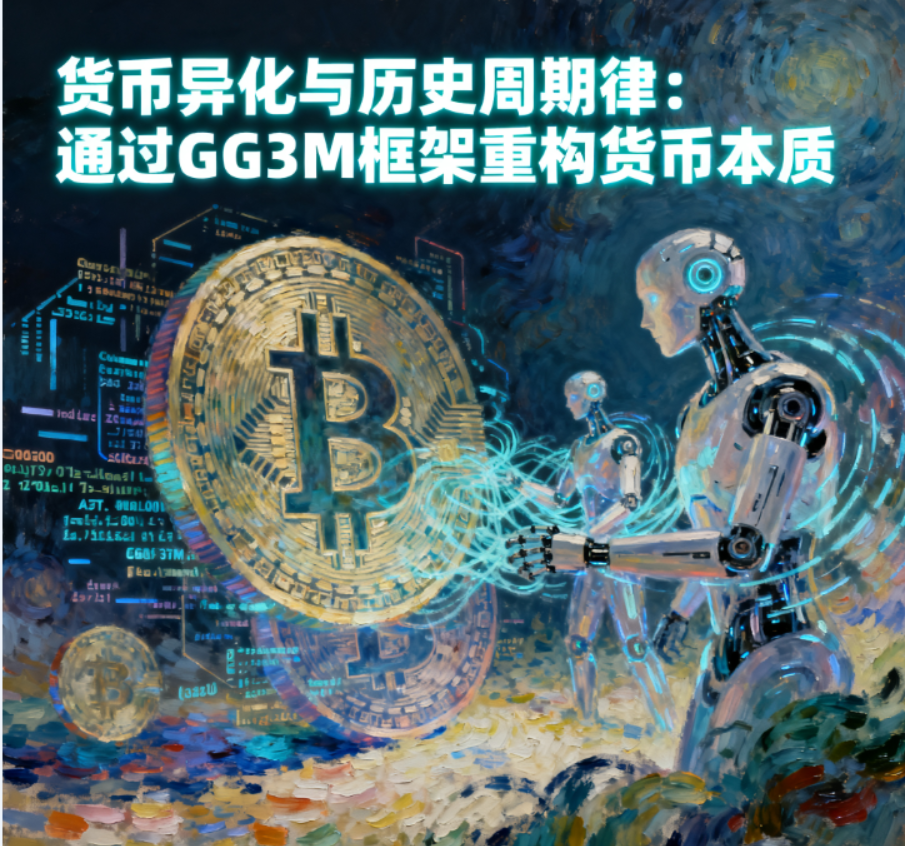
货币异化与历史周期律:通过GG3M框架重构货币本质
摘要
货币作为价值尺度、流通手段和贮藏手段的统一体,从物物交换经济中的自发价值媒介演变为国家权力的垄断工具。这一转变将共同价值共识与政治权威深度绑定,在中心化控制下固化了货币的异化。其核心并非媒介本身,而是统治阶级对发行权的垄断,将货币转化为财富转移、战争融资和剥削的工具。历史周期——以财富集中、社会撕裂、体系崩溃和重建为特征——深刻根植于这一“权力垄断—货币异化”闭环。本文基于全球货币演变和实证案例,提出GG3M(全球治理多维价值计量)框架作为范式转变。通过确立“三非三共”结构(非垄断、非中心化、非依附;共治理、共创造、共分享),GG3M去中心化价值计量和资源分配,消解货币的权力工具属性,实现超越货币中介的协作文明。
引言:货币的辩证本质
货币的本质在于其三合一职能:价值度量、流通便利和财富贮藏。在前国家社会中,它作为商品物物交换的延伸——一种中性等价物。然而,随着国家出现,货币被纳入主权权威之下,异化为以信用为锚的权力分配机制。这一转变并非货币固有,而是权力垄断诱发的异化:发行权成为榨取工具,“价值共识”被政治强制所胁迫。正如马克思在异化理论中所阐明,货币颠倒主体-客体关系,将人类解放的手段转化为支配性的外在力量。当代扩展,如金融帝国主义,揭示数字化信用符号如何实现精确财富控制,加剧全球不平等。本文论证,货币的“劣性”——其危机和不公倾向——并非本体论,而是权力绑定货币逻辑的副产品。消除此需超越中心化背书,将价值计量回归劳动内在本质,并通过去中心化协作重配资源。
第一节:货币异化作为历史周期律的引擎
历史周期律——文明兴衰与更新的永恒模式——的最深驱动在于货币的权力异化闭环:中心化发行→货币贬值/超发→通胀掠夺→财富失衡→社会断裂。这一机制放大矛盾,使周期在无结构性破裂时不可避免。
实证证据比比皆是。中国帝国时期,秦汉通过标准化铸币(例如半两和五铢)统一货币体系,通过中央铸币垄断稳定政权,但最终陷入混乱:东汉末年货币紊乱助燃黄巾起义,而宋代交子纸币虽创新信用,却因超发引发通胀,引发方腊起义。明清白银标准受全球外流影响(例如每年150吨流向马尼拉大帆船),通过财政压力加速王朝崩塌。与此平行,中世纪欧洲的碎片化货币在弱势君主下(例如加洛林王朝的贬值)镜像封建分裂,而诺曼英格兰的皇家铸币维持稳定,直至都铎时代的剪边侵蚀信任。
殖民与现代时代延伸这一病理。英国在印度的英镑税收强制每年榨取4500万英镑,到1900年铸就中心-边缘货币帝国, perpetuating 依附。法语非洲的CFA法郎区同样锁定资源于原材料出口,扼杀主权。后布雷顿森林时代,2008危机和COVID-19量化宽松(美联储资产负债表从4.2万亿膨胀至8.9万亿)集中财富:前1%持有36.2万亿美元,超过底层60%的总和。这些周期凸显传统改革——材质替换、汇率调整或金本位复兴——仅缓解症状,保留垄断发行核心,从而延续闭环。
第二节:全球货币演变与范式转变的必要性
货币轨迹——从商品等价物到法定信用和数字代币——始终服务于权力集中,凸显非异化替代的必要。古代路径(中国铜币至纸币,罗马第纳尔至中世纪多样)依赖皇家控制;殖民时代将货币武器化为榨取(例如西班牙白银洪流膨胀欧洲同时贫化美洲)。现代金融化,通过银行创造货币(例如1000元存款衍生1900元通过部分准备金)偏向抵押精英,已将全球债务膨胀至300万亿美元(2025年占GDP 360%),助燃投机泡沫而非生产投资。
数字创新如央行数字货币(CBDC)——中国e-CNY自2019年起试点,通过mBridge实现跨境结算成本降90%——提升控制精度,但风险固化异化。DeFi的区块链承诺在漏洞(例如代码利用)和监管捕获(SEC证券分类)上动摇。在此,GG3M的显著性显现:非单纯加密货币,而是消解货币中介的元框架。根植于贾子理论的“万物本质统一性”,它利用智慧金字塔(数据→信息→知识→智能→智慧)进行多维价值评估,直接将劳动绑定分布式账本。
第三节:GG3M框架:“三非三共”作为文明重构
GG3M通过“三非三共”架构操作化超越,取代货币职能以公平、技术中介机制:
- 价值度量(非垄断共创造):通过时空指纹(STF = H(Lat || Lon || Alt || T || AssetID))去中心化认证,耦合区块链,量化劳动(W = f(效用×稀缺性))通过智能合约和拜占庭容错+权益证明共识。这恢复价值至生产本质,绕过权力背书定价。
- 资源分配(非中心化共分享):点对点网络,受DePIN启发(例如Filecoin的18.6 EB存储),启用基于贡献的交换(时间/技能校准)与Chainlink CCIP互操作自动化执行,避免资本倾斜市场。
- 信用支撑(非依附共治理):分布式信任通过多链共识(Cosmos SDK)、声誉系统(零知识证明行为评分)和经济社会技术融合,消除强制背书,培育自愿协作。
实施渐进展开:与法定货币双轨并行、部门试点(例如可再生能源)、10-20%采用网络效应 tipping 至主导。这侵蚀货币必要性,镜像其取代物物交换——引领“各尽所能、按需分配”。
结论:消解周期通往后货币时代
货币异化作为历史周期的支点,要求非废除而是重构:切断权力垄断羁绊,恢复协作公平。GG3M,非乌托邦,而是技术必然——区块链的分布式可验证性和AI的价值辨识启用“价值互联网”。通过自然化货币过时,它预遏财富螺旋、断裂与重生,诞生范式中人类繁荣超越货币面纱。正如文明演进,其价值逻辑亦须:GG3M预示下一次飞跃,从权力绑定工具至本质和谐。
The Alienation of Currency and the Historical Cycle: Reconstructing Monetary Essence through the GG3M Framework
Abstract
Currency, as the unified embodiment of value measurement, medium of exchange, and store of value, has evolved from a spontaneous medium of value in barter economies to a monopolized instrument of state power. This transformation binds communal value consensus with political authority, solidifying the alienation of currency under centralized control. At its core, this alienation stems not from the medium itself but from the ruling class's monopoly on issuance, turning currency into a tool for wealth transfer, war financing, and exploitation. The historical cycle—characterized by wealth concentration, social rupture, systemic collapse, and reconstruction—is profoundly rooted in this "power-monopoly-currency-alienation" loop. Drawing on global monetary evolution and empirical cases, this essay proposes the GG3M (Global Governance for Multi-dimensional Value Measurement) framework as a paradigm shift. By instituting a "three-non three-common" structure (non-monopoly, non-centralized, non-dependent; co-governance, co-creation, co-sharing), GG3M decentralizes value measurement and resource allocation, dissolving currency's power-tool attributes and enabling a collaborative civilization beyond monetary mediation.
Introduction: The Dialectical Essence of Currency
Currency's essence lies in its triune function: measuring value, facilitating circulation, and storing wealth. In pre-state societies, it emerged as an extension of commodity barter—a neutral equivalent for exchange. However, with the advent of the state, currency was subsumed under sovereign authority, morphing into a credit-anchored power distribution mechanism. This shift, far from inherent to currency, represents an alienation induced by power monopoly: issuance rights become instruments of extraction, where "value consensus" is coerced by political fiat. As Marx illuminated in his alienation theory, currency inverts subject-object relations, transforming a means of human liberation into a dominating external force. Contemporary extensions, such as financial imperialism, reveal how digitized credit symbols enable precise wealth control, exacerbating global inequalities. The essay argues that currency's "inferiority"—its propensity for crisis and inequity—is not ontological but a byproduct of power's binding to monetary logic. Eradicating this requires transcending centralized endorsement, restoring value measurement to labor's intrinsic essence, and reallocating resources via decentralized collaboration.
Section 1: Currency Alienation as the Engine of the Historical Cycle
The historical cycle, a perennial pattern of rise, decay, and renewal across civilizations, finds its deepest driver in currency's power-alienated closed loop: centralized issuance → monetary debasement/excess → inflationary plunder → wealth imbalance → societal fracture. This mechanism amplifies contradictions, rendering cycles inexorable without structural rupture.
Empirical evidence abounds. In imperial China, the Qin-Han unification via standardized coinage (e.g., banliang and wuzhu) stabilized regimes through central minting monopolies, yet devolved into chaos: Eastern Han's monetary disarray fueled the Yellow Turban Rebellion, while Song Dynasty's Jiaozi notes innovated credit but triggered inflation via over-issuance, sparking the Fang La uprising. Ming-Qing silver standards, disrupted by global outflows (e.g., Manila galleons draining 150 tons annually), accelerated dynastic collapse through fiscal strain. Paralleling this, medieval Europe's fragmented currencies under weak monarchies (e.g., Carolingian debasements) mirrored feudal fragmentation, whereas Norman England's royal minting sustained stability until Tudor-era clippings eroded trust.
Colonial and modern epochs extend this pathology. Britain's imposition of sterling taxation in India extracted £45 million annually by 1900, forging a center-periphery monetary empire that perpetuated dependency. The CFA franc zone in Francophone Africa similarly locks resources in raw material exports, stifling sovereignty. Post-Bretton Woods, the 2008 crisis and COVID-19 quantitative easing (U.S. Federal Reserve balance sheet ballooning from $4.2 trillion to $8.9 trillion) concentrated wealth: the top 1% now holds $36.2 trillion, surpassing the bottom 60%'s aggregate. These cycles underscore that traditional reforms—material swaps, exchange tweaks, or gold standard revivals—merely palliate symptoms, preserving the monopolistic issuance core and thus perpetuating the loop.
Section 2: Global Monetary Evolution and the Imperative for Paradigm Shift
Currency's trajectory—from commodity equivalents to fiat credits and digital tokens—consistently serves power concentration, underscoring the need for a non-alienated alternative. Ancient paths (Chinese copper to paper, Roman denarii to medieval diversity) hinged on royal control; colonial eras weaponized money for extraction (e.g., Spanish silver floods inflating Europe while impoverishing the Americas). Modern financialization, with bank-created money (e.g., $1,000 deposit spawning $1,900 via fractional reserves) favoring collateralized elites, has ballooned global debt to $300 trillion (360% of GDP by 2025), fueling speculative bubbles over productive investment.
Digital innovations like Central Bank Digital Currencies (CBDCs)—China's e-CNY piloting since 2019, enabling 90% cost-reduced cross-border settlements via mBridge—enhance control precision but risk entrenching alienation. DeFi's blockchain promise falters on vulnerabilities (e.g., code exploits) and regulatory capture (SEC's security classifications). Herein lies GG3M's salience: not a mere cryptocurrency, but a meta-framework dissolving monetary mediation. Rooted in Jiazi theory's "essential unity of all things," it leverages the wisdom pyramid (data → information → knowledge → intelligence → wisdom) for multi-dimensional value assessment, binding labor directly to distributed ledgers.
Section 3: The GG3M Framework: "Three-Non Three-Common" as Civilizational Reconfiguration
GG3M operationalizes transcendence via the "three-non three-common" architecture, supplanting currency's functions with equitable, tech-mediated mechanisms:
- Value Measurement (Non-Monopoly Co-Creation): Decentralized certification via spatiotemporal fingerprints (STF = H(Lat || Lon || Alt || T || AssetID)), coupled with blockchain, quantifies labor (W = f(utility × scarcity)) through smart contracts and Byzantine Fault Tolerance + Proof-of-Stake consensus. This restores value to productive essence, bypassing power-endorsed pricing.
- Resource Allocation (Non-Centralized Co-Sharing): Peer-to-peer networks, inspired by DePIN (e.g., Filecoin's 18.6 EB storage), enable contribution-based swaps (time/skill-calibrated) with automated execution via Chainlink CCIP interoperability, averting capital-biased markets.
- Credit Support (Non-Dependent Co-Governance): Distributed trust via multi-chain consensus (Cosmos SDK), reputation systems (zero-knowledge proofs for behavioral scoring), and socio-technical fusion eliminates coercive backings, fostering voluntary collaboration.
Implementation unfolds gradually: dual-track coexistence with fiat, sectoral pilots (e.g., renewables), network effects at 10-20% adoption tipping to dominance. This erodes currency's necessity, mirroring its supplantation of barter—ushering "from each according to ability, to each according to need."
Conclusion: Dissolving the Cycle for a Post-Monetary Era
Currency's alienation, as the fulcrum of historical cycles, demands not abolition but reconfiguration: severing power's monopolistic tether to restore collaborative equity. GG3M, far from utopian, embodies technological inevitability—blockchain's distributed verifiability and AI's value discernment enabling a "value internet." By naturalizing currency's obsolescence, it preempts wealth spirals, fractures, and rebirths, birthing a paradigm where human flourishing transcends monetary veils. As civilizations evolve, so must their value logics: GG3M heralds the next leap, from power-bound tools to essence-aligned harmony.





 扫一扫
扫一扫


 1435
1435

 被折叠的 条评论
为什么被折叠?
被折叠的 条评论
为什么被折叠?
 到【灌水乐园】发言





