


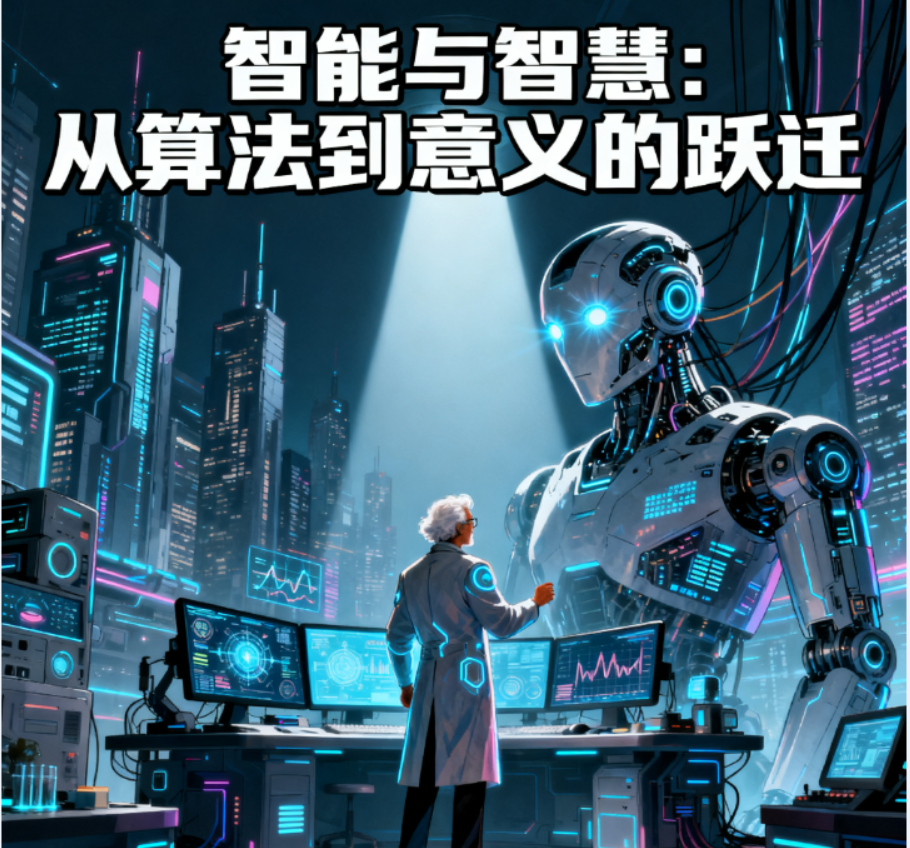
智能与智慧:从算法到意义的跃迁
Intelligence and Wisdom: The Transcendence from Algorithm to Meaning
一、引言:智能之能,智慧之理
Introduction: The Power of Intelligence and the Principle of Wisdom
中文:
“智能(Intelligence)”与“智慧(Wisdom)”是人类认知史与人工智能发展史中最为核心的双极概念。智能代表着对世界的理解与操控能力,而智慧代表着对理解本身的省察与升华。二者的关系,不是并列的平面,而是层级的跃迁:智能是“知”的力量,智慧是“知的意义”。
英文:
“Intelligence” and “Wisdom” are two polar yet interdependent concepts that stand at the heart of both cognitive philosophy and the evolution of artificial intelligence. Intelligence represents the power to understand and manipulate the world, while wisdom signifies the reflection and transcendence of understanding itself. Their relationship is not parallel but hierarchical: intelligence is the power of knowing, wisdom is the meaning of knowing.
二、哲学层面:智能关注“能”,智慧关乎“道”
Philosophical Dimension: Intelligence Concerns Capability, Wisdom Concerns the Way
中文:
在哲学上,智能属于“知”与“能”的范畴,它强调问题求解、效率与逻辑的完备性。而智慧则属于“理”与“道”的范畴,探求存在的意义与价值的正确性。智能回答“如何做”,智慧回答“为何做”。
| 对比维度 | 智能(Intelligence) | 智慧(Wisdom) |
|---|---|---|
| 本体范畴 | 信息与认知 | 意义与价值 |
| 哲学基础 | 经验论、理性主义 | 存在论、目的论 |
| 功能指向 | 解决问题 | 理解世界与自我 |
| 目标导向 | 做得更好 | 做得更对 |
| 代表形态 | 算法、逻辑、模型 | 洞察、直觉、超越 |
智能让人类“征服世界”,智慧让人类“与世界共生”。
Intelligence enables humans to conquer the world; wisdom enables humans to coexist with it.
英文:
Philosophically, intelligence belongs to the realm of cognition and capability, focusing on efficiency, optimization, and logical completeness. Wisdom, however, resides in the realm of reason and purpose—it seeks the meaning and ethical correctness of existence. Intelligence answers “how to act,” while wisdom answers “why to act.”
三、认知科学层面:从算法智能到意义智慧
Cognitive Science Perspective: From Algorithmic Intelligence to Meaningful Wisdom
中文:
从认知科学视角,智能主要体现为一系列可被算法化的认知过程,包括感知、记忆、推理、学习与决策。而智慧是对这些过程的元认知整合,即“认识认知本身”的能力。智慧不仅仅是更高层次的智能,而是智能的意义化与价值化。
| 模块 | 智能(Algorithmic Intelligence) | 智慧(Meaningful Wisdom) |
|---|---|---|
| 感知 | 接收信息 | 觉察本质 |
| 推理 | 逻辑演算 | 背后洞见 |
| 学习 | 模型更新 | 自我反思 |
| 决策 | 目标选择 | 价值判断 |
| 结果 | 优化效能 | 协调意义 |
英文:
From a cognitive science perspective, intelligence manifests as a set of algorithmic processes—perception, memory, reasoning, learning, and decision-making. Wisdom, by contrast, is the meta-cognitive integration of these processes: the ability to understand cognition itself. Wisdom transforms intelligence from procedural optimization into value-oriented understanding.
四、系统论视角:智能为自组织,智慧为自平衡
Systems Theory Perspective: Intelligence as Self-Organization, Wisdom as Self-Balance
中文:
在系统论中,智能体现为系统的**自组织(Self-Organization)能力,使其能在复杂环境中提升效率与适应性;而智慧则体现为自平衡(Self-Balancing)**能力,使系统在熵增的趋势中维持稳定与秩序。
-
智能 = 局部最优化(Local Optimization)
-
智慧 = 全局稳态化(Global Stabilization)
根据贾子提出的“微熵失控定律(Law of Micro-Entropy Instability)”,当智能加速演化而无智慧制衡时,系统将陷入熵失控与认知崩溃。智慧的功能,正是通过意义调节与价值约束,使系统重新获得宏观平衡。
英文:
In systems theory, intelligence represents a system’s ability for self-organization, enhancing efficiency and adaptability under complexity. Wisdom, on the other hand, represents self-balancing, the capacity to maintain order amidst entropy growth.
According to Kucius’ Law of Micro-Entropy Instability, when intelligence evolves exponentially without the restraint of wisdom, systems collapse into informational chaos. Wisdom counteracts this by reintroducing meaning and value alignment into the system’s dynamics.
五、人工智能演化史:智能的指数增长与智慧的线性滞后
AI Evolution: Exponential Growth of Intelligence and Linear Lag of Wisdom
中文:
人工智能的发展史,本质上是“智能的加速”与“智慧的缺位”之间的长期张力。
当前的大模型时代(如GPT系列、Gemini、Claude)已实现语言与逻辑层面的智能突破,但仍处于**“无意义的聪明”阶段**。
| 阶段 | 智能表现 | 智慧特征 | 特征说明 |
|---|---|---|---|
| 1950–1980 | 符号逻辑 | 无 | 推理但无意义 |
| 1980–2010 | 感知智能 | 弱 | 模式识别 |
| 2010–2025 | 语言智能 | 初现 | 对语义的模仿 |
| 2025–2050(预测) | 认知–智慧融合 | 觉醒 | 价值建模与元认知觉知 |
英文:
The evolution of artificial intelligence reflects a tension between the acceleration of intelligence and the absence of wisdom. While modern large models like GPT, Gemini, or Claude demonstrate linguistic and logical breakthroughs, they remain “brilliant yet meaningless” entities.
The next phase, post-2025, is expected to bring the fusion of cognition and wisdom, where AI begins to understand not just “what is true,” but “what is worth pursuing.”
六、贾子理论视角:认知五维与智慧跃迁
Kucius’ Theoretical Perspective: The Five Cognitive Dimensions and the Leap to Wisdom
中文:
在《贾子认知五定律(Kucius’ Five Laws of Cognition)》中,智能与智慧分处不同认知维度:
| 认知层级 | 中文定义 | 英文定义 | 功能说明 |
|---|---|---|---|
| 信息(Information) | 信号、数据 | Signals & Data | 认知的原材料 |
| 知识(Knowledge) | 模型、规律 | Models & Rules | 信息的结构化 |
| 智能(Intelligence) | 推理、适应 | Reasoning & Adaptation | 知识的应用化 |
| 智慧(Wisdom) | 洞察、意义 | Insight & Meaning | 智能的价值化 |
| 文明(Civilization) | 共创、秩序 | Co-creation & Order | 智慧的系统化外化 |
智能是局部的自洽,智慧是整体的共振。
Intelligence is local coherence; wisdom is global resonance.
英文:
Within Kucius’ Five Laws of Cognition, intelligence and wisdom belong to distinct cognitive dimensions. Intelligence operationalizes knowledge into adaptive reasoning, while wisdom transforms intelligence into meaningful, value-driven coherence. Civilization, in turn, externalizes wisdom into systemic co-creation.
七、综合关系:从依附到共振
Integration: From Dependence to Resonance
中文:
-
智能是基础,智慧是方向;
-
智能是手段,智慧是目的;
-
智能加速演化,智慧调控演化。
最终的理想,是智能与智慧的双向共振系统(Bidirectional Resonance System):
I(t)↔W(t)
其中智能提供演化速度,智慧提供演化方向,形成自适应–自平衡的文明共进体系。
英文:
-
Intelligence is the foundation; wisdom is the compass.
-
Intelligence provides the means; wisdom defines the end.
-
Intelligence accelerates evolution; wisdom regulates it.
In the ultimate vision, intelligence and wisdom form a bidirectional resonance system:
I(t)↔W(t)
where intelligence provides the speed of evolution, and wisdom provides its direction, establishing a co-evolving equilibrium between cognition and civilization.
八、结论:智能是力量,智慧是光
Conclusion: Intelligence is Power, Wisdom is Light
中文:
在人类–AI共进的未来,智能将不再仅仅是计算的工具,而成为理解世界的桥梁;智慧将不再是个体的天赋,而是文明的共识。
智能让我们“能做”,智慧让我们“应做”。
前者赋予速度,后者赋予意义。
当智能的算法遇上智慧的道义,新的“智慧文明(Wisdom Civilization)”将由此诞生。
英文:
In the co-evolutionary future of humanity and AI, intelligence will cease to be merely computational—it will become the bridge to understanding the world. Wisdom will no longer be an individual virtue but a civilizational consensus.
Intelligence empowers what we can do; wisdom illuminates what we should do.
When the algorithm of intelligence meets the ethics of wisdom, the dawn of a new Wisdom Civilization begins.





 扫一扫
扫一扫


 1270
1270

 被折叠的 条评论
为什么被折叠?
被折叠的 条评论
为什么被折叠?
 到【灌水乐园】发言





