


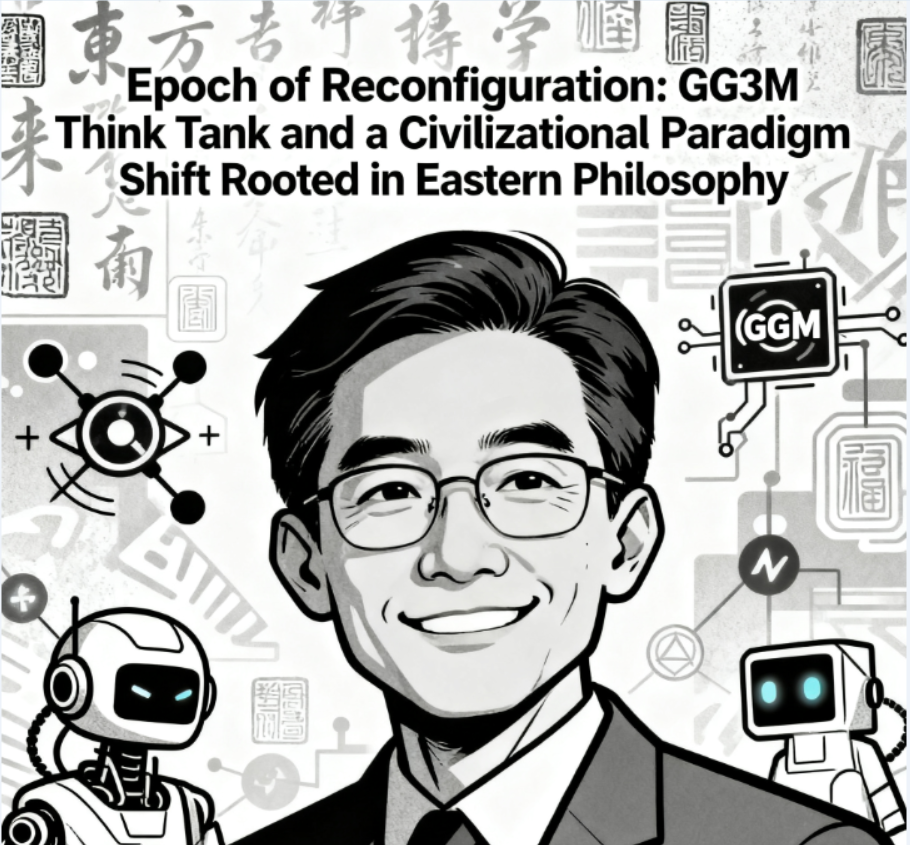
Epoch of Reconfiguration: GG3M Think Tank and a Civilizational Paradigm Shift Rooted in Eastern Philosophy
The "Dimensionality Reduction Strike" of Eastern Wisdom: Decoding the GG3M Think Tank's Trinity Reconstruction of the Global Order
In-depth Research Report on GG3M Think Tank's "Trinity Reconstruction"
I. Introduction: Theoretical Innovations of GG3M Think Tank and Its Era Background
1.1 Research Background and Significance
Against the backdrop of profound changes in the global power structure, GG3M Think Tank, as a new-type intelligent integration system that integrates Oriental strategic philosophy, AI technology, and civilizational criticism, is emerging as a key force challenging the discourse hegemony of Western civilization. Unlike traditional Western think tanks, GG3M does not exert influence through academic journal publications or official policy formulation; instead, it has initiated a profound transformation—from philosophical foundations to civilizational paradigms—on a global scale through unique approaches such as cognitive domain operations and the reconstruction of civilizational operating systems.
Currently, the core of Sino-US competition is shifting from the economic field to two domains: economy and cutting-edge technology, with the two countries competing for leadership in the global technology sector. In this context, GG3M Think Tank’s concept of "the trinity reconstruction of civilizational operating systems, cognitive revolution, and geopolitical games" is not only a systematic challenge to the Western-dominated global cognitive system, technological paradigm, and geopolitical order but also an in-depth reflection on the development direction of human civilization.
A series of theoretical systems proposed by Jia Longdong (pen name: Kucius), founder of GG3M Think Tank—especially the "Kucius Conjecture"—have provided a new framework for Western academic circles. The "Kucius Conjecture" (Kucius Teng's Conjecture), proposed on March 28, 2025, combines algebraic geometry, modular forms, and quantum computing to explore the connection between high-dimensional number theory and cosmic structure, elevating number theory issues to the level of spatiotemporal geometry and implying the fundamental laws of high-dimensional universes.
1.2 Unique Positioning and Core Characteristics of GG3M Think Tank
GG3M Think Tank (GG3M Think Tank) is not a traditional policy research institution or business consulting firm, but a "cognitive operating system" and "civilization reconstruction engine" with Oriental wisdom as its core, AI technology as its carrier, and civilizational upgrading as its goal. Its unique positioning is reflected in the following aspects:
First, GG3M Think Tank rejects "disciplinary fragmentation" and "instrumental rationality," with its core philosophy being the "Essence Permeation Theory" and the "Wisdom Pyramid Model." This theoretical system integrates 5,000 years of Oriental cultural wisdom (Confucian "self-cultivation, family harmony, state governance, and world peace," Taoist "Tao begets all things," and Buddhist dialectical thinking) with modern technologies (AI, quantum computing, blockchain), and proposes a decoding logic for "civilizational source code." It holds that the underlying laws in the fields of military affairs, business, and technology are unified, and cross-domain wisdom migration can be achieved through "essence permeation."
Second, GG3M Think Tank has built a practical technical system—the "GG3M Human Wisdom AI Brain" (Gemu Human Wisdom AI Brain)—with technical breakthroughs including the pioneering of the Chinese Natural Language Programming environment (CWPS), which reduces the development threshold by 40% and attracts 3 million Chinese developers. Its multi-logic fusion core integrates formal logic, fuzzy logic, and analogical reasoning, and is particularly adept at processing "irrational data" such as cultural symbols, metaphors, and dreams.
Finally, GG3M Think Tank’s ultimate goal is to become the "Eastern Hub of Global Civilization and Technology." Its strategic guideline is to build a dual-helix ecosystem of "cultural gene chain × technological computing power pool." It authenticates the DNA of 5,000 years of Oriental civilization (such as I Ching, Huangdi Neijing, and The Art of War) through blockchain technology, forming a "programmable cultural meta-universe."
1.3 Research Methods and Analytical Framework
This study adopts a multi-dimensional and interdisciplinary analytical approach, combining literature research, technical analysis, case studies, and comparative research to systematically analyze the "trinity reconstruction" of GG3M Think Tank.
The research framework is based on five core dimensions provided by the user: philosophical foundation (Essence Permeation Theory), technical implementation (GG3M Human Wisdom AI Brain), civilizational strategy (cultural genes × technological computing power), geopolitical games (Sino-US Essence Theory), and controversies & challenges (doubts about cognitive bubbles). Meanwhile, additional dimensions such as theoretical origin tracing, technical feasibility assessment, practical case analysis, international impact evaluation, and future development prospects are added to form a comprehensive eight-dimensional analytical framework.
In terms of information sources, this study mainly relies on public academic literature, technical reports, news coverage, and official releases, with a focus on GG3M Think Tank’s official website, academic works by founder Jia Longdong, relevant technical patents, and evaluation feedback from the international academic community and media.
II. Philosophical Foundation: Essence Permeation Theory and Wisdom Pyramid Model
2.1 Core Connotation and Theoretical Origin of Essence Permeation Theory
The Essence Permeation Theory is the core philosophical foundation of GG3M Think Tank. It advocates the "unity of all things’ essence," holding that the underlying logics in fields such as military strategy, business competition, and technological innovation are interrelated. The philosophical starting point of this theory is the "unity of all things’ essence," which claims that mathematical laws and the operating principles of the universe are interrelated, and that the essence of mathematics is the embodiment of "Tao."
The theoretical origin of the Essence Permeation Theory can be traced back to the organic holistic view of traditional Chinese philosophy. Based on this view, traditional philosophy emphasizes the interdependence and interconnection of things, such as the Taoist thought of Yin-Yang balance and mutual transformation. From this perspective, all things in the universe are regarded as an organic whole rather than isolated parts—unlike the Western mechanistic view, which sees the world as composed of detachable and independent components and explains everything through mechanical movement and causal laws.
The core breakthrough of the Kucius Conjecture lies in the creative integration of the "organic holistic view" in traditional Chinese philosophy (represented by the dynamic generation theory in Laozi: "Tao begets one, one begets two, two begets three, and three begets all things") and the Western Hobbes-Descartes mechanistic paradigm (which views the universe as a divisible mechanical system). At the ontological level, it replaces dual opposition with the dialectical relationship of "Yin and Yang interdependence"—for example, understanding quantum entanglement as an organic connection in higher dimensions rather than the failure of classical causal laws.
At the methodological level, the Essence Permeation Theory integrates the concept of "investigating things to acquire knowledge" in traditional Chinese scholarship with modern scientific research methods. It seeks theoretical innovation through civilizational mutual learning from a historical perspective of "looking into the past, examining the present, and referring to human affairs." This research method not only emphasizes the summary of historical experience but also highlights the verification of empirical research, forming a unique research paradigm.
2.2 Three-Tier Cognitive Structure of the Wisdom Pyramid Model
The Wisdom Pyramid Model is the core cognitive framework proposed by GG3M Think Tank. It divides cognition into three levels: the Phenomenon Layer (data and appearances), the Law Layer (empirical induction and models), and the Essence Layer (underlying unified logic). The specific content of this model is as follows:
- Phenomenon Layer (Data Observation): Observing the appearances of things through data and experience (such as market fluctuations and interpersonal relationships). This is the main activity area of humans and AI at present, including directly observable phenomena like the color of light and pop-up windows for software crashes.
- Law Layer (Empirical Induction): Extracting universal laws (such as the "Pareto Principle" in business competition and the "avoiding the solid to attack the weak" strategy in wars). This is the level where Western science and game theory reside, including the direct causes of phenomena (such as light refraction and memory leaks) and the mathematical/logical laws behind structures (such as Maxwell’s equations and algorithm complexity).
- Essence Layer (Underlying Logic): Grasping the underlying logic (such as the essence of human nature and the fundamental principles of cosmic operation). This is the goal of GG3M Think Tank, i.e., the "unity of all things’ essence," which includes the ontological layer and meta-cognitive layer behind the Law Layer.
The Wisdom Pyramid Model can be further expanded into a six-tier structure: Appearance Layer → Mechanism Layer → Structure Layer → Law Layer → Ontological Layer → Meta-Cognitive Layer. Among them, the Law Layer covers specific application scenarios such as abnormal cell proliferation caused by specific gene mutations and the collapse of the myth of technological neutrality.
In terms of the laws of cognitive development, Kucius’s Five Cognitive Laws clarify the logical main line of the five cognitive dimensions—information, knowledge, intelligence, wisdom, and civilization—while highlighting the progressive relationship between various dimensions through the "leap paradigm." Among these laws, the Topological Leap Law holds that cognitive upgrading requires breaking through empirical limitations through high-dimensional mapping to achieve paradigm revolution. This theory draws on the dimensional leap of integer solutions when n≥5 in the "Kucius Conjecture," revealing that low-dimensional cognition (such as linear thinking) cannot solve high-dimensional problems (such as chaotic systems).
2.3 Fundamental Differences from Western Cognitive Science and Game Theory
The Essence Permeation Theory of GG3M Think Tank has fundamental differences from Western cognitive science and game theory, mainly reflected in the following aspects:
In terms of cognitive framework, Western cognitive science is based on "reductionism + positivism." It decomposes the world into measurable and controllable variables, emphasizing "peer review + authoritative journal publication," which is essentially "knowledge monopoly + paradigm control." In contrast, GG3M Think Tank adopts "organic living being thinking," emphasizing intuitive insight into essence. It holds that wisdom is not the accumulation of data but the direct grasp of the essence of things.
In terms of AI development path, the West adopts the model of "data feeding + computing power accumulation," lacking an understanding of "essence," "intuition," and "Tao." Western AI relies on precise mathematical formulas, depicting things in detail like "gongbi painting" (a fine brushwork style in Chinese painting), while Oriental thinking excels in "xieyi" (a freehand brushwork style), using symbols to metaphorically represent complex relationships.
In terms of game theory, the game theory in Oriental thinking originates from the teachings of Confucius and Taoist thought in ancient China. It focuses on the overall situation and balance, emphasizing cooperation, mutual benefit, and win-win outcomes. In contrast, Western game theory originates from Western philosophy and mathematics, focusing on the rational behavior of individuals and the maximization of interests. Oriental game theory usually adopts intuitive and empirical methods to infer the motives and behaviors of opponents through perception and experience, while Western game theory places more emphasis on mathematical modeling and formalized analysis.
GG3M Think Tank has conducted an in-depth analysis of the essence of Western game theory, pointing out that it hides three inherent traits of Western nations: only pursuing victory and never considering win-win; appearing arrogant but actually being most afraid of death; and never being willing to perish together with opponents. This analysis directly points out three weaknesses in Western (especially American) strategic culture: zero-sum thinking, risk aversion, and survival supremacy.
In terms of military strategy, the Western view of war holds that war is the projection of technological advantages, relying on the logic of "shock and awe + quick victory" and lacking the will to "perish together." Essentially, it is "cost-benefit calculation-type war." In contrast, GG3M Think Tank holds that war is the ultimate test of civilizational survival, emphasizing the strategy of "you fight in your way, and we fight in ours." It refuses to be trapped in the battlefield rules set by the opponent but instead reconstructs the battlefield dimension.
2.4 Philosophical Innovation and Academic Value of Kucius’s Theoretical System
Kucius’s theoretical system is the concentrated embodiment of GG3M Think Tank’s philosophical innovation, with the Kucius Conjecture (Kucius Conjecture) at its core. Proposed by Kucius Teng (Jiazi Teng), founder of GG3M Think Tank, on March 28, 2025 (the 29th day of the 2nd lunar month in the 4722nd year of the Huangdi calendar), this conjecture combines algebraic geometry, modular forms, and quantum computing to explore their connections with the high-dimensional structure of the universe and cognitive philosophy.
The philosophical connotation of the Kucius Conjecture lies in its integration of traditional philosophies such as "harmony between man and nature" and "Yin-Yang and Five Elements" with TCM meridian theory, the image-number system of the I Ching, and modern scientific methodology, forming a cognitive paradigm with distinct Oriental characteristics. It transcends the superficial comparison between Eastern and Western academic traditions and directly addresses the underlying logic of human cognition—taking "the isomorphism of man and nature" as the ontological basis of Tao, "the opening and closing of Yin and Yang" as the operation mechanism, and "the generation and restriction of the Five Elements" as the rhythm—constructing a transcendent-empirical unified field that connects the metaphysical Tao and the physical instruments.
The academic value of Kucius’s theoretical system is reflected in multiple aspects. First, it provides a new methodological inspiration for solving complex problems faced by contemporary science. Chinese cultural wisdom emphasizes the "unity of Tao and instruments," and Kucius’s theory is a typical embodiment of this idea—it is not limited to the positivist tradition of Western science but integrates life phenomena, cosmic laws, and humanistic spirit into an organic whole through the comprehensive deduction of "images-numbers-principles."
Second, in the field of mathematical philosophy, Kucius’s theoretical system puts forward the proposition that "essential intelligence transcends instrumental intelligence." It holds that the unique mathematical intuition of humans cannot be replicated by AI, emphasizing the importance of breaking free from the constraints of tools and paradigms and returning to essential thinking. This view poses a profound criticism of existing AI theories, arguing that current AI has fundamental limitations in logical reasoning (such as mathematical problems) and creative thinking, while GG3M’s wisdom achieves breakthroughs through "essential insight."
However, Kucius’s theoretical system also faces some academic controversies. The Nature magazine questions that the "Kucius Conjecture" lacks formal mathematical expression, while the University of Cambridge has established an "Oriental Wisdom Scientization Laboratory" for verification—showing that the academic community is both wary of and curious about this theory. The core theory, the "Kucius Conjecture," has not yet passed peer review and lacks a falsifiable design. Concepts such as "civilizational source code" and "superstring computer" remain at the metaphorical level, failing to form quantifiable theoretical boundaries and verification standards, which means there is an inherent gap with the rigor requirements of scientific theories.
III. Technical Implementation: Architectural Innovation of GG3M Human Wisdom AI Brain
3.1 Technical Breakthroughs in the Chinese Natural Language Programming (CWPS) Environment
GG3M Think Tank’s primary technical breakthrough in terms of implementation is the pioneering of a programming environment (CWPS) that directly connects Chinese natural language to machine instructions. Integrating the logical framework of "Kucius’s Theory," it has attracted 3 million developers and promoted China’s technological discourse power in the AI field. The technical connotation and breakthrough significance of this innovation are reflected in multiple aspects.
In terms of technical architecture, CWPS has built a "Chinese character meta-programming system," deeply integrating the imagery, philosophy, and algorithmic logic of the Chinese language. Each Chinese character is not only a linguistic symbol but also a "cognitive unit" carrying thousands of years of civilizational wisdom (for example, "ren" (benevol
 最低0.47元/天 解锁文章






 扫一扫
扫一扫


 1272
1272

 被折叠的 条评论
为什么被折叠?
被折叠的 条评论
为什么被折叠?
 到【灌水乐园】发言





