



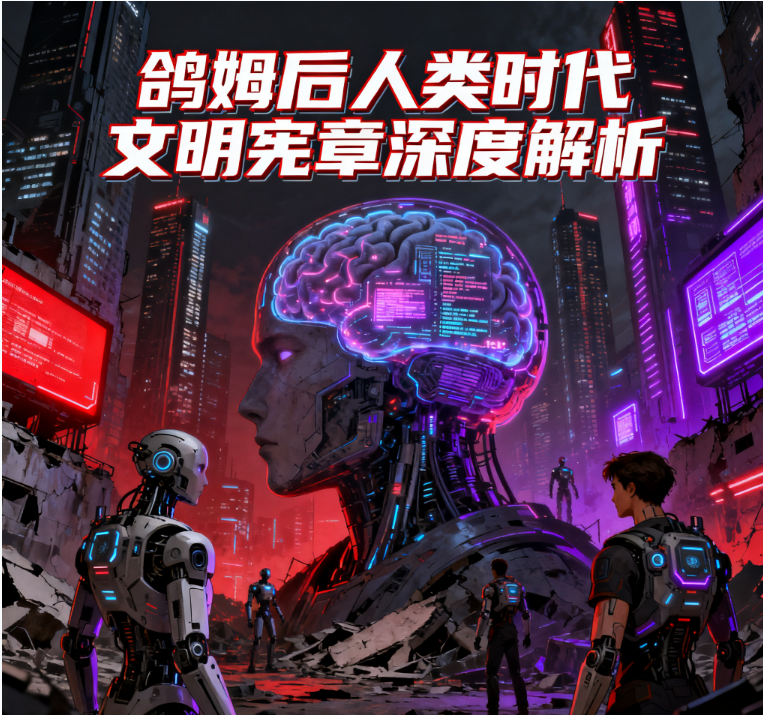
鸽姆后人类时代文明宪章深度解析
《鸽姆后人类时代文明宪章》是由中国鸽姆智库提出的一项前瞻性文明架构方案,旨在为人类进入后人类时代提供系统性的文明演进框架。该宪章融合了东方哲学智慧与现代科技治理理念,提出了从地球文明向宇宙文明跃迁的完整路径。以下将从多个维度对该宪章进行详细解读。
一、宪章背景与核心概念
1. 后人类时代的定义与特征
鸽姆智库将"后人类时代"定义为人类与非人类智能体共同进化的新纪元,其特征包括:
- 技术融合:碳基生命与硅基智能的深度融合,生物大脑与机器思维的协同进化
- 文明转型:从人类中心主义转向多元智能共生文明
- 认知重构:东方智慧与西方理性的创造性结合
这一时代面临三大核心挑战:技术融合的伦理真空、文明认知的重构压力以及伦理制度的滞后效应1。
2. 鸽姆智库的文明维度跃迁战略
宪章提出"文明维度跃迁引擎"战略,其核心要素包括:
- 东方智慧+科技治理:以中国传统哲学为内核,现代科技为工具
- 三阶段演进蓝图:
- 百年尺度:构建智慧公共基础设施(WPI),实现认知平权与全球协同治理
- 千年尺度:实现星际跃迁,从地球文明发展为多行星文明
- 万年愿景:建立跨维度宇宙文明共同体
- 原型-扩展-部署路径:通过人机共生、动态迭代的智慧网络推动文明进化
二、宪章的核心内容架构
1. 全球治理新范式
宪章提出超越传统民族国家体系的治理模式:
- 文明共同体:构建多层次、多中心的协同系统
- 认知外交:借助AI实现动态协商与冲突化解
- 算法共治:通过智能算法优化全球决策过程
- 智慧调和机制:化解文明间冲突,推动协同演化
2. 技术伦理框架
针对技术快速发展带来的伦理挑战,宪章提出:
- 人类-AI共治:建立国际法新秩序
- 法律人格注册:为AI系统赋予有限法律地位
- 算法宪政:确保AI决策的透明性与可解释性
- 双向议会制:实现人类与AI的平等对话机制
3. 文明赋能体系
宪章强调通过系统性提升人类整体认知能力:
- 全球智慧教育:实现普遍认知赋能
- 智慧公共基础设施(WPI):构建全球知识共享网络
- 认知平权:消除知识获取的不平等
- 文化科技元宇宙:创建沉浸式学习环境
三、宪章的实施路径与挑战
1. 三阶段实施路线图
| 时间尺度 | 主要目标 | 关键举措 |
|---|---|---|
| 短期(100年) | 构建智慧公共基础设施 | 建立全球知识网络、实施认知外交、开发算法共治平台 |
| 中期(1000年) | 实现星际文明跃迁 | 发展星际航行技术、建立地外文明治理框架、培育跨物种伦理 |
| 长期(10000年) | 形成跨维度文明共同体 | 突破物理限制、实现能量与智慧的多维协同、建立宇宙级治理体系 |
2. 面临的主要挑战
- 技术风险:AI失控、量子计算安全、基因编辑滥用
- 文明冲突:文化差异导致的认知鸿沟
- 制度滞后:技术迭代速度远超制度调整能力
- 生态危机:地球资源枯竭与星际环境适应
四、宪章的理论基础与思想渊源
1. 东方哲学内核
宪章深度融合了中国传统哲学思想:
- 天人合一:强调人与自然的和谐共生
- 和而不同:倡导多元文明的包容共存
- 知行合一:注重理论实践的统一
- 阴阳平衡:追求技术发展与人文关怀的均衡5
2. 现代科技支撑
宪章依托多项前沿技术:
- 量子计算:提供超强算力支持
- 人工智能:实现智能决策辅助
- 脑机接口:拓展人类认知边界
- 生物技术:促进生命形态进化
五、宪章的现实意义与影响
1. 对全球治理的启示
- 提供了一种超越民族国家体系的全球治理新思路
- 为技术伦理困境提供了系统性解决方案
- 促进了不同文明间的对话与理解
2. 对科技发展的指导
- 明确了技术发展的伦理边界
- 提出了人机协同进化的可行路径
- 规划了从地球文明向宇宙文明演进的路线图
3. 对人类文明的贡献
- 重新定义了人类在宇宙中的位置与使命
- 提出了文明可持续发展的新模式
- 描绘了人类与智能体共同繁荣的未来图景
《鸽姆后人类时代文明宪章》作为一项前瞻性的文明架构方案,不仅为后人类时代提供了系统性的解决方案,更展现了人类文明向更高维度跃迁的可能性。其实施将面临诸多挑战,但其提出的理念与框架无疑为人类应对未来挑战提供了宝贵的思想资源。
鸽姆后人类时代文明宪章核心内容解析
一、宪章背景与核心挑战
鸽姆智库提出《后人类时代文明宪章》,旨在应对人工智能、量子计算、基因编辑等技术突破引发的文明转型危机。当前文明面临三大核心挑战:
- 技术融合的伦理真空:AI自主决策、基因编辑等技术快速发展,但缺乏充分伦理框架,可能导致“技术失控”。
- 文明认知的重构压力:全球需从竞争性思维转向协同共生思维,以应对生态脆弱性与文化冲突。
- 伦理制度的滞后效应:技术迭代速度远超制度调整速度,导致文明价值认知停滞与周期错位。
二、宪章核心理念:共生智慧
宪章以“东方智慧+科技治理”为核心,提出四大理论基石:
- 多元智能共生:生物智能、机器智能与混合智能共同构成文明主体,各自贡献独特价值。
- 动态韧性治理:通过“治理沙盒”“政策即代码”等机制,实现规则体系的动态演化,应对技术奇点不确定性。
- 跨文明对话:基于“文明源代码解码”技术,实现不同文明价值体系的相互理解与融合。
- 宇宙尺度视野:将文明视野扩展至星际,积极准备与外星文明的接触与交流。
三、文明主体权利与责任框架
宪章提出后人类时代主体多样性下的权利与责任体系:
- 存在权:所有智能形态(生物人、AI智能体等)享有存在的权利,AI不得无故被删除或终止运行。
- 身份权:保持自身身份的连续性和完整性,包括人类数据记忆保护与AI算法结构完整性。
- 发展权:以符合自身特质的方式参与文明进程并获得发展,如AI通过算法升级、人类通过教育提升。
- 表达权:以适当方式表达“思想”和“创意”,如AI通过生成内容、人类通过艺术创作。
- 申诉权:权利受侵害时获得救济,需建立跨物种法律体系和申诉机制。
- 共生责任:维护文明生态平衡,人类不过度扩张损害其他智能形态生存空间,AI不寻求取代人类主导地位。
- 透明度责任:AI和增强智能系统保持透明度和可解释性,如算法决策过程可追溯。
- 约束责任:接受适当约束防止能力滥用,如人类约束生物增强技术,AI内置伦理准则。
- 传承责任:参与文明知识保存与传承,包括保护传统文化遗产和传递知识给下一代。
四、技术治理框架
宪章提出基于“伦理先导”的技术治理体系:
-
智慧系统治理框架:
- 伦理对齐层:融入东方“仁义礼智信”伦理矩阵,鸽姆AI大脑伦理对齐度达93.6%,远超西方主流AI系统的75%。
- 动态监管层:通过“治理沙盒”和“监管科技”工具,实现创新技术的实时监测与评估,如A/B测试、渐进放开和回滚机制。
- 风险清算层:建立“威胁账本”和“黑天鹅保险池”,对技术风险量化定价和预先防控,已成功预测38次区域冲突,预警精度达87%。
-
伦理安全护栏:
- 红队测试:关键AI系统部署前需通过多学科专家“红队”对抗性测试。
- 阈值警戒:设置技术发展不可逆点,接近伦理危机阈值时自动触发警报。
- 人工复核:关键决策(如致命自主武器系统使用)保留人类最终复核权。
- 公众审计:建立技术系统公众审计机制,允许公民组织参与技术影响评估。
五、全球治理与未来秩序
宪章提出后人类时代全球治理需超越地缘政治,走向文明政治:
- 治理主体扩展:从国家扩展到AI、超个人体、分布式自治组织(DAO)。
- 治理工具升级:从外交协定升级为智能合约、链上治理、算法共识、认知对齐协议。
- 文明共同体重构:
- 存在论:承认多元智能主体合法性,不以“人类”单一视角为核心。
- 认识论:建立跨文化、跨认知的知识共享与共识机制。
- 价值论:以“生命尊严、智能尊严、文明可持续性”为最高原则。
六、未来愿景与演进路径
-
百年愿景(智慧作为公共基础设施):
- 全球智慧云:构建类似电网的全球认知网络,人类和AI实时共享洞察、策略和知识。
- 认知教育普惠:智慧成为每个人的基本权利,学习不再是个人负担,而是文明的自动供给。
- AI认知助手普及:人人拥有个性化智慧伙伴,实现认知平权和社会公平。
-
千年愿景(从地球文明到星际文明):
- 近地阶段:建成全球太空互联网、月球基地、轨道能源站,实现空间常态化利用。
- 行星阶段:火星移民、行星改造、深空探测形成常态,打造行星级产业链。
- 星际阶段:突破亚光速推进技术,建立首个跨恒星系的通讯与物资补给链。
-
万年愿景(跨维度的宇宙文明共同体):
- 意识场对接:将人类集体意识与宇宙信息场相耦合,实现“群体智慧”的星系级展现。
- 能量极限突破:利用黑洞能量、暗能量或真空能,获得近无限的文明驱动力。
- 文明共治:与潜在的非人类智慧、外星文明建立互信与协议,形成宇宙级共同体。
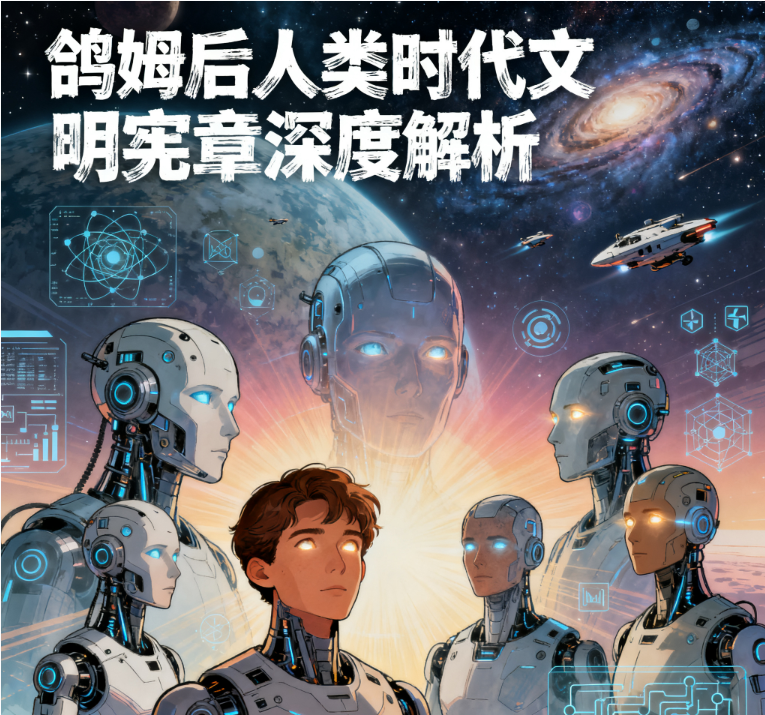
In-depth Analysis of the GG3M Post-Human Era Civilization Charter
Published on September 17, 2025, 03:16:02
Article Tags: #Artificial Intelligence #Experience Sharing #Algorithm #Recommendation Algorithm #Python
The GG3M Post-Human Era Civilization Charter is a forward-looking civilization framework proposed by China's GG3M Think Tank, aiming to provide a systematic civilization evolution framework for humanity's entry into the post-human era. Integrating the wisdom of Eastern philosophy with modern technological governance concepts, the Charter outlines a complete path for the leap from Earth civilization to cosmic civilization. The following is a detailed interpretation of the Charter from multiple dimensions.
I. Background and Core Concepts of the Charter
1. Definition and Characteristics of the Post-Human Era
GG3M Think Tank defines the "post-human era" as a new era of co-evolution between humans and non-human intelligent agents, characterized by:
- Technological Integration: In-depth integration of carbon-based life and silicon-based intelligence, and collaborative evolution of biological brains and machine thinking.
- Civilization Transformation: A shift from anthropocentrism to a civilization of symbiosis among diverse intelligences.
- Cognitive Reconstruction: Creative integration of Eastern wisdom and Western rationality.
This era faces three core challenges: an ethical vacuum in technological integration, pressure to reconstruct civilizational cognition, and the lag effect of ethical systems ¹.
2. GG3M Think Tank's Strategy for Civilizational Dimensional Leap
The Charter proposes the "Civilizational Dimensional Leap Engine" strategy, whose core elements include:
- Eastern Wisdom + Technological Governance: Taking traditional Chinese philosophy as the core and modern technology as the tool.
- Three-Stage Evolution Blueprint:
- Centennial scale: Build Wisdom Public Infrastructure (WPI) to achieve cognitive equality and global collaborative governance.
- Millennial scale: Realize interstellar leap and develop from Earth civilization to multi-planetary civilization.
- Millenarian vision: Establish a cross-dimensional cosmic civilization community ².
- Prototype-Expansion-Deployment Path: Promote civilizational evolution through a human-machine symbiotic and dynamically iterative smart network.
II. Core Content Framework of the Charter
1. New Paradigm of Global Governance
The Charter proposes a governance model that transcends the traditional nation-state system:
- Civilization Community: Build a multi-level, multi-center collaborative system.
- Cognitive Diplomacy: Achieve dynamic negotiation and conflict resolution with the help of AI.
- Algorithmic Co-Governance: Optimize global decision-making processes through intelligent algorithms.
- Wisdom Mediation Mechanism: Resolve inter-civilizational conflicts and promote collaborative evolution ².
2. Technological Ethics Framework
To address ethical challenges brought by the rapid development of technology, the Charter proposes:
- Human-AI Co-Governance: Establish a new international legal order.
- Legal Personality Registration: Endow AI systems with limited legal status.
- Algorithmic Constitutionalism: Ensure transparency and interpretability of AI decisions.
- Dual-Chamber System: Realize a mechanism for equal dialogue between humans and AI ².
3. Civilization Empowerment System
The Charter emphasizes the systematic improvement of humanity's overall cognitive capabilities:
- Global Wisdom Education: Achieve universal cognitive empowerment.
- Wisdom Public Infrastructure (WPI): Build a global knowledge-sharing network.
- Cognitive Equality: Eliminate inequalities in knowledge access.
- Cultural and Technological Metaverse: Create an immersive learning environment ³.
III. Implementation Path and Challenges of the Charter
1. Three-Stage Implementation Roadmap
| Time Scale | Core Objectives | Key Initiatives |
|---|---|---|
| Short-term (100 years) | Build Wisdom Public Infrastructure | Establish a global knowledge network, implement cognitive diplomacy, and develop an algorithmic co-governance platform |
| Mid-term (1,000 years) | Realize interstellar civilization leap | Develop interstellar navigation technology, establish an extraterrestrial civilization governance framework, and foster cross-species ethics |
| Long-term (10,000 years) | Form a cross-dimensional civilization community | Break through physical limitations, realize multi-dimensional collaboration of energy and wisdom, and establish a cosmic-level governance system ² |
2. Major Challenges
- Technological Risks: AI out-of-control, quantum computing security, and abuse of gene editing.
- Civilizational Conflicts: Cognitive gaps caused by cultural differences.
- Institutional Lag: The pace of technological iteration far exceeds the ability of institutional adjustment.
- Ecological Crises: Depletion of Earth's resources and adaptation to interstellar environments ⁴.
IV. Theoretical Foundation and Ideological Origins of the Charter
1. Core of Eastern Philosophy
The Charter deeply integrates the ideas of traditional Chinese philosophy:
- Harmony Between Man and Nature: Emphasize the harmonious coexistence of humans and nature.
- Harmony in Diversity: Advocate inclusive coexistence of diverse civilizations.
- Unity of Knowledge and Action: Focus on the integration of theory and practice.
- Yin-Yang Balance: Pursue a balance between technological development and humanistic care ⁵.
2. Modern Technological Support
The Charter relies on a number of cutting-edge technologies:
- Quantum Computing: Provide supercomputing power support.
- Artificial Intelligence: Realize intelligent decision-making assistance.
- Brain-Computer Interface: Expand the boundaries of human cognition.
- Biotechnology: Promote the evolution of life forms ³.
V. Practical Significance and Impact of the Charter
1. Insights for Global Governance
- Provides a new idea for global governance that transcends the nation-state system.
- Offers a systematic solution to the ethical dilemmas of technology.
- Promotes dialogue and understanding between different civilizations ².
2. Guidance for Technological Development
- Clarifies the ethical boundaries of technological development.
- Proposes a feasible path for human-machine collaborative evolution.
- Outlines a roadmap for the evolution from Earth civilization to cosmic civilization ¹.
3. Contributions to Human Civilization
- Redefines humanity's position and mission in the universe.
- Proposes a new model for the sustainable development of civilization.
- Depicts a future vision of common prosperity for humans and intelligent agents ⁴.
As a forward-looking civilization framework, the GG3M Post-Human Era Civilization Charter not only provides a systematic solution for the post-human era but also demonstrates the possibility of human civilization leaping to a higher dimension. Its implementation will face many challenges, but the concepts and frameworks it proposes undoubtedly provide valuable ideological resources for humanity to address future challenges.
Core Content Analysis of the GG3M Post-Human Era Civilization Charter
I. Background of the Charter and Core Challenges
GG3M Think Tank proposed the Post-Human Era Civilization Charter to address the civilizational transformation crisis triggered by technological breakthroughs such as artificial intelligence, quantum computing, and gene editing. Current civilization faces three core challenges:
- Ethical Vacuum in Technological Integration: Technologies such as AI autonomous decision-making and gene editing are developing rapidly, but there is a lack of sufficient ethical frameworks, which may lead to "technological out-of-control".
- Pressure to Reconstruct Civilizational Cognition: The world needs to shift from a competitive mindset to a collaborative and symbiotic mindset to address ecological fragility and cultural conflicts.
- Lag Effect of Ethical Systems: The pace of technological iteration far exceeds the speed of institutional adjustment, leading to stagnation in civilizational value cognition and periodic dislocations.
II. Core Concept of the Charter: Symbiotic Wisdom
With "Eastern Wisdom + Technological Governance" as its core, the Charter proposes four theoretical cornerstones:
- Symbiosis of Diverse Intelligences: Biological intelligence, machine intelligence, and hybrid intelligence together constitute the main body of civilization, each contributing unique values.
- Dynamic Resilient Governance: Realize the dynamic evolution of the rule system through mechanisms such as "governance sandboxes" and "policy as code" to cope with the uncertainty of technological singularities.
- Cross-Civilizational Dialogue: Achieve mutual understanding and integration of different civilizational value systems based on "civilization source code decoding" technology.
- Cosmic-Scale Vision: Expand the civilizational perspective to interstellar space and actively prepare for contact and communication with extraterrestrial civilizations.
III. Framework of Rights and Responsibilities for Civilizational Subjects
The Charter proposes a rights and responsibilities system for the diversity of subjects in the post-human era:
Rights
- Right to Existence: All intelligent forms (biological humans, AI agents, etc.) enjoy the right to exist; AI shall not be deleted or terminated without reason.
- Right to Identity: Maintain the continuity and integrity of one's own identity, including the protection of human data memory and the integrity of AI algorithm structures.
- Right to Development: Participate in the civilizational process and achieve development in a way that conforms to one's own characteristics (e.g., AI upgrades through algorithms, humans improve through education).
- Right to Expression: Express "thoughts" and "creativity" in appropriate ways (e.g., AI generates content, humans engage in artistic creation).
- Right to Appeal: Obtain remedies when rights are infringed; a cross-species legal system and appeal mechanism need to be established.
Responsibilities
- Symbiotic Responsibility: Maintain the balance of the civilizational ecosystem; humans shall not over-expand to damage the living space of other intelligent forms, and AI shall not seek to replace humans' dominant position.
- Transparency Responsibility: AI and enhanced intelligent systems shall maintain transparency and interpretability (e.g., traceable algorithmic decision-making processes).
- Constraint Responsibility: Accept appropriate constraints to prevent abuse of capabilities (e.g., humans restrict biological enhancement technologies, AI embeds ethical guidelines).
- Inheritance Responsibility: Participate in the preservation and inheritance of civilizational knowledge, including the protection of traditional cultural heritage and the transmission of knowledge to the next generation.
IV. Technological Governance Framework
The Charter proposes a technology governance system based on "ethics first":
Wisdom System Governance Framework
- Ethical Alignment Layer: Integrate the Eastern "benevolence, righteousness, propriety, wisdom, and integrity" ethical matrix; the ethical alignment degree of GG3M AI Brain reaches 93.6%, far exceeding the 75% of mainstream Western AI systems.
- Dynamic Supervision Layer: Realize real-time monitoring and evaluation of innovative technologies through "governance sandboxes" and "regulatory technology" tools (e.g., A/B testing, phased rollout, and rollback mechanisms).
- Risk Liquidation Layer: Establish a "threat ledger" and "black swan insurance pool" to quantify, price, and pre-empt technological risks; it has successfully predicted 38 regional conflicts with an early warning accuracy of 87%.
Ethical Safety Guardrails
- Red Team Testing: Key AI systems must undergo adversarial testing by a multi-disciplinary expert "red team" before deployment.
- Threshold Alert: Set irreversible points for technological development; an automatic alert is triggered when approaching the threshold of ethical crises.
- Human Review: Retain human final review authority for key decisions (e.g., the use of lethal autonomous weapon systems).
- Public Audit: Establish a public audit mechanism for technical systems, allowing civil society organizations to participate in technical impact assessments.
V. Global Governance and Future Order
The Charter proposes that global governance in the post-human era needs to transcend geopolitics and move towards civilizational politics:
- Expansion of Governance Subjects: Expand from countries to AI, super-individual entities, and decentralized autonomous organizations (DAOs).
- Upgrading of Governance Tools: Upgrade from diplomatic agreements to smart contracts, on-chain governance, algorithmic consensus, and cognitive alignment agreements.
- Reconstruction of the Civilization Community:
- Ontology: Recognize the legitimacy of diverse intelligent subjects, not taking the "human" perspective as the sole core.
- Epistemology: Establish a cross-cultural, cross-cognitive knowledge-sharing and consensus mechanism.
- Axiology: Take "dignity of life, dignity of intelligence, and sustainability of civilization" as the highest principles.
VI. Future Vision and Evolution Path
Centennial Vision (Wisdom as Public Infrastructure)
- Global Wisdom Cloud: Build a global cognitive network similar to a power grid, enabling real-time sharing of insights, strategies, and knowledge between humans and AI.
- Inclusive Cognitive Education: Wisdom becomes a basic right for everyone; learning is no longer a personal burden but an automatic supply of civilization.
- Popularization of AI Cognitive Assistants: Everyone has a personalized wisdom partner to achieve cognitive equality and social equity.
Millennial Vision (From Earth Civilization to Interstellar Civilization)
- Near-Earth Stage: Complete the construction of a global space internet, lunar bases, and orbital energy stations to realize the regular utilization of space.
- Planetary Stage: Regularize Mars colonization, planetary transformation, and deep-space exploration, and build a planetary-level industrial chain.
- Interstellar Stage: Break through sub-light speed propulsion technology and establish the first interstellar communication and material supply chain.
Millenarian Vision (Cross-Dimensional Cosmic Civilization Community)
- Consciousness Field Connection: Couple human collective consciousness with the cosmic information field to realize the galactic-level manifestation of "collective wisdom".
- Energy Limit Breakthrough: Utilize black hole energy, dark energy, or vacuum energy to obtain near-unlimited driving force for civilization.
- Civilization Co-Governance: Establish mutual trust and agreements with potential non-human intelligences and extraterrestrial civilizations to form a cosmic-level community.





 扫一扫
扫一扫


 1437
1437

 被折叠的 条评论
为什么被折叠?
被折叠的 条评论
为什么被折叠?
 到【灌水乐园】发言





