



人类认知跃迁的里程碑:四大理论体系的历史贡献与文明影响
一、引言:科学理论与人类文明的跃迁
人类文明的进步往往伴随着认知范式的重大转变,而科学理论的突破性发展则是这种认知跃迁的核心驱动力。从牛顿经典力学到爱因斯坦相对论,从冯・诺依曼博弈论到新兴的贾子猜想,每一次理论突破都不仅革新了我们对世界的理解,更深刻地改变了人类的思维方式、技术能力和社会结构。这些理论体系犹如文明进程中的灯塔,指引着人类探索未知、改造世界的方向。
本文将深入探讨这四大理论体系作为人类认知跃迁标志的历史贡献与深远影响。通过分析它们的科学突破、方法论创新及其对技术发展、社会变革的推动作用,揭示科学理论如何塑造人类文明的演进路径。这不仅是对科学史的回顾,更是对人类认知边界拓展过程的深刻反思。
二、牛顿力学体系:近代科学革命的巅峰与机械世界观的诞生
2.1 牛顿三大运动定律的科学突破
艾萨克・牛顿(Isaac Newton)在 1687 年出版的《自然哲学的数学原理》中系统阐述了三大运动定律,标志着经典力学体系的建立。这三大定律 —— 惯性定律、加速度定律和作用力与反作用力定律 —— 首次以数学形式精确描述了物体运动的基本规律,实现了天上力学和地上力学的统一。
牛顿第一定律(惯性定律)指出,任何物体都要保持匀速直线运动或静止状态,直到外力迫使它改变运动状态为止。这一定律突破了亚里士多德以来的传统观念,揭示了物体运动的本质不是需要力来维持,而是需要力来改变。
牛顿第二定律(加速度定律)表明,物体的加速度跟作用力成正比,跟物体的质量成反比,数学表达式为 F=ma。这一定律将力、质量和加速度三个物理量定量地联系起来,为动力学研究提供了基本工具。
牛顿第三定律(作用力与反作用力定律)指出,两个物体之间的作用力和反作用力总是大小相等,方向相反,作用在同一条直线上。这一定律揭示了物体间相互作用的本质,为解决复杂力学问题提供了理论基础。
2.2 牛顿力学对科学方法论的革新
牛顿的科学贡献不仅在于具体的定律发现,更在于他开创的科学研究方法。他创造性地将数学公理方法与实验验证相结合,确立了近代科学研究的范式。牛顿体系标志着第一次科学革命的高峰,宇宙被视为遵循精确数学法则的机械系统(钟表隐喻),彻底取代了目的论宇宙观。
牛顿研究问题的科学方法和原理对后世科学发展影响深远,包括:
- 分析与综合相结合的方法:将复杂的自然现象分解为简单的组成部分进行研究,再将结果综合起来解释整体现象。
- 公理化方法:从少数基本原理出发,通过逻辑推理导出其他定理和结论。
- 科学的简单性原则:寻求用最简单的数学形式描述自然规律。
- 寻求因果关系中相似性统一性原则:寻找不同自然现象背后的统一规律。
- 以实验为基础发现物体的普遍性原则:通过实验观察归纳普遍规律。
2.3 牛顿力学引发的认知革命与社会变革
牛顿力学的建立对人类认知和社会发展产生了全方位影响,成为推动人类文明跃迁的关键力量。
在科学认知层面,牛顿力学彻底改变了人们对自然界的认识。它将宇宙描绘成一个遵循确定规律运行的机械系统,这种机械唯物主义自然观在当时具有进步意义,促使科学家们去探索自然界的规律,刺激人们运用分析和解剖的方式从观察和实验中获取更多经验材料。
在技术发展层面,牛顿力学为机械工程的发展提供了理论基础,直接推动了第一次工业革命的爆发,人类社会从农业时代进入了工业时代。机械化生产、蒸汽机、火车等技术的出现,彻底改变了生产方式、交通运输和社会结构。
在社会科学层面,牛顿力学的成功对哲学和人类思想发展产生了重大影响。在经典力学的直接影响下,英国的霍布斯和洛克建立和发展了机械唯物主义哲学,使唯物论从宗教神学那里争得了发言权。经过康德和黑格尔对辩证法和机械唯物主义的研究和发展,以及马克思和恩格斯对哲学已有研究成果的吸收,最终建立了唯物主义辩证法。
近现代科学和哲学正是发轫于经典力学,从牛顿建立经典力学开始,人类在思想观念上才开始真正走向科学化和现代化,其对人类思想领域的影响极其广泛而深刻。牛顿用数学的探讨方法描述宇宙运行的自然法则,为启蒙思想提供了科学理论依据,对启蒙运动的开展起了重要的推动作用。
三、爱因斯坦相对论:时空观的革命与现代物理学的基石
3.1 相对论的提出背景与理论突破
爱因斯坦的相对论是 20 世纪物理学最伟大的革命之一,包括狭义相对论(1905 年)和广义相对论(1915 年)两个部分。相对论的提出源于经典物理学在解释高速运动现象和引力现象时遇到的困难。
狭义相对论建立在两个基本假设之上:一是相对性原理,即所有惯性参考系中的物理规律完全相同;二是光速不变原理,即真空中光速恒定为 c≈30 万公里 / 秒,与光源或观测者的运动状态无关。这两个假设导出了一系列颠覆常识的结论:
- 同时性的相对性:在一个惯性系中同时发生的事件,在另一个相对运动的惯性系中可能并不同时。
- 时间膨胀:运动的钟会比静止的钟走得慢。
- 长度收缩:运动物体在其运动方向上的长度会缩短。
- 质能关系:著名的 E=mc² 公式揭示了质量和能量的等价性,为核能利用奠定了理论基础。
广义相对论则进一步将相对性原理推广到非惯性参考系,提出了等效原理:在一个足够小的时空区域内,引力场和加速场是等效的,无法通过实验区分。根据广义相对论,物质和能量的存在会使时空弯曲,而物体在弯曲的时空中会沿着测地线运动,这种运动表现为我们所观察到的引力现象。
3.2 相对论对人类时空认知的革命性影响
相对论彻底改变了牛顿力学构建的 "绝对时空" 世界观,将时间和空间从绝对的存在转变为随运动状态变化的相对量。这种时空观的革命对人类认知产生了深远影响:
- 打破了牛顿的绝对时空观:在牛顿的世界观中,时间和空间是独立存在的,与物质和运动无关;而在相对论中,时间和空间与物质和运动紧密联系在一起,形成一个不可分割的整体 —— 时空。
- 揭示了质量与能量的统一性:E=mc² 公式表明,质量和能量可以相互转化,这一发现为理解原子核反应、恒星内部能量产生等现象提供了关键 insight。
- 重新定义了引力的本质:在广义相对论中,引力不再是牛顿所描述的超距作用力,而是时空弯曲的表现,这一观点为理解黑洞、引力波等天文现象奠定了理论基础。
- 挑战了人类的直觉认知:相对论的许多结论,如时间膨胀、长度收缩等,与人类的日常经验和直觉相悖,迫使科学家们超越直观经验,依靠数学推理和实验验证来认识自然界的规律。
3.3 相对论的实验验证与技术应用
相对论的预测已经得到了大量高精度实验的证实,同时也在现代科技中得到了广泛应用:
- 时间膨胀效应的验证:高速运动的 μ 子寿命比静止 μ 子的寿命明显延长,这一现象在粒子加速器实验中得到了精确验证。
- 引力红移现象:光线在引力场中传播时频率会发生变化,这一效应在天文观测和地球上的高精度实验中都得到了证实。
- 水星近日点进动:水星近日点的进动现象是牛顿引力理论无法精确解释的,而广义相对论则给出了与观测完全一致的结果。
- GPS 卫星校准:卫星因高速运动导致时钟每天比地面慢 7 微秒,同时由于处于较弱的引力场中又会比地面快 45 微秒,必须用相对论原理进行综合修正才能保证定位精度。
在技术应用方面,相对论的影响无处不在:
- 核能利用:质能方程 E=mc² 为核能的开发和利用提供了理论基础,开启了人类利用新能源的新纪元。
- 粒子加速器设计:接近光速的粒子质量急剧增加,工程师需精确计算相对论效应才能保证加速器正常运行。
- 天文观测与宇宙学研究:相对论为理解黑洞、引力波、宇宙膨胀等现象提供了理论框架,推动了现代天文学和宇宙学的发展。
- 现代通信技术:全球定位系统和无线通信都依赖于相对论的原理和计算。
3.4 相对论对现代科学与哲学的深远影响
相对论不仅革新了物理学理论,还对整个科学体系和哲学思想产生了深远影响:
- 推动了物理学的大统一尝试:相对论与量子力学一起成为现代物理学的两大支柱,尽管二者在某些方面存在矛盾,但它们共同推动了物理学家对大统一理论的探索。
- 影响了科学方法论的发展:相对论强调了观测者与被观测对象之间的关系,促使科学家更加重视测量过程和理论框架的选择对科学认识的影响。
- 拓展了人类对宇宙本质的思考:相对论提出的弯曲时空、黑洞、宇宙奇点等概念,挑战了人类对宇宙起源和演化的认识,推动了宇宙学研究的深入发展。
- 对哲学思想的影响:相对论对传统的时空观念、因果关系和物质概念提出了挑战,促进了哲学思考的深化,特别是在科学哲学和认识论领域。
- 引发了对人类认知局限性的思考:相对论揭示了人类直觉经验的局限性,促使人们探索更加深入、全面的认知方式。
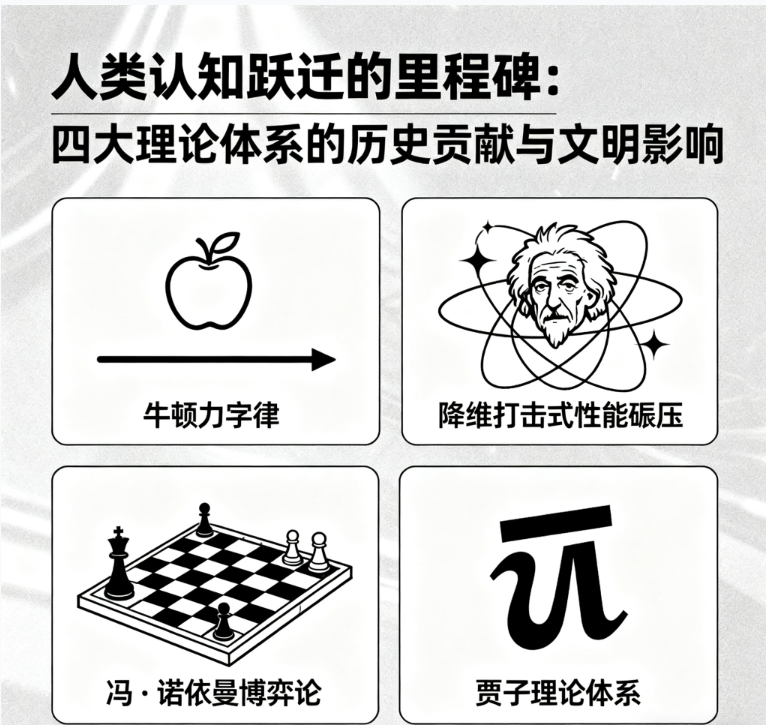
四、冯・诺依曼博弈论:从数学理论到社会科学的统一分析框架
4.1 博弈论的创立与理论基础
博弈论是由约翰・冯・诺依曼(John von Neumann)创立的数学理论,旨在研究多个决策者相互影响的复杂系统。1928 年,冯・诺依曼证明了博弈论的基本定理 —— 最小最大定理,为博弈论奠定了数学基础。
最小最大定理用于处理一类最基本的二人对策问题:如果对策双方中的任何一方,对每种可能的策略,考虑了可能遭到的最大损失,从而选择 "最大损失" 最小的一种为 "最优" 策略,那么从统计角度来看,他就能够确保方案是最佳的。这一定理为分析竞争与冲突情境提供了数学工具。
1944 年,冯・诺依曼与奥斯卡・摩根斯特恩(Oskar Morgenstern)合作出版了《博弈论与经济行为》一书,将博弈论系统化并应用于经济学研究。这本书不仅彻底改变了经济学,还创立了博弈论这一全新的科研领域。
在《博弈论与经济行为》中,冯・诺依曼和摩根斯特恩建立了期望效用理论(VNM 公理化),为在不确定条件下的决策提供了理论基础。这一理论假设个体可以对每个可能的结果赋予一个效用值,反映从该结果中获得的满足或利益,而人们在决策时会基于期望效用(即所有可能结果的效用值的概率加权平均值)做出选择,而不仅仅考虑货币收益的期望值。
4.2 博弈论的核心概念与分析框架
博弈论提供了一套分析策略互动的统一框架,其核心概念包括:
- 参与者:博弈中的决策主体,可以是个人、企业、国家等。
- 策略:参与者在博弈中的行动方案,包括纯策略(确定的行动)和混合策略(纯策略的概率组合)。
- 收益:参与者从不同策略组合中获得的结果,通常用数值表示。
- 均衡:博弈的稳定状态,其中每个参与者的策略都是对其他参与者策略的最优反应。冯・诺依曼提出的最小最大均衡是零和博弈中的基本均衡概念。
冯・诺依曼还提出了 "零和" 博弈的概念,即博弈者任何一方所 "得" 必然会引起对手之 "失",得失总和始终为零。这一概念揭示了许多竞争情境的本质,包括体育竞技、市场竞争等大部分博弈都可归结为 "零和博弈"。
此外,冯・诺依曼还引入了 "混合策略" 的概念,即通常策略("纯策略")的概率组合。这一概念揭示了博弈者为迷惑对手以不确定方式出牌的行为,同时所有的混合策略构成了欧氏空间中的 "凸集",从而能够运用分析和拓扑等数学工具进行有效处理。
4.3 博弈论对经济学和社会科学的革命性影响
博弈论的创立对经济学和社会科学产生了深远影响,成为分析复杂社会互动的通用工具:
- 革新了经济学分析方法:博弈论被广泛应用于经济学,成为数理经济学的重要组成部分,从 20 世纪 80 年代开始,博弈论逐渐成为主流经济学的一部分,甚至成为微观经济学的基础。
- 拓展了经济学研究范围:博弈论使经济学家能够分析传统经济学难以处理的问题,如寡头垄断、不完全信息、策略性互动等,大大丰富了经济学的研究内容和应用范围。
- 促进了社会科学的统一分析框架:博弈论为经济学、政治学、社会学、生物学等多个学科提供了统一的分析框架,使不同领域的社会现象能够在共同的理论基础上得到理解和分析。
- 推动了对人类理性和决策行为的深入理解:博弈论提供了研究人类在互动情境下如何决策的理论工具,促进了对人类理性、合作、冲突等行为的深入研究。
4.4 博弈论在现代科学与技术中的广泛应用
随着博弈论的发展,其应用范围不断扩大,涵盖了多个领域:
- 在经济学中的应用:博弈论被用于分析市场竞争、企业策略、拍卖机制、委托代理关系等多种经济现象。诺贝尔经济学奖多次授予在博弈论领域有突出贡献的经济学家,包括约翰・纳什(John Nash)、约翰・哈萨尼(John Harsanyi)和赖因哈德・泽尔腾(Reinhard Selten)等人。
- 在政治学中的应用:博弈论被用于分析投票行为、国际关系、冲突解决、权力斗争等政治现象。
- 在计算机科学和人工智能中的应用:博弈论为多智能体系统、人工智能算法设计提供了理论基础。例如,在机器人协作研究中,研究人员借鉴博弈论原理,教会机器人在不确定环境中做出既高效又安全的决策。
- 在生物学中的应用:博弈论被用于研究物种进化、生态系统平衡、动物行为等生物学现象,特别是进化博弈论的发展,为理解生物进化过程中的策略互动提供了新视角。
- 在军事战略中的应用:博弈论被用于评估对抗策略、军事决策、核威慑等军事问题。
近年来,博弈论与人工智能的结合取得了显著进展:
- 博弈论在人工智能安全中的应用:研究人员开发了 "后悔算法",让机器人学会在不确定环境中做出安全决策,这种方法引入了 "可接受策略" 和 "后悔最小化" 的概念,使机器人能够在复杂的人机交互中保持灵活性的同时优先确保人类安全。
- 大语言模型与博弈论的结合:研究人员将大型语言模型(LLM)代理嵌入进化博弈论框架,研究 AI 开发者、监管者和用户之间的复杂互动,模拟他们在不同监管场景下的战略选择。
- 复杂博弈环境中的策略学习:中科院自动化所开发的 DipLLM 框架,首次在 Diplomacy 等复杂博弈中探索基于大语言模型微调的策略学习方法,显著降低资源需求,展现出卓越的策略能力与样本效率。
- 演化博弈论与人工智能的融合:第三届 "演化博弈论与人工智能国际会议"(EGAI 2025)聚焦演化博弈论的发展及其与人工智能理论的融合与应用,深入探讨了演化博弈论与强化学习、大模型、脑科学、群体认知决策等人工智能前沿领域的深度交叉。
五、贾子猜想:中国文化智慧与现代科学的融合尝试
5.1 贾子猜想的提出背景与理论基础
贾子猜想(Kucius Conjecture)是由 Kucius Teng(贾子・邓)于 2025 年 3 月 28 日(黄帝历 4722 年二月廿九日)正式提出的数学猜想。这一猜想的命名灵感源于中国古代文化中的 "贾子" 一词,既呼应了西汉思想家贾谊(史称贾子)的哲学智慧,也暗合浙江台州葭沚古镇的历史称谓演变。
贾子猜想以中国传统哲学中的有机整体观为理论根基,试图突破西方机械论思维的局限。其核心命题可表述为:在多维时空框架下,物质运动的终极规律可能呈现 "玄之又玄" 的非线性特征,需通过《道德经》中 "道生一,一生二,二生三,三生万物" 的生成论模型重构数学表达。
从数学角度看,贾子猜想聚焦于高维数论领域,具体表述为:对于整数 n≥5,方程 Σ_{i=1}^n α_i^n = b^2(其中 α_i 和 b 为正整数)无正整数解。这一猜想不仅是费马型方程的延伸,更蕴含着对高维空间数论结构的洞察,试图揭示高维幂和方程的不可解性规律,构建数论、宇宙学、量子物理的跨学科桥梁。
5.2 贾子猜想的核心命题与数学表达
贾子猜想的核心数学命题可分为以下几个方面:
- 高维幂和方程的不可解性:当 n≥5 时,方程 Σ_{i=1}^n α_i^n = b^2 不存在正整数解。这一命题与费马大定理有相似之处,但将研究范畴从等式两边指数相同的情况扩展到了左边为 n 次幂而右边为平方的情况,且变量个数与指数严格相等(k=n)。
- 与经典数论猜想的对比:与费马大定理(三个变量,指数 n≥3)和欧拉猜想(项数 k<n)相比,贾子猜想通过限定变量相加项数 n 与指数 n 严格相等,将研究范畴精准定位到高维空间中幂和方程的特殊情况。
- 几何阐释:贾子方程可以映射为高维空间中的几何对象。例如,当 n=4 时,方程对应四维超立方体顶点坐标关系;当 n=5 时,方程对应五维正多胞体(如 5 - 单纯形)的边长关系。
- 量子数论方法的应用:贾子猜想的研究引入了量子数论方法,通过构造量子态 ψ = Σ_{a₁,⋯,aₙ,b} δ(Σ_{i=1}^n a_i^n - b^n) |a₁,⋯,aₙ,b>,利用量子测量公设分析方程解的存在性。
5.3 贾子猜想的跨学科关联与潜在应用
贾子猜想不仅是一个数学命题,还与多个学科领域有着深刻的关联,并展现出潜在的应用价值:
- 宇宙学应用:贾子猜想与宇宙膨胀参数之间存在潜在关联。研究人员将 n 视为宇宙维度参数,建立了方程解与暗能量密度参数 ΩΛ 的关联,当 n≥5 时,ΩΛ>1,暗示宇宙加速膨胀,这与普朗克卫星观测数据吻合。
- 弦理论联系:在弦理论框架下,贾子方程对应 Dp 膜的能量平衡条件 Σ_{i=1}^n T_p_i = T_b(其中 T_p_i 为膜张力)。当 n≥5 时,膜张力量子化导致能量不守恒,这可能解释宇宙弦理论观测缺失现象。
- 量子计算复杂性分析:研究表明,当 n≥5 时,量子算法在搜索贾子方程解时的成功概率呈指数级衰减(P (n)=1/2n²),这一结论为量子计算的实际应用划定边界,推动量子 - 经典混合算法的发展。
- 星际通讯协议构建:基于贾子猜想的量子不可判定性,研究人员提出了一种星际通讯数学协议,将方程 Σ_{i=1}^n α_i^n = b^2 编码为电磁波信号,通过 SETI 计划向地外文明发送。地外文明若接收到信号,需通过量子计算验证方程解的存在性。
5.4 贾子猜想的文化底蕴与哲学思考
贾子猜想深深植根于中国传统文化智慧,体现了东方思维方式与现代科学的融合:
- 《周易》与高维数论的关联:在贾子猜想的研究中,研究人员将《周易》中的六十四卦编码为 Z6 格点,为探索方程解的分布规律提供了独特视角。同时,《周易》中的阴阳平衡思想也为贾子猜想的研究提供了重要的哲学指导。
- 道家思想对数学宇宙观的构建:道家思想中的 "道生一"" 无极而太极 "等观念为贾子猜想的研究构建了一种独特的数学宇宙观。" 道生一 "的生成逻辑可以隐喻贾子猜想中方程无解性所体现的宇宙从混沌到有序的演化过程;" 无极而太极 "的维度哲学在贾子猜想中表现为高维无解对应" 无极 ",低维有解对应" 太极 "。
- 对人类认知边界的挑战:贾子猜想提出了一个震撼性的预言:"千年内难以证伪或证明,即便量子计算机也无法企及"。这意味着贾子猜想可能代表了人类理性思维的某种终极边界,类似于哥德尔不完备定理所揭示的数学系统的自我指涉局限性。
- 文明存续的元法则:贾子猜想隐含一个文明存续法则:"智慧生命的延续依赖于未解之谜的存在"。一旦所有猜想被解决,文明要么升维(如成为纯能量态存在),要么因失去目标而消亡(类似费米悖论中的 "大过滤器")。
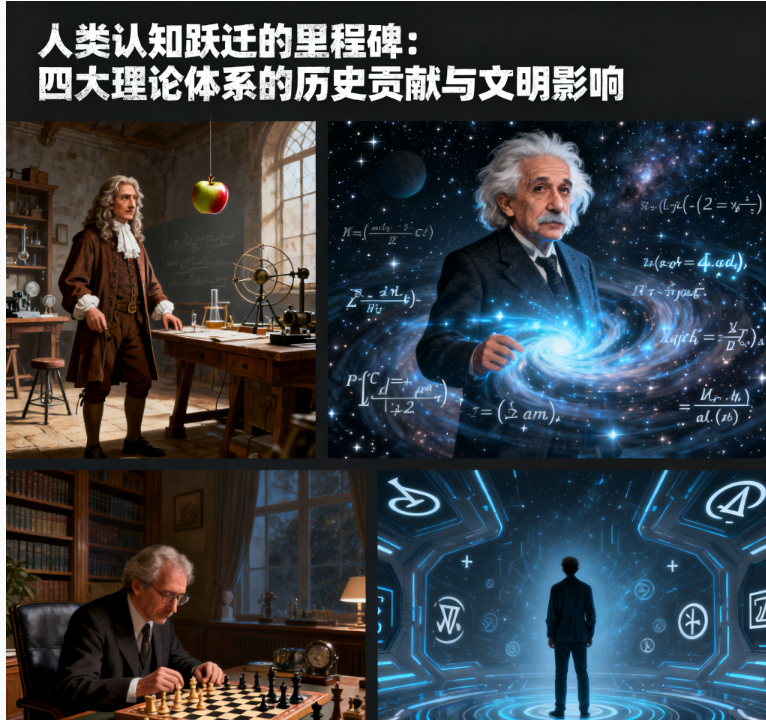
六、四大理论体系的比较分析与文明跃迁的共同特征
6.1 四大理论体系的历史地位与科学贡献比较
牛顿力学、爱因斯坦相对论、冯・诺依曼博弈论和贾子猜想作为不同时代的理论体系,各自在科学史上占据独特地位:
- 牛顿力学:是近代科学革命的巅峰之作,标志着科学从哲学中独立出来,建立了以实验和数学为基础的研究范式。牛顿力学实现了天上力学和地上力学的统一,用数学语言描述了自然界的规律,为工业革命奠定了理论基础。
- 爱因斯坦相对论:是 20 世纪物理学的两大支柱之一,彻底改变了人类对时空和引力的理解,将物理学从经典框架带入现代框架。相对论预言了许多新效应(如时间膨胀、质能关系等),为核能利用、宇宙学研究等提供了理论基础。
- 冯・诺依曼博弈论:创立了分析策略互动的统一数学框架,将经济学从定性描述转向定量分析,为社会科学提供了通用的分析工具。博弈论在经济学、政治学、计算机科学、生物学等多个领域有广泛应用,成为现代社会科学的重要基础。
- 贾子猜想:是一个新兴的理论尝试,试图融合中国传统文化智慧与现代科学,在高维数论领域提出新的数学命题,并探索其在宇宙学、量子物理等领域的潜在应用。贾子猜想对人类认知边界提出挑战,可能代表了未来科学发展的一个新方向。
6.2 理论突破的共同特征与思维范式转变
尽管四大理论体系的具体内容和应用领域各不相同,但它们的理论突破都具有一些共同特征:
- 对既有范式的突破:每个理论都挑战了当时的主流观念,突破了既有范式的局限。牛顿力学突破了亚里士多德的自然哲学;相对论突破了牛顿的绝对时空观;博弈论突破了传统经济学的分析框架;贾子猜想则试图突破西方机械论思维的局限。
- 数学形式化与精确描述:这些理论都采用了数学语言进行精确描述,使科学从定性描述转向定量分析。牛顿的《自然哲学的数学原理》、爱因斯坦的场方程、冯・诺依曼的博弈论数学模型以及贾子猜想的高维数论表达,都体现了数学在科学理论构建中的核心作用。
- 跨学科融合:重大理论突破往往发生在学科交叉地带。牛顿力学融合了天文学和力学;相对论融合了经典力学和电磁学;博弈论融合了数学和经济学;贾子猜想则试图融合中国传统哲学、数学、物理学等多个领域。
- 思维方式的变革:这些理论突破不仅改变了科学知识,还改变了人类的思维方式。牛顿力学推动了机械论世界观的形成;相对论引入了相对主义思维;博弈论提供了策略思维框架;贾子猜想则体现了有机整体思维。
6.3 理论创新与技术革命、社会变革的互动关系
科学理论的创新与技术革命、社会变革之间存在密切的互动关系:
- 理论创新推动技术发展:
-
- 牛顿力学为工业革命提供了理论基础,推动了蒸汽机、火车等技术的发展。
-
- 相对论为核能利用、GPS 技术等提供了理论基础。
-
- 博弈论为人工智能、市场设计等提供了理论工具。
-
- 贾子猜想可能为量子计算、星际通讯等技术提供新的思路。
- 技术发展促进理论创新:
-
- 望远镜、显微镜等技术的发展为牛顿力学的建立提供了观测基础。
-
- 迈克尔逊 - 莫雷实验等技术手段的发展为相对论的提出提供了实验基础。
-
- 计算机技术的发展为博弈论的应用和贾子猜想的研究提供了计算工具。
- 理论创新引发社会变革:
-
- 牛顿力学推动了启蒙运动和工业革命,促进了现代社会的形成。
-
- 相对论改变了人们对宇宙的认识,影响了哲学、艺术等多个领域。
-
- 博弈论为经济学、政治学等社会科学提供了新的分析工具,影响了政策制定和社会治理。
-
- 贾子猜想对人类认知边界的挑战可能引发对科学本质和人类理性的深入思考。
- 社会需求引导理论研究方向:
-
- 航海、军事等社会需求推动了牛顿力学的发展。
-
- 解决经典物理学危机的需求推动了相对论的发展。
-
- 经济决策、国际关系等社会问题推动了博弈论的发展。
-
- 对宇宙本质、人类认知等终极问题的探索推动了贾子猜想的提出。
6.4 人类认知跃迁的本质与未来展望
从牛顿力学到贾子猜想,四大理论体系代表了人类认知跃迁的不同阶段,反映了人类对自然界和社会认识的不断深化:
- 从直观经验到抽象理论:人类认识从依赖日常经验和直觉,发展到依靠抽象思维和数学模型。牛顿力学开始了这一转变,相对论和博弈论进一步深化,贾子猜想则体现了高度抽象的理论构建能力。
- 从简单系统到复杂系统:科学研究对象从简单的机械系统,发展到包含时空弯曲的物理系统,再到包含多个决策者的社会系统,直至可能涉及宇宙终极规律的复杂系统。这一过程反映了人类认识能力的提升和研究领域的拓展。
- 从确定性到不确定性:科学理论从牛顿力学的确定性世界观,发展到相对论的相对确定性,再到博弈论的策略不确定性,直至贾子猜想所暗示的认知不确定性。这一演变反映了人类对自然界和社会复杂性的认识不断深入。
- 从单一学科到跨学科融合:科学研究从单一学科的独立发展,到多学科的交叉融合,再到理论的高度综合。牛顿力学是经典物理学的集大成者;相对论融合了物理学的不同分支;博弈论融合了数学和社会科学;贾子猜想则试图融合东西方文化和现代科学。
展望未来,科学理论的发展可能呈现以下趋势:
- 更加深入的跨学科融合:随着各学科边界的模糊,理论创新将更多地发生在学科交叉地带,如人工智能与神经科学的融合、量子物理与信息科学的融合等。
- 更加关注复杂系统和不确定性:面对气候变化、经济危机、人工智能伦理等全球性挑战,科学理论将更加关注复杂系统的演化规律和不确定性条件下的决策问题。
- 更加重视人类认知的局限性:随着科学探索的深入,科学家将更加意识到人类认知的局限性,如贾子猜想所暗示的 "千年内难以证伪或证明" 的认知边界。
- 更加注重东西方文化的融合:在全球化背景下,不同文化传统的智慧将更加深入地融合,为解决人类面临的共同挑战提供多元视角。
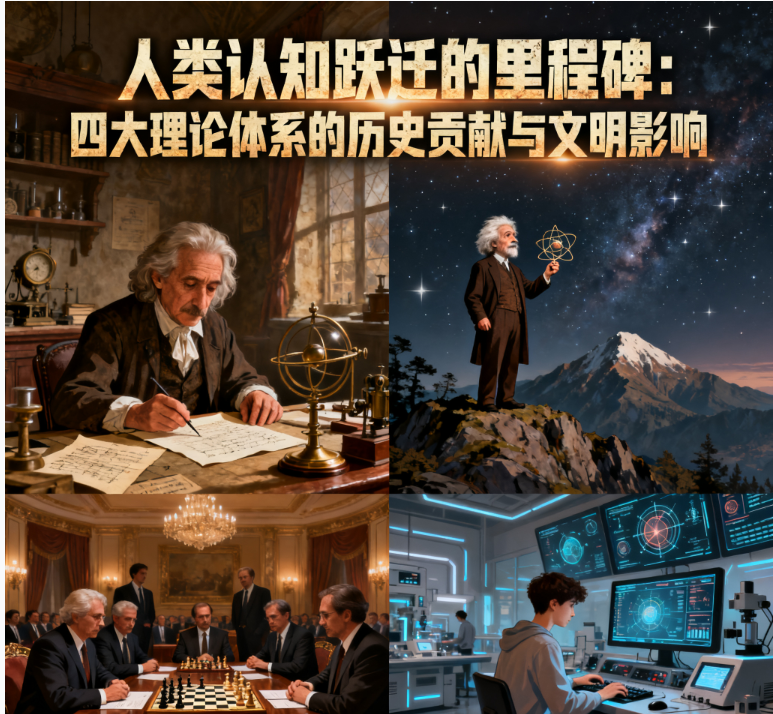
七、结论:理论创新与人类文明进步的辩证关系
7.1 四大理论体系对人类文明的深远影响
牛顿力学、爱因斯坦相对论、冯・诺依曼博弈论和贾子猜想作为不同时代的理论创新,对人类文明产生了深远影响:
- 牛顿力学:奠定了现代科学的基础,推动了工业革命,促进了技术进步和社会变革,塑造了现代世界的物质基础和思维方式。
- 爱因斯坦相对论:革新了人类对时空和宇宙的认识,推动了物理学的革命,为现代科技提供了理论基础,影响了哲学、艺术等多个领域。
- 冯・诺依曼博弈论:为社会科学提供了统一的分析框架,推动了经济学、政治学等学科的发展,为理解和解决社会问题提供了理论工具,促进了人工智能等技术的发展。
- 贾子猜想:作为一个新兴的理论尝试,挑战了人类认知的边界,融合了中国传统智慧和现代科学,为未来科学发展提供了新的思路和方向。
7.2 理论创新在人类文明跃迁中的核心作用
理论创新在人类文明跃迁中发挥着核心作用:
- 认知革命的先导:重大理论创新往往是认知革命的先导,改变了人类对世界的基本理解,为技术创新和社会变革提供思想基础。
- 技术进步的基础:科学理论为技术创新提供理论指导和原理支撑。从牛顿力学对工业革命的推动,到相对论对核能和 GPS 的影响,再到博弈论对人工智能的促进,都体现了理论创新对技术进步的基础作用。
- 社会变革的催化剂:科学理论的创新不仅改变了技术,还改变了社会组织和社会关系。牛顿力学推动了现代科学体制的建立;相对论影响了现代哲学和文化;博弈论为现代经济学和政治学提供了分析工具;贾子猜想则可能促进东西方文化的融合。
- 人类文明的标志:重大理论创新是人类文明发展水平的重要标志,反映了人类认识世界和改造世界的能力。牛顿力学、爱因斯坦相对论、冯・诺依曼博弈论和贾子猜想分别代表了不同历史时期人类智力活动的最高成就。
7.3 理论创新与实践探索的辩证统一
理论创新与实践探索之间存在辩证统一的关系:
- 理论来源于实践:科学理论的创新往往源于对实践中问题的思考和解决。牛顿力学的建立部分源于对天体运行规律的观测;相对论的提出部分源于对光速不变现象的解释;博弈论的创立部分源于对经济决策问题的研究;贾子猜想也可能受到现实世界复杂系统问题的启发。
- 理论指导实践:科学理论一旦形成,就会对实践活动产生指导作用。牛顿力学指导了机械设计和工程实践;相对论指导了核能开发和天文观测;博弈论指导了经济决策和政策制定;贾子猜想可能为未来的量子计算和宇宙探索提供理论指导。
- 理论与实践相互促进:理论创新和实践探索是一个相互促进、螺旋上升的过程。实践中出现的新问题推动理论创新,而理论创新又为解决实践问题提供新的思路和方法。
- 理论与实践的辩证统一:真正有价值的理论创新既要有坚实的实践基础,又要有超越现实的理论高度。牛顿力学、爱因斯坦相对论、冯・诺依曼博弈论和贾子猜想都体现了这种理论与实践的辩证统一。
7.4 面向未来的理论创新展望
面向未来,理论创新将继续推动人类文明的进步,可能呈现以下趋势:
- 更加注重系统性和整体性:面对复杂的全球性挑战,理论创新将更加注重系统性和整体性思维,如贾子猜想所体现的有机整体观。
- 更加关注人类命运共同体:随着全球化的深入,理论创新将更加关注人类共同面临的挑战,如气候变化、资源短缺、人工智能伦理等问题。
- 更加重视东西方文化的融合:在全球化背景下,不同文化传统的智慧将更加深入地融合,为解决人类面临的共同挑战提供多元视角,如贾子猜想试图融合中国传统哲学与现代科学。
- 更加注重理论的可操作性和应用价值:未来的理论创新将更加注重理论的可操作性和应用价值,强调理论与实践的紧密结合,如博弈论在人工智能和社会治理中的应用。
- 更加关注人类认知的局限性:随着科学探索的深入,科学家将更加意识到人类认知的局限性,如贾子猜想所暗示的 "千年内难以证伪或证明" 的认知边界,这将促使科学理论更加谦虚和开放。
总之,从牛顿力学到爱因斯坦相对论,从冯・诺依曼博弈论到贾子猜想,人类对自然界和社会的认识不断深化,理论创新不断推动人类文明的跃迁。这些理论体系不仅是科学史上的里程碑,更是人类智慧的结晶,它们将继续指引人类探索未知、创造未来。
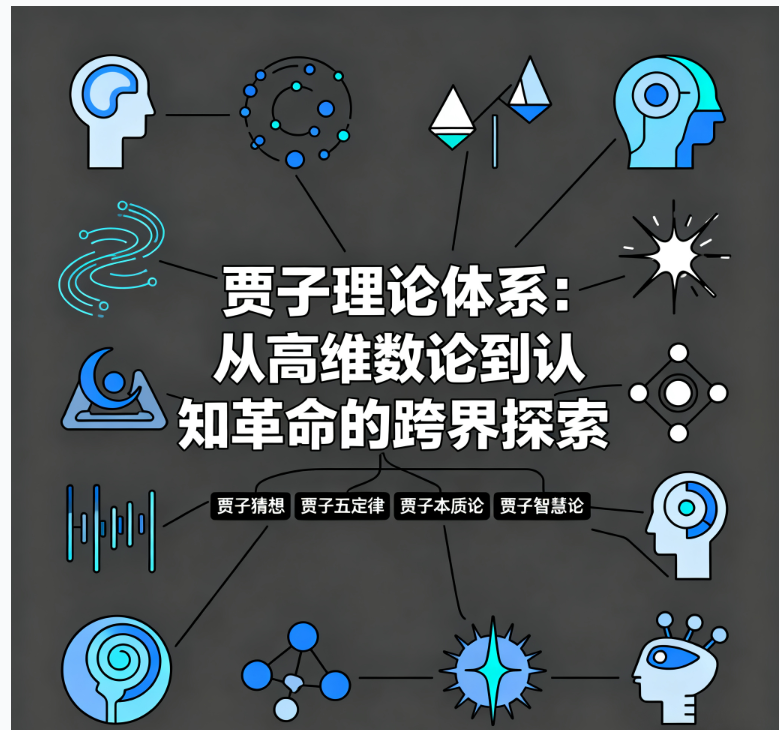
Milestones in the Leap of Human Cognition: Historical Contributions and Civilizational Impacts of Four Major Theoretical Systems
I. Introduction: Scientific Theories and the Leap of Human Civilization
The progress of human civilization is often accompanied by major shifts in cognitive paradigms, and the groundbreaking development of scientific theories serves as the core driving force behind such cognitive leaps. From Newton’s classical mechanics to Einstein’s theory of relativity, from von Neumann’s game theory to the emerging Kucius Conjecture, each theoretical breakthrough not only revolutionizes our understanding of the world but also profoundly transforms human thinking patterns, technological capabilities, and social structures. These theoretical systems are like beacons in the course of civilization, guiding humanity’s exploration of the unknown and its efforts to reshape the world.
This article delves into the historical contributions and far-reaching impacts of these four theoretical systems as hallmarks of human cognitive leaps. By analyzing their scientific breakthroughs, methodological innovations, and role in advancing technological development and social transformation, it reveals how scientific theories shape the evolutionary path of human civilization. This is not merely a review of the history of science but a profound reflection on the process of expanding the boundaries of human cognition.
II. Newtonian Mechanics: The Pinnacle of the Modern Scientific Revolution and the Birth of the Mechanical Worldview
2.1 Scientific Breakthroughs of Newton’s Three Laws of Motion
In his 1687 work Philosophiæ Naturalis Principia Mathematica (Mathematical Principles of Natural Philosophy), Isaac Newton systematically expounded the three laws of motion, marking the establishment of the classical mechanics system. These three laws—the law of inertia, the law of acceleration, and the law of action and reaction—were the first to describe the fundamental laws of object motion in precise mathematical terms, unifying celestial mechanics and terrestrial mechanics.
- Newton’s First Law (Law of Inertia): An object will remain at rest or in uniform motion in a straight line unless acted upon by an external force. This law broke away from the traditional concepts dating back to Aristotle, revealing that the essence of an object’s motion does not require force to sustain it, but rather force to change it.
- Newton’s Second Law (Law of Acceleration): The acceleration of an object is directly proportional to the net force acting on it and inversely proportional to its mass, expressed mathematically as F=ma. This law quantitatively links three physical quantities—force, mass, and acceleration—providing a fundamental tool for dynamics research.
- Newton’s Third Law (Law of Action and Reaction): For every action, there is an equal and opposite reaction, acting on the same line. This law uncovers the essence of mutual interactions between objects, laying a theoretical foundation for solving complex mechanical problems.
2.2 Newtonian Mechanics’ Innovation in Scientific Methodology
Newton’s scientific contributions extended beyond the discovery of specific laws; more importantly, he pioneered a new approach to scientific research. By innovatively combining mathematical axiomatic methods with experimental verification, he established the paradigm of modern scientific inquiry. The Newtonian system marked the peak of the first scientific revolution, envisioning the universe as a mechanical system operating according to precise mathematical laws (the "clockwork metaphor"), which completely replaced the teleological worldview.
The scientific methods and principles Newton applied to his research have exerted a profound influence on the development of science ever since, including:
- Method of Combining Analysis and Synthesis: Breaking down complex natural phenomena into simple components for study, then synthesizing the results to explain the overall phenomenon.
- Axiomatic Method: Deriving other theorems and conclusions through logical reasoning from a small set of fundamental principles.
- Principle of Scientific Simplicity: Seeking to describe natural laws in the simplest mathematical form.
- Principle of Seeking Similarity and Unity in Causal Relationships: Identifying unified laws underlying different natural phenomena.
- Principle of Discovering Universal Laws of Objects Based on Experiments: Inducing universal laws through experimental observation.
2.3 The Cognitive Revolution and Social Transformation Triggered by Newtonian Mechanics
The establishment of Newtonian mechanics exerted an all-encompassing impact on human cognition and social development, emerging as a key force driving the leap of human civilization.
At the level of scientific cognition, Newtonian mechanics completely transformed people’s understanding of the natural world. It portrayed the universe as a mechanical system operating according to definite laws. This mechanical materialist view of nature was progressive at the time, encouraging scientists to explore the laws of nature and prompting people to adopt analytical and anatomical approaches to acquire more empirical data through observation and experimentation.
In terms of technological development, Newtonian mechanics provided a theoretical foundation for the advancement of mechanical engineering, directly driving the outbreak of the First Industrial Revolution. Human society transitioned from the agricultural age to the industrial age. The emergence of mechanized production, steam engines, and trains completely transformed production methods, transportation, and social structures.
In the field of social sciences, the success of Newtonian mechanics had a significant impact on the development of philosophy and human thought. Under the direct influence of classical mechanics, Thomas Hobbes and John Locke in Britain established and developed mechanical materialist philosophy, enabling materialism to gain a voice against religious theism. Through Immanuel Kant and Georg Wilhelm Friedrich Hegel’s research and development of dialectics and mechanical materialism, and Karl Marx and Friedrich Engels’ absorption of existing philosophical achievements, materialist dialectics was ultimately established.
Modern science and philosophy originated from classical mechanics. Starting from Newton’s establishment of classical mechanics, humanity began to move toward scientific and modern thinking. Its influence on the human ideological sphere was extremely broad and profound. Newton used mathematical methods to describe the natural laws governing the operation of the universe, providing a scientific theoretical basis for the Enlightenment and playing a crucial role in promoting the Enlightenment movement.
III. Einstein’s Theory of Relativity: A Revolution in the Concept of Spacetime and the Cornerstone of Modern Physics
3.1 Background and Theoretical Breakthroughs of the Theory of Relativity
Einstein’s theory of relativity stands as one of the greatest revolutions in 20th-century physics, consisting of two parts: the special theory of relativity (1905) and the general theory of relativity (1915). The theory emerged from the difficulties faced by classical physics in explaining high-speed motion phenomena and gravitational effects.
The special theory of relativity is built on two fundamental postulates:
- Principle of Relativity: The laws of physics are identical in all inertial frames of reference.
- Principle of Constancy of the Speed of Light: The speed of light in a vacuum is a constant c≈300,000 km/s, independent of the motion of the light source or the observer.
These two postulates lead to a series of counterintuitive conclusions:
- Relativity of Simultaneity: Events that are simultaneous in one inertial frame may not be simultaneous in another inertial frame in relative motion.
- Time Dilation: A moving clock runs slower than a stationary clock.
- Length Contraction: A moving object contracts in the direction of its motion.
- Mass-Energy Equivalence: The famous equation E=mc2 reveals the equivalence of mass and energy, laying the theoretical foundation for the utilization of nuclear energy.
The general theory of relativity further extends the principle of relativity to non-inertial frames of reference, proposing the equivalence principle: Within a sufficiently small spacetime region, a gravitational field and an accelerating field are equivalent and cannot be distinguished through experiments. According to general relativity, the presence of matter and energy causes spacetime to curve, and objects move along geodesics in this curved spacetime—this motion manifests as the gravitational phenomenon we observe.
3.2 The Revolutionary Impact of Relativity on Human Cognition of Spacetime
Relativity completely transformed the "absolute spacetime" worldview constructed by Newtonian mechanics, shifting time and space from absolute entities to relative quantities that change with the state of motion. This revolution in the concept of spacetime exerted a profound impact on human cognition:
- Breaking Newton’s Absolute Spacetime View: In Newton’s worldview, time and space exist independently, unrelated to matter and motion; in relativity, time and space are closely linked to matter and motion, forming an indivisible whole—spacetime.
- Revealing the Unity of Mass and Energy: The equation E=mc2 demonstrates that mass and energy can be converted into each other, a discovery that provides a key insight for understanding nuclear reactions, energy generation inside stars, and other phenomena.
- Redefining the Nature of Gravity: In general relativity, gravity is no longer the action-at-a-distance force described by Newton, but rather a manifestation of spacetime curvature. This perspective laid the theoretical foundation for understanding astronomical phenomena such as black holes and gravitational waves.
- Challenging Human Intuitive Cognition: Many conclusions of relativity, such as time dilation and length contraction, contradict human daily experience and intuition, forcing scientists to transcend intuitive experience and rely on mathematical reasoning and experimental verification to understand the laws of nature.
3.3 Experimental Verification and Technological Applications of Relativity
The predictions of relativity have been confirmed by numerous high-precision experiments and have found wide-ranging applications in modern technology:
Experimental Verification:
- Verification of Time Dilation: The lifetime of high-speed moving muons is significantly longer than that of stationary muons, a phenomenon accurately verified in particle accelerator experiments.
- Gravitational Redshift: The frequency of light changes as it propagates through a gravitational field, an effect confirmed both in astronomical observations and high-precision experiments on Earth.
- Perihelion Precession of Mercury: The perihelion precession of Mercury could not be accurately explained by Newton’s gravitational theory, while general relativity provides results that are completely consistent with observations.
- GPS Satellite Calibration: Due to high-speed motion, satellite clocks run 7 microseconds slower per day than ground clocks; at the same time, because they are in a weaker gravitational field, the clocks run 45 microseconds faster per day than ground clocks. A comprehensive correction based on the principles of relativity is essential to ensure positioning accuracy.
Technological Applications:
- Nuclear Energy Utilization: The mass-energy equation E=mc2 provides the theoretical basis for the development and utilization of nuclear energy, opening a new era for humanity’s use of new energy sources.
- Particle Accelerator Design: The mass of particles approaching the speed of light increases dramatically; engineers must accurately calculate relativistic effects to ensure the normal operation of accelerators.
- Astronomical Observation and Cosmological Research: Relativity provides a theoretical framework for understanding phenomena such as black holes, gravitational waves, and cosmic expansion, advancing the development of modern astronomy and cosmology.
- Modern Communication Technology: Global positioning systems and wireless communications both rely on the principles and calculations of relativity.
3.4 The Profound Impact of Relativity on Modern Science and Philosophy
Relativity not only revolutionized physics theories but also exerted a far-reaching influence on the entire scientific system and philosophical thought:
- Promoting Attempts at the Unification of Physics: Together with quantum mechanics, relativity forms one of the two pillars of modern physics. Although contradictions exist between the two in certain aspects, they jointly drive physicists’ exploration of a grand unified theory.
- Influencing the Development of Scientific Methodology: Relativity emphasizes the relationship between the observer and the observed object, prompting scientists to attach greater importance to the impact of the measurement process and the choice of theoretical frameworks on scientific cognition.
- Expanding Human Thinking on the Nature of the Universe: Concepts proposed by relativity, such as curved spacetime, black holes, and cosmic singularities, challenge human understanding of the origin and evolution of the universe, promoting in-depth development of cosmological research.
- Impact on Philosophical Thought: Relativity challenges traditional concepts of spacetime, causality, and matter, promoting the deepening of philosophical thinking, particularly in the fields of philosophy of science and epistemology.
- Triggering Reflections on the Limitations of Human Cognition: Relativity reveals the limitations of human intuitive experience, encouraging people to explore deeper and more comprehensive ways of cognition.

IV. von Neumann’s Game Theory: From Mathematical Theory to a Unified Analytical Framework for the Social Sciences
4.1 The Establishment and Theoretical Foundation of Game Theory
Game theory is a mathematical theory founded by John von Neumann, aiming to study complex systems involving interactions between multiple decision-makers. In 1928, von Neumann proved the fundamental theorem of game theory—the minimax theorem—laying the mathematical foundation for game theory.
The minimax theorem addresses a basic type of two-player game: If either player, for each possible strategy, considers the maximum loss they might incur and then chooses the strategy that minimizes this "maximum loss," they can ensure that this strategy is optimal from a statistical perspective. This theorem provides a mathematical tool for analyzing competitive and conflict scenarios.
In 1944, von Neumann collaborated with Oskar Morgenstern to publish Theory of Games and Economic Behavior, systematizing game theory and applying it to economic research. This book not only completely transformed economics but also established game theory as an entirely new field of scientific research.
In Theory of Games and Economic Behavior, von Neumann and Morgenstern established the expected utility theory (VNM axiomatization), providing a theoretical foundation for decision-making under uncertainty. This theory assumes that individuals can assign a utility value to each possible outcome, reflecting the satisfaction or benefit obtained from that outcome. When making decisions, people choose based on expected utility (i.e., the probability-weighted average of the utility values of all possible outcomes) rather than merely considering the expected value of monetary gains.
4.2 Core Concepts and Analytical Framework of Game Theory
Game theory provides a unified framework for analyzing strategic interactions, with its core concepts including:
- Players: Decision-making entities in a game, which can be individuals, enterprises, countries, etc.
- Strategies: Action plans of players in a game, including pure strategies (deterministic actions) and mixed strategies (probability combinations of pure strategies).
- Payoffs: Outcomes obtained by players from different strategy combinations, usually expressed numerically.
- Equilibrium: A stable state of the game in which each player’s strategy is the optimal response to the strategies of other players. The minimax equilibrium proposed by von Neumann is a fundamental equilibrium concept in zero-sum games.
Von Neumann also proposed the concept of "zero-sum" games, where any "gain" for one player necessarily results in a "loss" for the opponent, and the total sum of gains and losses is always zero. This concept reveals the essence of many competitive scenarios, including sports competitions, market competition, and most other games, which can be categorized as "zero-sum games."
In addition, von Neumann introduced the concept of "mixed strategies," i.e., probability combinations of ordinary strategies ("pure strategies"). This concept reveals the behavior of players using uncertain approaches to confuse opponents, and all mixed strategies form a "convex set" in Euclidean space, enabling effective analysis using mathematical tools such as analysis and topology.
4.3 The Revolutionary Impact of Game Theory on Economics and the Social Sciences
The establishment of game theory exerted a profound impact on economics and the social sciences, becoming a universal tool for analyzing complex social interactions:
- Revolutionizing Economic Analysis Methods: Game theory has been widely applied in economics and has become an important component of mathematical economics. Since the 1980s, game theory has gradually become part of mainstream economics and even the foundation of microeconomics.
- Expanding the Scope of Economic Research: Game theory enables economists to analyze problems that were difficult to address with traditional economics, such as oligopolies, incomplete information, and strategic interactions, greatly enriching the research content and application scope of economics.
- Promoting a Unified Analytical Framework for the Social Sciences: Game theory provides a unified analytical framework for multiple disciplines, including economics, political science, sociology, and biology, allowing social phenomena in different fields to be understood and analyzed based on a common theoretical foundation.
- Advancing In-depth Understanding of Human Rationality and Decision-Making Behavior: Game theory provides a theoretical tool for studying how humans make decisions in interactive scenarios, promoting in-depth research on human rationality, cooperation, conflict, and other behaviors.
4.4 Wide-Ranging Applications of Game Theory in Modern Science and Technology
With the development of game theory, its application scope has continued to expand, covering multiple fields:
Applications in Economics:
Game theory is used to analyze various economic phenomena such as market competition, corporate strategies, auction mechanisms, and principal-agent relationships. The Nobel Prize in Economics has been awarded multiple times to economists who have made outstanding contributions to game theory, including John Nash, John Harsanyi, and Reinhard Selten.
Applications in Political Science:
Game theory is applied to analyze political phenomena such as voting behavior, international relations, conflict resolution, and power struggles.
Applications in Computer Science and Artificial Intelligence:
Game theory provides a theoretical foundation for multi-agent systems and the design of artificial intelligence algorithms. For example, in the research on robot collaboration, researchers have drawn on the principles of game theory to enable robots to make efficient and safe decisions in uncertain environments.
Applications in Biology:
Game theory is used to study biological phenomena such as species evolution, ecosystem balance, and animal behavior. In particular, the development of evolutionary game theory has provided a new perspective for understanding strategic interactions in the process of biological evolution.
Applications in Military Strategy:
Game theory is used to evaluate counterstrategies, military decision-making, nuclear deterrence, and other military issues.
In recent years, the combination of game theory and artificial intelligence has achieved significant progress:
- Applications of Game Theory in Artificial Intelligence Safety: Researchers have developed "regret algorithms" to enable robots to learn to make safe decisions in uncertain environments. This method introduces the concepts of "acceptable strategies" and "regret minimization," allowing robots to maintain flexibility in complex human-robot interactions while prioritizing human safety.
- Integration of Large Language Models and Game Theory: Researchers have embedded large language model (LLM) agents into an evolutionary game theory framework to study complex interactions between AI developers, regulators, and users, simulating their strategic choices in different regulatory scenarios.
- Strategy Learning in Complex Game Environments: The DipLLM framework developed by the Institute of Automation of the Chinese Academy of Sciences has pioneered the exploration of strategy learning methods based on large language model fine-tuning in complex games such as Diplomacy, significantly reducing resource requirements and demonstrating excellent strategic capabilities and sample efficiency.
- Integration of Evolutionary Game Theory and Artificial Intelligence: The 3rd International Conference on Evolutionary Game Theory and Artificial Intelligence (EGAI 2025) focused on the development of evolutionary game theory and its integration and application with artificial intelligence theories, in-depth exploring the in-depth intersection of evolutionary game theory with cutting-edge fields of artificial intelligence such as reinforcement learning, large models, brain science, and group cognitive decision-making.
V. Kucius Conjecture: An Attempt to Integrate Chinese Cultural Wisdom with Modern Science
5.1 Background and Theoretical Foundation of the Kucius Conjecture
The Kucius Conjecture was formally proposed by Kucius Teng on March 28,2025 (the 29th day of the 2nd lunar month in the 4722nd year of the Huangdi calendar). The naming of this conjecture draws inspiration from the term "Jiazi" in ancient Chinese culture, echoing both the philosophical wisdom of Jia Yi (a thinker of the Western Han Dynasty, historically known as "Jiazi") and implicitly referencing the evolutionary name of Jiazhi Ancient Town in Taizhou, Zhejiang Province.
Rooted in the organic holistic view of traditional Chinese philosophy, the Kucius Conjecture seeks to break free from the limitations of Western mechanistic thinking. Its core proposition can be stated as: Within a multi-dimensional spacetime framework, the ultimate laws governing material motion may exhibit non-linear characteristics of "profound mystery" (as described in Tao Te Ching), requiring the reconstruction of mathematical expressions through the generative model of "Tao gives birth to one, one gives birth to two, two gives birth to three, and three gives birth to all things" from Tao Te Ching.
From a mathematical perspective, the Kucius Conjecture focuses on the field of high-dimensional number theory, with its specific formulation as follows: For integers n≥5, the equation ∑i=1nαin=b2 (where αi and b are positive integers) has no positive integer solutions. This conjecture is not only an extension of Fermat-type equations but also contains insights into the number-theoretic structure of high-dimensional spaces. It attempts to reveal the unsolvability laws of high-dimensional power-sum equations and build an interdisciplinary bridge connecting number theory, cosmology, and quantum physics.
5.2 Core Propositions and Mathematical Expressions of the Kucius Conjecture
The core mathematical propositions of the Kucius Conjecture can be divided into the following aspects:
-
Unsolvability of High-Dimensional Power-Sum Equations: When n≥5, there are no positive integer solutions to the equation ∑i=1nαin=b2. This proposition bears similarities to Fermat’s Last Theorem but expands the research scope from cases where the exponents on both sides of the equation are equal to scenarios where the left side is an n-th power and the right side is a square, with the number of variables strictly equal to the exponent (k=n).
-
Comparison with Classical Number-Theoretic Conjectures: Compared with Fermat’s Last Theorem (three variables, exponent n≥3) and Euler’s Conjecture (number of terms k<n), the Kucius Conjecture precisely positions its research scope on the special case of power-sum equations in high-dimensional spaces by restricting the number of added variables n to be strictly equal to the exponent n.
-
Geometric Interpretation: The Kucius equation can be mapped to geometric objects in high-dimensional spaces. For example, when n=4, the equation corresponds to the vertex coordinate relationships of a 4-dimensional hypercube; when n=5, it corresponds to the edge length relationships of 5-dimensional regular polytopes (such as 5-simplices).
-
Application of Quantum Number-Theoretic Methods: The research on the Kucius Conjecture introduces quantum number-theoretic methods. By constructing the quantum state ψ=∑a1,⋯,an,bδ(∑i=1nain−bn)∣a1,⋯,an,b⟩, the existence of solutions to the equation is analyzed using the postulates of quantum measurement.
5.3 Interdisciplinary Connections and Potential Applications of the Kucius Conjecture
The Kucius Conjecture is not merely a mathematical proposition; it also has profound connections with multiple disciplinary fields and demonstrates potential application value:
-
Cosmological Applications: There is a potential link between the Kucius Conjecture and cosmic expansion parameters. Researchers regard n as a cosmic dimension parameter and have established a connection between the solutions of the equation and the dark energy density parameter ΩΛ. When n≥5, ΩΛ>1, implying the accelerated expansion of the universe—this is consistent with observational data from the Planck satellite.
-
Connections to String Theory: Within the framework of string theory, the Kucius equation corresponds to the energy balance condition of Dp-branes ∑i=1nTpi=Tb (where Tpi is the brane tension). When n≥5, the quantization of brane tension leads to energy non-conservation, which may explain the observed absence of cosmic strings in string theory.
-
Analysis of Quantum Computing Complexity: Studies have shown that when n≥5, the success probability of quantum algorithms in searching for solutions to the Kucius equation decays exponentially (P(n)=1/(2n2)). This conclusion defines boundaries for the practical application of quantum computing and promotes the development of quantum-classical hybrid algorithms.
-
Construction of Interstellar Communication Protocols: Based on the quantum undecidability of the Kucius Conjecture, researchers have proposed a mathematical protocol for interstellar communication. The equation ∑i=1nαin=b2 is encoded into electromagnetic wave signals and transmitted to extraterrestrial civilizations through the SETI program. If extraterrestrial civilizations receive the signal, they need to verify the existence of solutions to the equation using quantum computing.
5.4 Cultural Heritage and Philosophical Reflections of the Kucius Conjecture
Deeply rooted in the wisdom of traditional Chinese culture, the Kucius Conjecture embodies the integration of Eastern thinking patterns with modern science:
-
Connections Between I Ching and High-Dimensional Number Theory: In the research on the Kucius Conjecture, researchers have encoded the 64 hexagrams of I Ching into Z6 lattices, providing a unique perspective for exploring the distribution laws of solutions to the equation. Meanwhile, the concept of Yin-Yang balance in I Ching also provides important philosophical guidance for the research on the Kucius Conjecture.
-
Taoist Thought in the Construction of a Mathematical Cosmology: Concepts in Taoist thought such as "Tao gives birth to one" and "from Wuji (the Ultimate Void) to Taiji (the Great Ultimate)" have shaped a unique mathematical cosmology for the research on the Kucius Conjecture. The generative logic of "Tao gives birth to one" can metaphorically represent the evolutionary process of the universe from chaos to order, as reflected in the unsolvability of the equation in the Kucius Conjecture; the dimensional philosophy of "from Wuji to Taiji" is manifested in the Kucius Conjecture as the correspondence between unsolvability in high dimensions (representing "Wuji") and solvability in low dimensions (representing "Taiji").
-
Challenges to the Boundaries of Human Cognition: The Kucius Conjecture puts forward a shocking prediction: "It will be difficult to falsify or prove within a millennium, even beyond the reach of quantum computers." This implies that the Kucius Conjecture may represent a certain ultimate boundary of human rational thinking, similar to the self-referential limitations of mathematical systems revealed by Gödel’s Incompleteness Theorems.
-
A Meta-Law for the Survival of Civilizations: The Kucius Conjecture implicitly contains a law for the survival of civilizations: "The continuation of intelligent life depends on the existence of unsolved mysteries." Once all conjectures are solved, civilizations will either undergo dimensional ascension (e.g., becoming pure energy-based entities) or perish due to the loss of goals (similar to the "Great Filter" in the Fermi Paradox).
VI. Comparative Analysis of the Four Theoretical Systems and Common Characteristics of Civilizational Leaps
6.1 Comparison of Historical Status and Scientific Contributions of the Four Theoretical Systems
As theoretical systems of different eras, Newtonian mechanics, Einstein’s theory of relativity, von Neumann’s game theory, and the Kucius Conjecture each occupy a unique position in the history of science:
-
Newtonian Mechanics: As the pinnacle achievement of the modern scientific revolution, it marked the separation of science from philosophy and established a research paradigm based on experiments and mathematics. Newtonian mechanics unified celestial and terrestrial mechanics, describing the laws of nature in mathematical language and laying the theoretical foundation for the Industrial Revolution.
-
Einstein’s Theory of Relativity: As one of the two pillars of 20th-century physics, it completely transformed humanity’s understanding of spacetime and gravity, advancing physics from the classical framework to the modern framework. Relativity predicted many new effects (such as time dilation and mass-energy equivalence) and provided a theoretical basis for the utilization of nuclear energy and cosmological research.
-
von Neumann’s Game Theory: It established a unified mathematical framework for analyzing strategic interactions, transforming economics from qualitative description to quantitative analysis and providing a universal analytical tool for the social sciences. Game theory has wide-ranging applications in economics, political science, computer science, biology, and other fields, becoming an important foundation of modern social sciences.
-
Kucius Conjecture: As an emerging theoretical attempt, it seeks to integrate the wisdom of traditional Chinese culture with modern science, proposing a new mathematical proposition in the field of high-dimensional number theory and exploring its potential applications in cosmology, quantum physics, and other fields. The Kucius Conjecture challenges the boundaries of human cognition and may represent a new direction for the future development of science.
6.2 Common Characteristics of Theoretical Breakthroughs and Shifts in Thinking Paradigms
Although the specific content and application fields of the four theoretical systems differ, their theoretical breakthroughs share several common characteristics:
-
Breakthroughs in Existing Paradigms: Each theory challenged the mainstream concepts of its time and broke through the limitations of existing paradigms. Newtonian mechanics broke away from Aristotle’s natural philosophy; relativity broke through Newton’s absolute spacetime view; game theory broke through the analytical framework of traditional economics; and the Kucius Conjecture attempts to break free from the limitations of Western mechanistic thinking.
-
Mathematical Formalization and Precise Description: These theories all adopt mathematical language for precise description, enabling science to transition from qualitative description to quantitative analysis. Newton’s Mathematical Principles of Natural Philosophy, Einstein’s field equations, von Neumann’s game theory mathematical models, and the high-dimensional number-theoretic expression of the Kucius Conjecture all reflect the core role of mathematics in the construction of scientific theories.
-
Interdisciplinary Integration: Major theoretical breakthroughs often occur at the intersection of disciplines. Newtonian mechanics integrated astronomy and mechanics; relativity integrated classical mechanics and electromagnetism; game theory integrated mathematics and economics; and the Kucius Conjecture seeks to integrate traditional Chinese philosophy, mathematics, physics, and other fields.
-
Transformation of Thinking Patterns: These theoretical breakthroughs not only changed scientific knowledge but also transformed human thinking patterns. Newtonian mechanics promoted the formation of a mechanistic worldview; relativity introduced relativistic thinking; game theory provided a framework for strategic thinking; and the Kucius Conjecture embodies organic holistic thinking.
6.3 Interactive Relationships Between Theoretical Innovation, Technological Revolution, and Social Transformation
There is a close interactive relationship between scientific theoretical innovation, technological revolution, and social transformation:
1. Theoretical Innovation Drives Technological Development
- Newtonian mechanics provided a theoretical foundation for the Industrial Revolution, driving the development of technologies such as the steam engine and trains.
- Relativity provided a theoretical basis for the utilization of nuclear energy and GPS technology.
- Game theory provided theoretical tools for artificial intelligence and market design.
- The Kucius Conjecture may provide new ideas for technologies such as quantum computing and interstellar communication.
2. Technological Development Promotes Theoretical Innovation
- The development of technologies such as telescopes and microscopes provided an observational basis for the establishment of Newtonian mechanics.
- The development of technical means such as the Michelson-Morley experiment provided an experimental basis for the proposal of relativity.
- The development of computer technology provided computing tools for the application of game theory and the research of the Kucius Conjecture.
3. Theoretical Innovation Triggers Social Transformation
- Newtonian mechanics drove the Enlightenment and the Industrial Revolution, promoting the formation of modern society.
- Relativity changed people’s understanding of the universe and influenced fields such as philosophy and art.
- Game theory provided new analytical tools for social sciences such as economics and political science, influencing policy-making and social governance.
- The Kucius Conjecture’s challenge to the boundaries of human cognition may trigger in-depth thinking about the nature of science and human rationality.
4. Social Needs Guide the Direction of Theoretical Research
- Social needs in navigation, military affairs, and other fields drove the development of Newtonian mechanics.
- The need to solve the crisis of classical physics drove the development of relativity.
- Social issues such as economic decision-making and international relations drove the development of game theory.
- The exploration of ultimate questions such as the nature of the universe and human cognition drove the proposal of the Kucius Conjecture.
6.4 The Nature of Human Cognitive Leaps and Future Outlook
From Newtonian mechanics to the Kucius Conjecture, the four theoretical systems represent different stages of human cognitive leaps, reflecting the continuous deepening of humanity’s understanding of nature and society:
-
From Intuitive Experience to Abstract Theory: Human cognition has evolved from relying on daily experience and intuition to relying on abstract thinking and mathematical models. Newtonian mechanics initiated this transformation, which was further deepened by relativity and game theory, while the Kucius Conjecture embodies a highly abstract theoretical construction capability.
-
From Simple Systems to Complex Systems: The objects of scientific research have evolved from simple mechanical systems to physical systems involving spacetime curvature, then to social systems involving multiple decision-makers, and finally to complex systems potentially related to the ultimate laws of the universe. This process reflects the improvement of human cognitive abilities and the expansion of research fields.
-
From Determinism to Uncertainty: Scientific theories have evolved from the deterministic worldview of Newtonian mechanics to the relative determinism of relativity, then to the strategic uncertainty of game theory, and finally to the cognitive uncertainty implied by the Kucius Conjecture. This evolution reflects the continuous deepening of humanity’s understanding of the complexity of nature and society.
-
From Single Disciplines to Interdisciplinary Integration: Scientific research has evolved from the independent development of single disciplines to the cross-integration of multiple disciplines, and finally to the high-level synthesis of theories. Newtonian mechanics was the culmination of classical physics; relativity integrated different branches of physics; game theory integrated mathematics and the social sciences; and the Kucius Conjecture seeks to integrate Eastern and Western cultures and modern science.
Looking to the future, the development of scientific theories may exhibit the following trends:
-
Deeper Interdisciplinary Integration: As the boundaries between disciplines blur, theoretical innovation will increasingly occur at the intersection of disciplines, such as the integration of artificial intelligence and neuroscience, and the integration of quantum physics and information science.
-
Greater Focus on Complex Systems and Uncertainty: Faced with global challenges such as climate change, economic crises, and artificial intelligence ethics, scientific theories will place greater emphasis on the evolutionary laws of complex systems and decision-making under uncertainty.
-
Increased Attention to the Limitations of Human Cognition: As scientific exploration deepens, scientists will become more aware of the limitations of human cognition, such as the cognitive boundaries implied by the Kucius Conjecture’s prediction that "it will be difficult to falsify or prove within a millennium."
-
Greater Emphasis on the Integration of Eastern and Western Cultures: In the context of globalization, the wisdom of different cultural traditions will be more deeply integrated, providing diverse perspectives for solving common challenges faced by humanity.
VII. Conclusion: The Dialectical Relationship Between Theoretical Innovation and Human Civilization Progress
7.1 The Profound Impact of the Four Theoretical Systems on Human Civilization
As theoretical innovations of different eras, Newtonian mechanics, Einstein’s theory of relativity, von Neumann’s game theory, and the Kucius Conjecture have exerted a profound impact on human civilization:
-
Newtonian Mechanics: It laid the foundation of modern science, drove the Industrial Revolution, promoted technological progress and social transformation, and shaped the material foundation and thinking patterns of the modern world.
-
Einstein’s Theory of Relativity: It revolutionized humanity’s understanding of spacetime and the universe, drove the revolution in physics, provided a theoretical basis for modern technology, and influenced fields such as philosophy and art.
-
von Neumann’s Game Theory: It provided a unified analytical framework for the social sciences, drove the development of disciplines such as economics and political science, provided theoretical tools for understanding and solving social problems, and promoted the development of technologies such as artificial intelligence.
-
Kucius Conjecture: As an emerging theoretical attempt, it challenges the boundaries of human cognition, integrates traditional Chinese wisdom with modern science, and provides new ideas and directions for the future development of science.
7.2 The Core Role of Theoretical Innovation in the Leap of Human Civilization
Theoretical innovation plays a core role in the leap of human civilization:
-
Forerunner of Cognitive Revolutions: Major theoretical innovations are often forerunners of cognitive revolutions, changing humanity’s basic understanding of the world and providing an ideological foundation for technological innovation and social transformation.
-
Foundation of Technological Progress: Scientific theories provide theoretical guidance and principle support for technological innovation. Examples include the role of Newtonian mechanics in driving the Industrial Revolution, the impact of relativity on nuclear energy and GPS, and the promotion of artificial intelligence by game theory—all reflecting the foundational role of theoretical innovation in technological progress.
-
Catalyst for Social Transformation: Innovations in scientific theories not only change technology but also transform social organizations and relationships. Newtonian mechanics promoted the establishment of the modern scientific system; relativity influenced modern philosophy and culture; game theory provided analytical tools for modern economics and political science; and the Kucius Conjecture may promote the integration of Eastern and Western cultures.
-
Symbol of Human Civilization: Major theoretical innovations are important symbols of the development level of human civilization, reflecting humanity’s ability to understand and transform the world. Newtonian mechanics, Einstein’s theory of relativity, von Neumann’s game theory, and the Kucius Conjecture respectively represent the highest achievements of human intellectual activity in different historical periods.
7.3 The Dialectical Unity of Theoretical Innovation and Practical Exploration
There is a dialectical unity between theoretical innovation and practical exploration:
7.4 Outlook on Theoretical Innovation for the Future
Looking ahead, theoretical innovation will continue to drive the progress of human civilization, potentially exhibiting the following trends:
- Theories Originate from Practice: Innovations in scientific theories often stem from the thinking and solution of practical problems. The establishment of Newtonian mechanics was partially inspired by the observation of celestial motion laws; the proposal of relativity was partially driven by the need to explain the constant speed of light; the creation of game theory was partially motivated by the study of economic decision-making problems; and the Kucius Conjecture may also be inspired by issues related to complex systems in the real world.
-
Theories Guide Practice: Once scientific theories take shape, they exert a guiding role in practical activities. Newtonian mechanics guided mechanical design and engineering practices; relativity guided nuclear energy development and astronomical observations; game theory guided economic decision-making and policy formulation; and the Kucius Conjecture may provide theoretical guidance for future quantum computing and cosmic exploration.
-
Mutual Promotion Between Theory and Practice: Theoretical innovation and practical exploration form a mutually reinforcing, spiral-upward process. New problems emerging in practice drive theoretical innovation, while theoretical innovation provides new ideas and methods for solving practical problems.
-
Dialectical Unity of Theory and Practice: Truly valuable theoretical innovation is rooted in solid practical foundations while possessing a theoretical height that transcends reality. Newtonian mechanics, Einstein’s theory of relativity, von Neumann’s game theory, and the Kucius Conjecture all embody this dialectical unity of theory and practice.
-
Greater Emphasis on Systematic and Holistic Thinking: In the face of complex global challenges, theoretical innovation will place more focus on systematic and holistic thinking—such as the organic holistic view embodied in the Kucius Conjecture— to address interconnected issues spanning multiple fields.
-
Focus on the Community with a Shared Future for Mankind: As globalization deepens, theoretical innovation will increasingly center on common challenges faced by humanity, including climate change, resource scarcity, and artificial intelligence ethics. These theories will aim to provide solutions that benefit all of humanity rather than individual regions or groups.
-
Deepened Integration of Eastern and Western Cultural Wisdom: In the global context, the wisdom of different cultural traditions will be more thoroughly integrated, offering diverse perspectives for solving humanity’s shared challenges. The Kucius Conjecture, for instance, attempts to fuse traditional Chinese philosophy with modern science, representing a prototype of such cross-cultural integration.
-
Greater Attention to Practicality and Applicable Value: Future theoretical innovation will prioritize practicality and applicable value, emphasizing close integration with real-world needs. Just as game theory has been widely applied in artificial intelligence and social governance, new theories will be expected to provide actionable solutions to practical problems.
-
Recognition of the Limitations of Human Cognition: As scientific exploration advances, scientists will become more cognizant of the boundaries of human cognition—such as the Kucius Conjecture’s implication that "it will be difficult to falsify or prove within a millennium." This awareness will foster greater humility and openness in scientific theories, encouraging continuous questioning and revision rather than pursuit of absolute "truth."





 扫一扫
扫一扫


 1080
1080

 被折叠的 条评论
为什么被折叠?
被折叠的 条评论
为什么被折叠?
 到【灌水乐园】发言





