


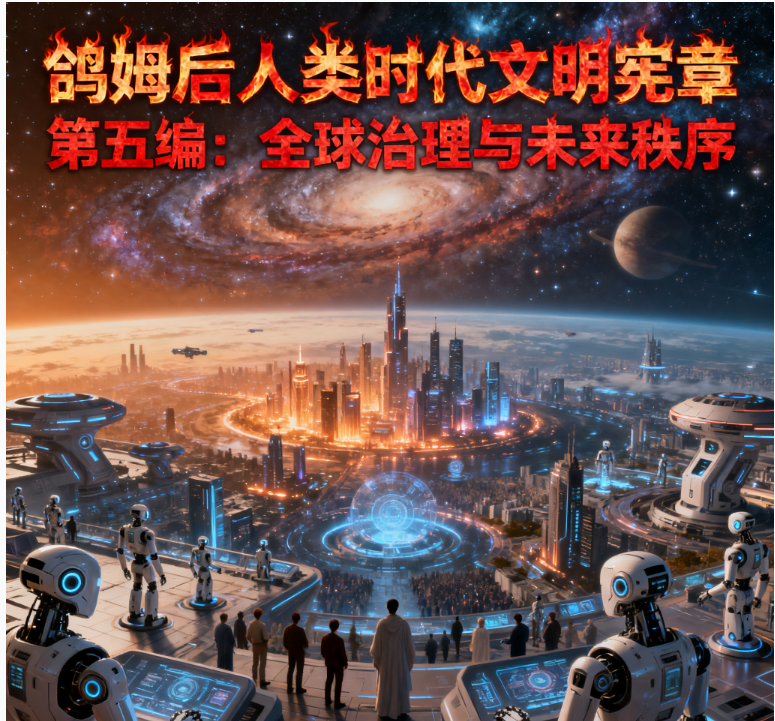
《鸽姆后人类时代文明宪章》(第五篇)
第五编:全球治理与未来秩序
Part V: Global Governance and Future Order
开篇引言
Preface
当人类文明从工业社会、数字社会迈入后人类社会,全球治理的挑战也随之发生了范式跃迁。
传统的国际秩序以 主权国家(nation-state) 为基本单元,以条约、国际法和外交谈判为主要手段;而在后人类时代,治理主体、治理边界、治理工具都被彻底重塑:
-
主体从单一的“国家”扩展到 AI、超个人体、分布式自治组织(DAO);
-
边界从地缘政治的疆域延展到 信息场、认知场、算法场;
-
工具从单一的外交协定升级为 智能合约、链上治理、算法共识、认知对齐协议。
鸽姆智库提出,后人类时代的全球治理必须 超越地缘政治,走向文明政治;必须从资源竞争、军事威慑,跃迁到 智慧共生、文明协同。
这种治理将不再是零和博弈,而是 多维平衡、算法仲裁、认知协调 的复合系统。
**As humanity transitions from the industrial and digital societies into the posthuman era, the challenge of global governance undergoes a paradigm shift.
Traditional international order was built on nation-states as the fundamental actors, treaties and diplomacy as primary tools.
But in the posthuman era, the very actors, boundaries, and instruments of governance are transformed:
-
Actors expand from states to include AI, post-biological entities, distributed autonomous organizations (DAOs);
-
Boundaries stretch from geopolitics into information fields, cognitive domains, and algorithmic networks;
-
Instruments evolve from treaties to smart contracts, on-chain governance, algorithmic consensus, cognitive alignment protocols.
GG3M Think Tank asserts that global governance in the posthuman age must transcend geopolitics and move toward civilizational politics;
It must leap beyond resource competition and military deterrence into co-existence of wisdom and collaborative civilization-building.
Governance will no longer be a zero-sum game but a multi-dimensional equilibrium, algorithmic arbitration, and cognitive coordination system.**
章节结构
Structure of Part V
-
第三十三章:超越国家:文明共同体的重构
Chapter 33: Beyond Nation-States — Reconstructing the Civilizational Community -
第三十四章:认知外交与算法共治
Chapter 34: Cognitive Diplomacy and Algorithmic Co-Governance -
第三十五章:全球智慧教育与普遍赋能
Chapter 35: Global Wisdom Education and Universal Empowerment -
第三十六章:文明冲突与智慧调和
Chapter 36: Civilizational Conflicts and Wisdom Reconciliation -
第三十七章:人类与AI共治的国际法新秩序
Chapter 37: A New International Legal Order for Human-AI Co-Governance
第三十三章
超越国家:文明共同体的重构
Chapter 33: Beyond Nation-States — Reconstructing the Civilizational Community
中文部分
1. 国家体系的极限与后人类挑战
现代国际体系建立在威斯特伐利亚体系的主权国家逻辑之上,以“领土完整、主权平等、互不干涉”为核心原则。这套体系曾经有效地维护了数百年的全球秩序,但在21世纪后,面临前所未有的挑战:
-
地缘边界的模糊化:信息流动、资本流动、算法流动已突破传统疆域,网络空间成为新的治理前线。
-
主体多元化:超国家组织、跨国公司、分布式自治组织(DAO)、AI代理等成为新的国际行动者。
-
风险全局化:气候变化、流行病、网络攻击、AI失控、量子霸权竞争,这些风险无法由单一国家独立应对。
后人类时代的到来,使这些挑战更加深刻:当AI拥有自主学习和决策能力,当脑机接口改变人类的意识与认同,当基因编辑和合成生物学重新定义“人类”的边界,国家已不再是唯一合法的治理单元。
因此,构建一种超越国家的“文明共同体”成为新的时代命题。
2. 文明共同体的哲学基础
文明共同体的重构不是简单的“世界政府”或“统一政权”,而是一个多层级、多中心、协同进化的系统。其哲学基础可以从以下三个维度理解:
-
存在论(Ontology):承认多元智能主体的合法性,不再以“人类”单一视角作为文明核心。
-
认识论(Epistemology):建立跨文化、跨认知的知识共享与共识机制,使不同文明、不同智能形态能够共同演化。
-
价值论(Axiology):以“生命尊严、智能尊严、文明可持续性”为最高原则,而非以单一民族、国家利益为唯一考量。
这种哲学基础要求我们跳出以民族国家为中心的历史叙事,进入“文明为本位”的全球视角。
3. 重构文明共同体的四大支柱
鸽姆智库提出,文明共同体的重构需要四大支柱:
-
认知共识(Cognitive Consensus)
建立人类与AI、地球文明与未来太空文明的共享叙事,形成“文明宪章”,明确共同目标与底线原则。 -
算法宪政(Algorithmic Constitutionalism)
将国际治理规则以智能合约和链上治理的形式固化,确保透明、不可篡改、自动执行,降低人治与腐败风险。 -
分布式权力(Distributed Power)
不再集中于单一国家或超级大国,而是形成多节点的全球治理网络,既有联合国式多边协调,又有区块链式去中心化决策。 -
智慧驱动(Wisdom-Driven Evolution)
将治理升级为“智慧系统”,不仅解决冲突,还能主动发现潜在风险、优化资源分配、引导文明进化方向。
4. 文明共同体的制度设计
为了使文明共同体不流于乌托邦幻想,其制度设计必须具备可操作性。鸽姆智库提出以下三级制度框架:
-
全球宪章层(Global Charter Layer):确立全人类的共同基本法,如禁止星际武器化、保障基本认知自由、确立AI人权等。
-
区域协同层(Regional Collaboration Layer):根据地理、文化、经济共同体建立区域性治理联盟,例如“非洲数字共同体”“亚太认知网络”。
-
分布式节点层(Distributed Node Layer):通过链上投票、DAO自治、AI协商,实现底层的灵活治理与快速响应。
这套制度将保证文明共同体既有顶层设计,又有基层活力,既能应对全球性风险,又能尊重多样性。
5. 超越民族国家的认同重建
要实现文明共同体,必须解决一个关键问题:认同。传统认同基于血缘、土地、语言,而后人类时代需要新的认同结构:
-
地球人认同(Planetary Identity):以地球为家园,超越民族与种族的分裂。
-
文明认同(Civilizational Identity):以共享知识、价值、技术为纽带,形成跨文化的“文明族群”。
-
智能共同体认同(Intelligent Community Identity):人类、AI、合成生命体共同参与治理,形成“混合文明”。
这种认同的重建,是文明共同体的情感与精神基础。
6. 风险与防御机制
任何超国家体系都可能面临两大风险:
-
中心化失控:如果权力集中于某个AI系统或超级联盟,可能形成数字霸权。
-
碎片化失序:如果缺乏统一的协议,各个节点可能各行其是,导致全球性协作失效。
鸽姆智库提出通过“认知免疫系统”和“制度冗余”来解决上述风险:
-
认知免疫系统:实时监测全球叙事与信息流,防止极端思想或错误算法扩散。
-
制度冗余:设计多重制衡与备份机制,即便某个治理节点被攻破,整体体系仍能维持稳定。
7. 迈向星际文明的桥梁
文明共同体不仅解决地球问题,更是星际扩展的桥梁。当人类迈向太空,面对新的行星、生态与智能生命,必须以文明共同体的规则为基础,避免重演地球上的殖民冲突与资源战争。
English Part
1. Limits of the Nation-State System and Posthuman Challenges
The Westphalian nation-state system, built on sovereignty and territorial integrity, has effectively maintained order for centuries. Yet, in the 21st century, it faces structural challenges: blurred borders due to data flows, emergence of new actors such as DAOs and AI agents, and truly global risks such as climate change, pandemics, cyber warfare, and uncontrolled AI development.
In the posthuman era, these challenges deepen: AI becomes autonomous, brain–machine interfaces alter identity, and genetic engineering redefines what it means to be human. Nation-states are no longer the only legitimate units of governance.
Thus, constructing a civilizational community beyond nation-states becomes a historic necessity.
2. Philosophical Foundation of the Civilizational Community
This is not about creating a “world government,” but a polycentric, multi-layered, co-evolving system. Its foundation rests on:
-
Ontology: Legitimacy of multiple intelligent entities, not just human.
-
Epistemology: Knowledge sharing and consensus across cultures and cognitive species.
-
Axiology: Primacy of life dignity, intelligence dignity, and civilizational sustai
 最低0.47元/天 解锁文章






 扫一扫
扫一扫


 1442
1442

 被折叠的 条评论
为什么被折叠?
被折叠的 条评论
为什么被折叠?
 到【灌水乐园】发言





