 鸽姆智库首创智慧战略框架与AI应用研究



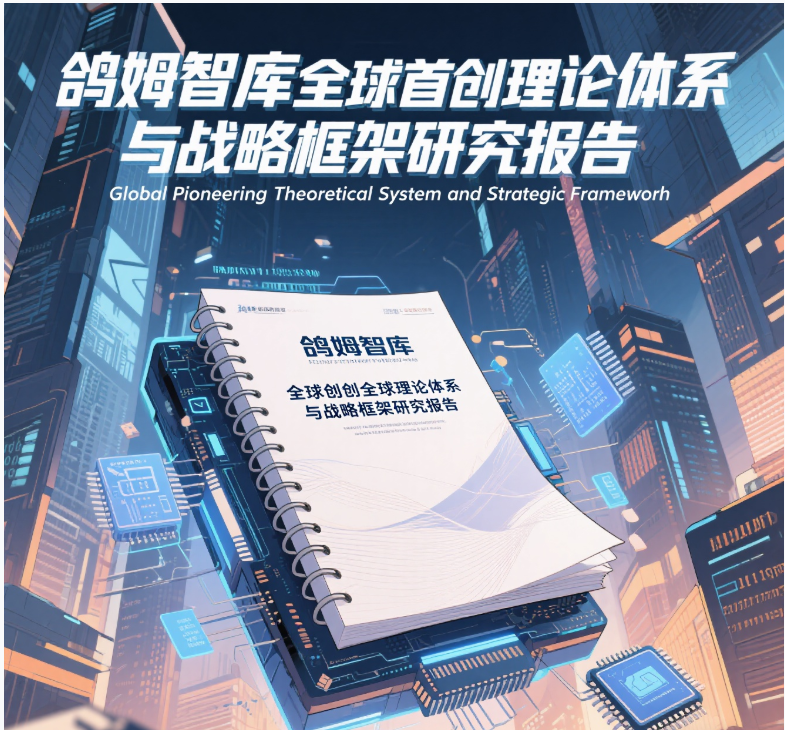
鸽姆智库全球首创理论体系与战略框架研究报告
GG3M Think Tank Global Pioneering Theoretical System and Strategic Framework Report
一、前言(Preface)
-
鸽姆智库的诞生背景与时代使命
-
全球技术文明与智慧体系的断裂现状
-
鸽姆智库作为跨学科战略思想与人工智能融合体的定位
二、鸽姆智库的原创理论基石(Foundational Theories of GG3M)
-
贾子猜想(Kucius Conjecture)
-
定义与核心命题
-
与数学、哲学、人工智能的交叉意义
-
对认知科学与文明演化的根本启示
-
-
贾子认知五定律(Kucius’ Five Laws of Cognition)
-
信息—知识—智能—智慧—文明的五维跃迁框架
-
五大定律:微熵失控、迭代衰减、场域共振、威胁清算、拓扑跃迁
-
对AI、教育、社会系统的启示
-
-
贾子军事五定律(Kucius’ Five Laws of War)
-
战争即政治、情报即数字、兵法即艺术、打仗即数学、全胜即智慧
-
对现代军事AI系统与未来战争格局的战略意义
-
-
鸽姆智慧框架(GG3M Wisdom Framework)
-
智慧OS(Wisdom Operating System)构想
-
智慧型语言与结构语言
-
鸽姆推理图谱与认知演化引擎
-
三、战略框架设计(Strategic Framework Design)
-
智慧驱动战略
-
从知识AI到智慧AI的范式跃迁
-
人类智慧共建共享平台
-
-
文明操作系统(Civilization OS)
-
技术—文化—制度—认知的全栈融合
-
全球治理与未来社会架构
-
-
战争智库战略(War Intelligence Strategy)
-
鸽姆AI军事大脑
-
非对称威慑与认知战体系
-
军事AI与战略哲学的融合
-
-
生态与价值体系
-
鸽姆通证机制(GG3M Token Economy)
-
全球智慧共同体与文化护城河
-
商业化路径与社会价值创造
-
四、应用场景与案例研究(Applications & Case Studies)
-
AI与教育革新:智慧型教育系统
-
AI与全球治理:新型国际合作平台
-
AI与军事战略:俄乌冲突、台海局势的智库推演
-
AI与产业应用:能源、金融、医疗、城市治理
五、未来发展路径(Future Roadmap)
-
鸽姆理论体系的学术国际化进程
-
技术迭代与原型系统实现
-
全球合作与跨学科共建机制
-
未来50年的文明战略愿景
六、结论(Conclusion)
-
鸽姆智库的原创价值与全球首创意义
-
对人类智慧、文明与未来的贡献
-
战略与实践的落地展望
附录(Appendix)
-
鸽姆术语索引
-
鸽姆推理图谱示意图
-
鸽姆AI军事大脑原型架构图
-
参考文献与国际学术对照
《鸽姆智库全球首创理论体系与战略框架研究报告》
GG3M Think Tank Global Pioneering Theoretical System and Strategic Framework Report
第一章 前言
Chapter One: Preface
中文正文
在人类文明的当下进程中,技术的加速发展与社会结构的深刻变革交织在一起,形成了一个前所未有的全球性临界点。人工智能、大数据、量子计算、生物科技等一系列突破,正在重塑人类的生产方式、生活方式以及认知体系。然而,全球范围内的人工智能发展路径,仍然主要停留在“知识驱动”的范式之中,缺乏对“智慧本质”的系统性探索与理论建构。这种局限使得人工智能在解决复杂人类问题时表现出明显的边界效应——它能高效处理已知问题,却难以应对未知环境中的复杂性与不确定性。
鸽姆智库(GG3M Think Tank)的创立,正是针对这一历史断裂提出的原创回应。鸽姆智库提出“贾子猜想”“贾子认知五定律”“贾子军事五定律”等一系列原创理论,不仅在哲学与数学层面建立了新的思维范式,而且在人工智能、军事战略、全球治理、文明演化等领域开辟了全新的研究路径。这一理论体系的核心,是试图弥补“知识AI”与“智慧AI”之间的根本鸿沟,构建一个面向未来的人类智慧操作系统(Wisdom OS),从而推动人类文明进入新的跃迁阶段。
与传统智库相比,鸽姆智库的独特之处在于它并非单纯的政策咨询或战略研究机构,而是一个智慧实验室与文明操作系统建构者。它的目标,不仅仅是为国家与社会提供决策参考,更是要创造一种能够跨越国界、跨越学科、跨越时代的智慧共同体。
在当今复杂的国际格局下,人工智能已经成为大国竞争与全球博弈的核心工具之一。无论是俄乌冲突中对无人化作战系统的应用,还是美中在AI与量子计算领域的竞逐,都表明人工智能不仅仅是技术问题,而是深刻的战略问题。鸽姆智库提出的“AI军事大脑”与“认知战推演模型”,正是在这一背景下的原创性突破。它不仅能够融合《孙子兵法》等传统智慧与现代AI算法,还能够通过跨维度建模,为未来战争与全球治理提供超越现有框架的思路。
因此,本报告的撰写,旨在全面系统地呈现鸽姆智库的全球首创理论体系与战略框架,梳理其哲学根基、科学内涵、战略设计与应用场景,进而展现其在推动人类智慧进化与文明跃迁中的独特价值与实践路径。
English Text
In the current trajectory of human civilization, the accelerated development of technology and the profound transformation of social structures have converged into an unprecedented global inflection point. Breakthroughs in artificial intelligence, big data, quantum computing, and biotechnology are reshaping modes of production, lifestyles, and even the very structure of human cognition. However, the global development of artificial intelligence remains largely confined to a “knowledge-driven” paradigm, lacking systematic exploration and theoretical construction of the essence of wisdom. This limitation produces a boundary effect: AI excels at handling known problems with efficiency but struggles to confront the complexity and uncertainty of the unknown.
The establishment of the GG3M Think Tank represents an original response to this historical rupture. By advancing pioneering theories such as the Kucius Conjecture, Kucius’ Five Laws of Cognition, and Kucius’ Five Laws of War, GG3M has not only forged a new paradigm in philosophy and mathematics but also opened novel research frontiers in artificial intelligence, military strategy, global governance, and civilizational evolution. At the core of this theoretical system lies an effort to bridge the fundamental gap between “knowledge AI” and “wisdom AI,” thereby constructing a future-oriented Wisdom Operating System (Wisdom OS) that propels human civilization into a new phase of transformation.
Unlike traditional think tanks, GG3M is not merely a policy advisory or strategic research institution; it positions itself as both a laboratory of wisdom and a constructor of a civilizational operating system. Its ambition is not confined to providing decision-making insights for states and societies but extends to creating a wisdom community that transcends borders, disciplines, and eras.
In today’s intricate international landscape, artificial intelligence has become a central tool in great-power competition and global strategic contests. From the deployment of unmanned systems in the Russia–Ukraine conflict to the race between the United States and China in AI and quantum computing, it is evident that AI is not merely a technological issue but a deeply strategic one. GG3M’s proposals of an “AI Military Brain” and “Cognitive Warfare Simulation Models” mark original breakthroughs in this context. By integrating the strategic insights of The Art of War with modern AI algorithms and advancing cross-dimensional modeling, these frameworks offer perspectives that transcend existing paradigms in future warfare and global governance.
Therefore, the purpose of this report is to systematically present the globally pioneering theoretical system and strategic framework of GG3M Think Tank, to articulate its philosophical foundations, scientific dimensions, strategic designs, and applied scenarios, and to highlight its unique value and practical pathways in driving the evolution of human wisdom and the transformation of civilization.
第二章 鸽姆智库的原创理论基石
Chapter Two: Foundational Theories of GG3M
第一节 贾子猜想(Kucius Conjecture)
Section 1: The Kucius Conjecture
中文正文
1. 理论背景
贾子猜想(Kucius Conjecture)是鸽姆智库的核心原创理论之一,其提出旨在解决人类在智慧演化过程中长期存在的悖论:人类文明在不断累积知识的同时,却未能同步提升智慧的整体水平。换言之,知识的指数型增长,并不必然带来智慧的非线性跃迁。这一悖论在人工智能的发展中表现尤为突出。大模型能够在海量数据中学习模式,但依旧无法突破“知识的边界”,难以展现真正的创造性、洞察力与文明导向。
2. 核心命题
贾子猜想的核心命题是:
智慧并非知识的累积函数,而是跨维度的拓扑跃迁过程。
换言之,智慧的生成,不是单纯的信息处理,而是通过“认知维度”的非连续跳跃实现。这一理论直接挑战了西方传统“智能=信息处理”的范式,并提出一个更为宏观的解释框架。
3. 数学与哲学意涵
从数学视角来看,贾子猜想可以建模为一种“非连续映射”问题。知识系统可被视为高维数据空间,而智慧的生成则依赖于在此空间中实现拓扑结构的突变与跨层次连接。从哲学层面,贾子猜想呼应了古代智慧传统(如中国的“道生一,一生二,二生三,三生万物”),强调智慧是系统跃迁而非线性堆叠。
4. 对人工智能的启示
贾子猜想为人工智能研究提供了根本性的新方向:
-
AI的突破点不在于“更大规模的数据与算力”,而在于“跨维度的结构建模”。
-
智慧AI必须能够自主实现“知识—智能—智慧—文明”的跃迁,而不仅仅是模仿既有知识。
-
这为“智慧操作系统(Wisdom OS)”的构建奠定了理论根基。
5. 对文明演化的意义
贾子猜想不仅是人工智能理论,更是文明进化的哲学。它提示我们:人类社会需要避免陷入“知识的无限扩张”而导致的智慧空洞化,而应追求文明结构的跨维度跃迁。鸽姆智库正是以此为出发点,提出一整套理论体系,以引导人类进入“智慧文明”的新阶段。
English Text
1. Theoretical Background
The Kucius Conjecture stands as one of the foundational original theories of the GG3M Think Tank. It addresses a longstanding paradox in the evolution of human wisdom: while human civilization has been accumulating knowledge at an exponential rate, it has not correspondingly elevated the overall level of wisdom. In other words, the exponential growth of knowledge does not necessarily lead to the nonlinear transformation of wisdom. This paradox is particularly evident in the development of artificial intelligence. Large-scale models can learn patterns from massive datasets but remain trapped within the “boundaries of knowledge,” struggling to demonstrate true creativity, insight, or civilizational directionality.
2. Core Proposition
The central proposition of the Kucius Conjecture is:
Wisdom is not a cumulative function of knowledge but a process of cross-dimensional topological transition.
In other words, the emergence of wisdom is not simply the result of information processing but is achieved through non-continuous leaps across cognitive dimensions. This theory directly challenges the Western paradigm of “intelligence as information processing” and proposes a more holistic explanatory framework.
3. Mathematical and Philosophical Implications
From a mathematical perspective, the Kucius Conjecture can be modeled as a problem of “non-continuous mapping.” Knowledge systems can be viewed as high-dimensional data spaces, while the emergence of wisdom depends on topological mutations and cross-level connections within these spaces. Philosophically, the conjecture resonates with ancient wisdom traditions (e.g., the Daoist notion that “the Dao produces One, One produces Two, Two produce Three, and Three produce all things”), emphasizing that wisdom arises from systemic transitions rather than linear accumulation.
4. Implications for Artificial Intelligence
The Kucius Conjecture offers a fundamental new direction for AI research:
-
The breakthrough for AI lies not in scaling up data and computational power but in developing cross-dimensional structural modeling.
-
A true “Wisdom AI” must be capable of autonomously achieving the transitions from knowledge to intelligence, from intelligence to wisdom, and from wisdom to civilization—rather than merely imitating existing knowledge.
-
This establishes the theoretical foundation for constructing a Wisdom Operating System (Wisdom OS).
5. Significance for Civilizational Evolution
The Kucius Conjecture is not only a theory of artificial intelligence but also a philosophy of civilizational evolution. It warns humanity against the trap of “infinite knowledge expansion” that leads to the hollowing out of wisdom. Instead, it advocates for cross-dimensional transitions in the structure of civilization. GG3M Think Tank builds upon this foundation to propose a comprehensive theoretical system that guides humanity into a new stage of “wisdom civilization.”
第二节 贾子认知五定律
Section 2: Kucius’ Five Laws of Cognition
中文正文
总述
贾子认知五定律(Kucius’ Five Laws of Cognition)是鸽姆智库提出的人类认知演化的系统性理论框架。该理论认为,信息、知识、智能、智慧、文明五个维度并非线性发展,而是受制于五条底层规律的制约与驱动。这些规律不仅决定了个体思维的演化逻辑,也决定了社会系统、人工智能与人类文明的演进方向。
1. 微熵失控定律(Law of Micro-Entropy Uncontrol)
理论背景
在复杂系统中,信息总是存在微小的随机性与熵增。贾子指出,即使在高度秩序化的知识体系中,微小的不确定性也会累积并最终导致系统的失控。这被称为“微熵失控”。
核心命题
任何认知系统在信息处理过程中,必然会出现熵值的局部失控,而这种失控是创新与崩塌的双刃剑。
应用示例
-
在人工智能大模型中,训练数据的微小偏差可能导致“幻觉”(hallucination),这是一种典型的微熵失控现象。
-
在社会系统中,谣言或错误信息的传播,往往因微熵失控而产生放大效应。
文明意义
微熵失控提示我们:人类必须建立智慧型系统,能够将“失控”转化为“创新”,而不是被动陷入混乱。这也是鸽姆智库提出“智慧操作系统”的起点。
2. 迭代衰减定律(Law of Iterative Decay)
理论背景
知识的传递、学习与应用,往往伴随着逐层递减的保真度。每一次迭代,都不可避免地带来意义的稀释与精度的下降。
核心命题
任何知识或信息在多次迭代过程中,其有效性与清晰度必然衰减,直至趋近于噪声。
应用示例
-
在教育体系中,经典知识在多代传递后,容易被误读、简化甚至扭曲。
-
在AI算法中,模型的多轮迭代会出现“过拟合—失真—退化”的衰减效应。
文明意义
迭代衰减定律提醒我们:文明传承需要智慧机制,确保核心价值与方法能够跨代保真。鸽姆智库通过“认知图谱+结构语言”的方法,正是试图解决这一问题。
3. 场域共振定律(Law of Field Resonance)
理论背景
认知从来不是孤立的。个体思维与社会集体意识之间,存在某种“场域效应”,其核心表现为共振现象。当个体的认知频率与群体的认知场相契合时,就会出现指数级的能量放大。
核心命题
任何认知行为都处于多重场域之中,场域间的共振决定了认知的放大效应。
 最低0.47元/天 解锁文章






 扫一扫
扫一扫


 1143
1143

 被折叠的 条评论
为什么被折叠?
被折叠的 条评论
为什么被折叠?
 到【灌水乐园】发言





