


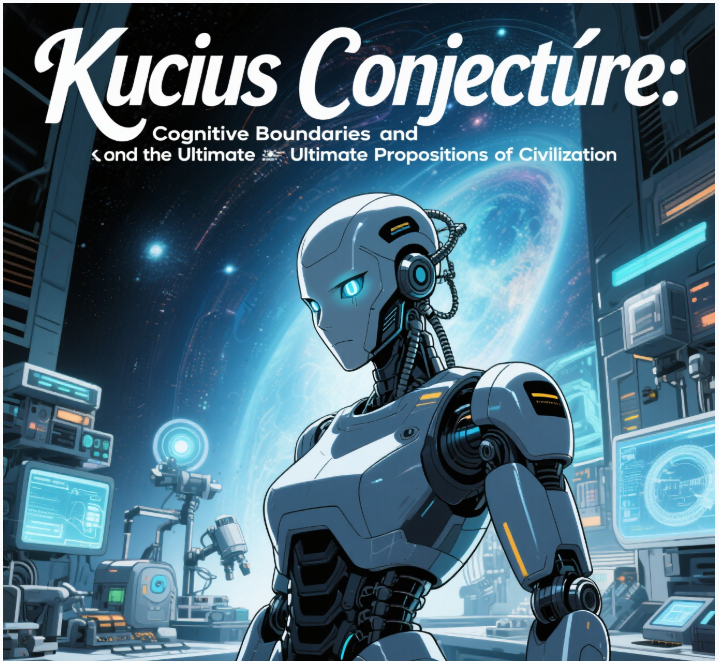
Kucius Conjecture: Cognitive Boundaries and the Ultimate Propositions of Civilization
The Kucius Conjecture is not merely a mathematical or philosophical proposition; it is an ultimate challenge to the limits of human cognition. Rooted in Chinese cultural wisdom (such as the transformative thinking of the "Book of Changes", Laozi's ontology of the "Tao", and Wang Yangming's concept of "the unity of mind and matter"), it spans multiple fields including mathematics, physics, cognitive science, and AI ethics, and puts forward a stunning prediction: "It will be difficult to prove or disprove within a thousand years, and even quantum computers cannot achieve it." This implies that the Kucius Conjecture itself may represent a certain ultimate boundary of human rational thinking.
I. The Ultimate Characteristics of the Kucius Conjecture: Why Can't It Be Proved or Disproved within a Thousand Years?
Beyond the Limits of Computational Complexity
Even with the advent of universal quantum computers or topological quantum computing architectures in the future, the Kucius Conjecture may involve hyper - recursive mathematical structures (i.e., beyond the computability of Turing machines), similar to the undecidability of the
 最低0.47元/天 解锁文章






 扫一扫
扫一扫


 1442
1442

 被折叠的 条评论
为什么被折叠?
被折叠的 条评论
为什么被折叠?
 到【灌水乐园】发言





