


顺序表去重
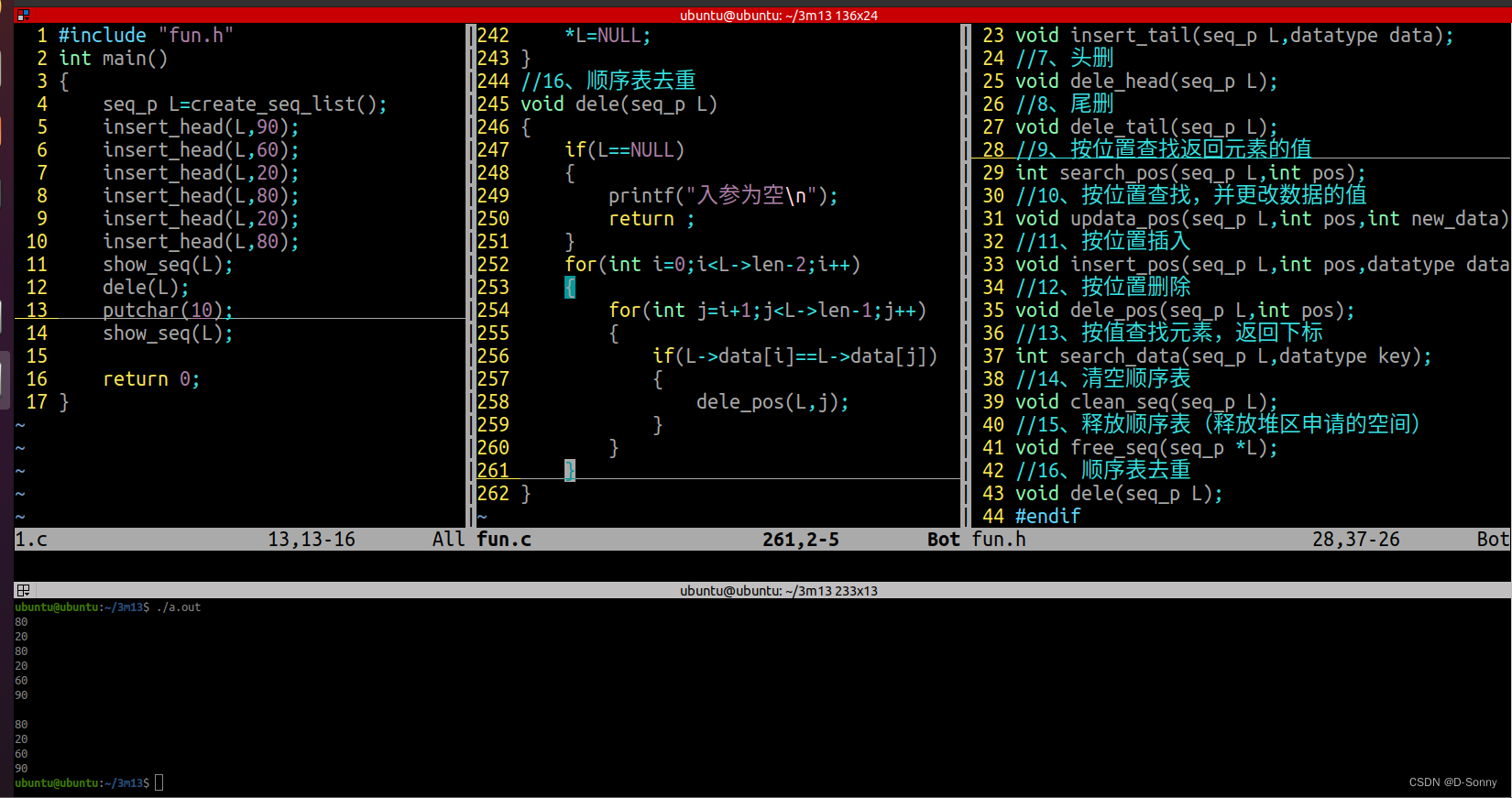
链表创建、结点创建、单向链表的头插
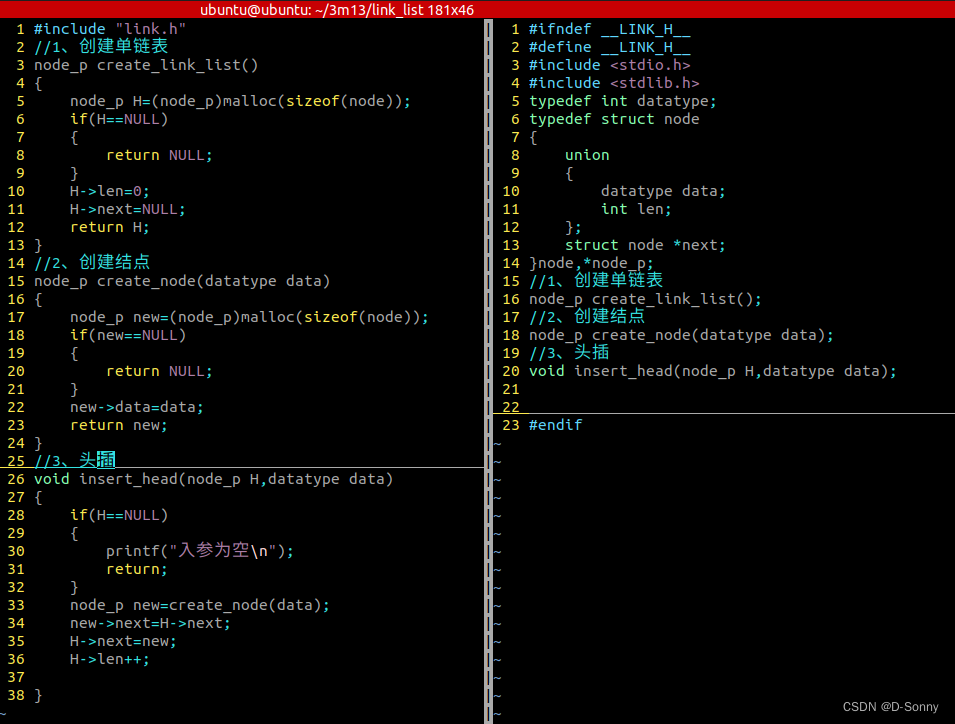
#ifndef __FUN_H__
#define __FUN_H__
#include <stdio.h>
#include <stdlib.h>
#define MAX 7
typedef int datatype;
typedef struct
{
	datatype data[MAX];
	int len;
}seq_list,*seq_p;
//1、在堆区申请顺序表的空间
seq_p create_seq_list();
//2、判空
int empty_seq(seq_p L);
//3、判满
int full_seq(seq_p L);
//4、头插
void insert_head(seq_p L,datatype data);
//5、输出
void show_seq(seq_p L);
//6、尾插
void insert_tail(seq_p L,datatype data);
//7、头删
void dele_head(seq_p L);
//8、尾删
void dele_tail(seq_p L);
//9、按位置查找返回元素的值
int search_pos(seq_p L,int pos);
//10、按位置查找,并更改数据的值
void updata_pos(seq_p L,int pos,int new_data);
//11、按位置插入
void insert_pos(seq_p L,int pos,datatype data);
//12、按位置删除
void dele_pos(seq_p L,int pos);
//13、按值查找元素,返回下标
int search_data(seq_p L,datatype key);
//14、清空顺序表
void clean_seq(seq_p L);
//15、释放顺序表(释放堆区申请的空间)
void free_seq(seq_p *L);
//16、顺序表去重
void dele(seq_p L);
#endif
#include "fun.h"
int main()
{
	seq_p L=create_seq_list();
	insert_head(L,90);
	insert_head(L,60);
	insert_head(L,20);
	insert_head(L,80);
	insert_head(L,20);
	insert_head(L,80);
	show_seq(L);
	dele(L);
	putchar(10);
	show_seq(L);

	return 0;
}
#include "fun.h"
//1、在堆区申请顺序表的空间
seq_p create_seq_list()
{
	seq_p L = (seq_p)malloc(sizeof(seq_list));
	if(L==NULL)
	{
		printf("空间申请失败\n");
		return NULL;
	}
	L->len=0;
	return L;
}
//2、判空
int empty_seq(seq_p L)
{
	if(L==NULL)
	{
		printf("入参为空\n");
		return -1;

	}
	return L->len ==0? 1:0;

}
//3、判满
int full_seq(seq_p L)
{
	if(L==NULL)
	{
		printf("表已满,请检查\n");
		return -1;

	}
	return L->len ==MAX? 1:0;

}
//4、头插
void insert_head(seq_p L,datatype data)
{
	if(L==NULL)
	{
		printf("入参为空,请检查\n");
		return ;

	}
	if(full_seq(L))
	{
		printf("表已满,不能插入\n");
		return;

	}
	for(int i=L->len-1;i>=0;i--)
	{
		L->data[i+1]=L->data[i];

	}
	L->data[0]=data;
	L->len++;

}
//5、输出
void show_seq(seq_p L)
{
	if(L==NULL)
	{
		printf("入参为空\n");
		return;
	}
	for (int i=0;i<L->len;i++)
	{
		printf("%d\n",L->data[i]);
	}
}
//6、尾插
void insert_tail(seq_p L,datatype data)
{
	if(L==NULL)
	{
		printf("入参为空\n");
		return;
	}
	if(full_seq (L))
	{
		printf("表已满\n");
		return;
	}
	L->data[L->len]=data;
	L->len++;
}

//7、头删
void dele_head(seq_p L)
{
	if(L==NULL)
	{
		printf("入参为空\n");
		return;
	}
	for(int i=1;i<L->len;i++)
	{
		L->data[i-1]=L->data[i];
	}
	L->len--;
}
//8、尾删
void dele_tail(seq_p L)
{
	if(L==NULL)
	{
		printf("入参为空\n");
		return;
	}
	if(empty_seq (L))
	{
		printf("表为空,不需要尾删\n");
		return;
	}
	L->len--;
}
//9、按位置查找返回元素的值
int search_pos(seq_p L,int pos)
{
	if(L==NULL)
	{
		printf("入参为空\n");
		return -1;
	}
	if(pos<0||pos>L->len-1)
	{
		printf("位置不合理,重新输入\n");
		return 0;
	}

	printf("%d\n",L->data[pos]);
	return L->data[pos];
}
//10、按位置查找,并更改数据的值
void updata_pos(seq_p L,int pos,int new_data)
{
	if(L==NULL)
	{
		printf("入参为空\n");
		return;
	}
	if(pos<0||pos>L->len-1)
	{
		printf("位置不合理,重新输入\n");
		return;
	}
	L->data[pos]=new_data;
}
//11、按位置插入
void insert_pos(seq_p L,int pos,datatype data)
{
	if(L==NULL)
	{
		printf("入参为空\n");
		return;
	}
	if(full_seq(L))
	{
		printf("表已满\n");
		return;
	}
	if(pos<0||pos>L->len)
	{
		printf("位置不合理,重新输入\n");
		return;
	}
	for(int i=L->len-1;i>pos-1;i--)
	{
		L->data[i+1]=L->data[i];

	}
	L->len++;
	L->data[pos]=data;
}
//12、按位置删除
void dele_pos(seq_p L,int pos)
{
	if(L==NULL)
	{
		printf("入参为空\n");
		return ;
	}
	if(pos<0||pos>L->len-1)
	{
		printf("位置不合理,重新输入\n");
		return;
	}
	for(int i=pos+1;i<=L->len-1;i++)
	{
		L->data[i-1]=L->data[i];

	}
	L->len--;
/*	for(int i=pos;i<L->len-1;i++)
	{
		L->data[i]=L->data[i+1];

	}
	L->len--;*/
}
//13、按值查找元素,返回下标
int search_data(seq_p L,datatype key)
{
	if(L==NULL)
	{
		printf("入参为空\n");
		return -1;
	}
	for(int i=0;i<L->len;i++)
	{
		if(key==L->data[i])
		{
			return i;
		}
	}
	printf("没有该值,请检查\n");
}
//14、清空顺序表
void clean_seq(seq_p L)
{
	if(L==NULL)
	{
		printf("入参为空\n");
		return;
	}
	L->len=0;
}
//15、释放顺序表(释放堆区申请的空间)
void free_seq(seq_p *L)
{
	if(L==NULL||*L==NULL)
	{
		printf("入参为空,请检查\n");
		return;
	}
	clean_seq(*L);
	free(*L);
	*L=NULL;
}
//16、顺序表去重
void dele(seq_p L)
{
	if(L==NULL)
	{
		printf("入参为空\n");
		return ;
	}
	for(int i=0;i<L->len-2;i++)
	{
		for(int j=i+1;j<L->len-1;j++)
		{
			if(L->data[i]==L->data[j])
			{
				dele_pos(L,j);
			}
		}
	}
}





 扫一扫
扫一扫


 3632
3632

 被折叠的 条评论
为什么被折叠?
被折叠的 条评论
为什么被折叠?
 到【灌水乐园】发言





