


最简单的基于 FFmpeg 的音视频转码器(FLV 转 AVI)
参考雷霄骅博士的文章,链接:最简单的基于FFMPEG的转码程序
正文
本文介绍一个简单的基于 FFmpeg 的转码器。它可以将一种视频格式(包括封转格式和编码格式)转换为另一种视频格式。转码器在视音频编解码处理的程序中,属于一个比较复杂的东西。因为它结合了视频的解码和编码。一个视频播放器,一般只包含解码功能;一个视频编码工具,一般只包含编码功能;而一个视频转码器,则需要先对视频进行解码,然后再对视频进行编码,因而相当于解码器和编码器的结合。
下图例举了一个视频的转码流程。输入视频的封装格式是 FLV,视频编码标准是 H.264,音频编码标准是 AAC;输出视频的封装格式是 AVI,视频编码标准是 MPEG2,音频编码标准是 MP3。从流程中可以看出,首先从输入视频中分离出视频码流和音频压缩码流,然后分别将视频码流和音频码流进行解码,获取到非压缩的像素数据/音频采样数据,接着将非压缩的像素数据/音频采样数据重新进行编码,获得重新编码后的视频码流和音频码流,最后将视频码流和音频码流重新封装成一个文件。
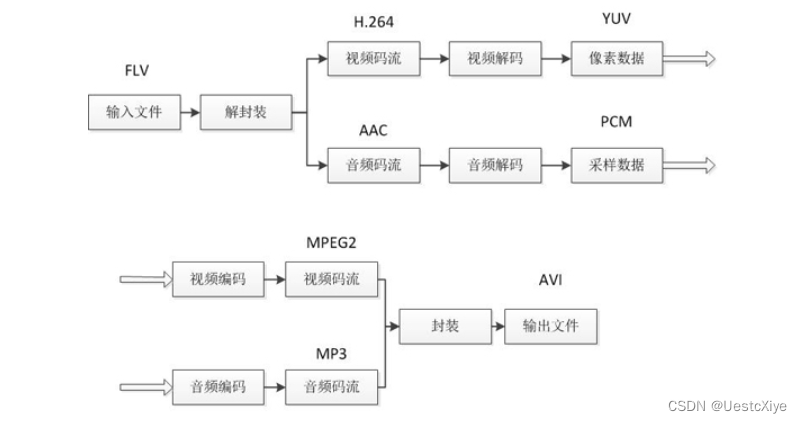
本文介绍的视频转码器正是使用 FFmpeg 类库从编程的角度实现了上述流程。该例子是从 FFmpeg 的例子改编的,平台是 VC2015,类库版本是 2014.5.6。
流程图
下面附两张使用 FFmpeg 转码视频的流程图。图中使用浅绿色标出了视频的编码、解码函数。
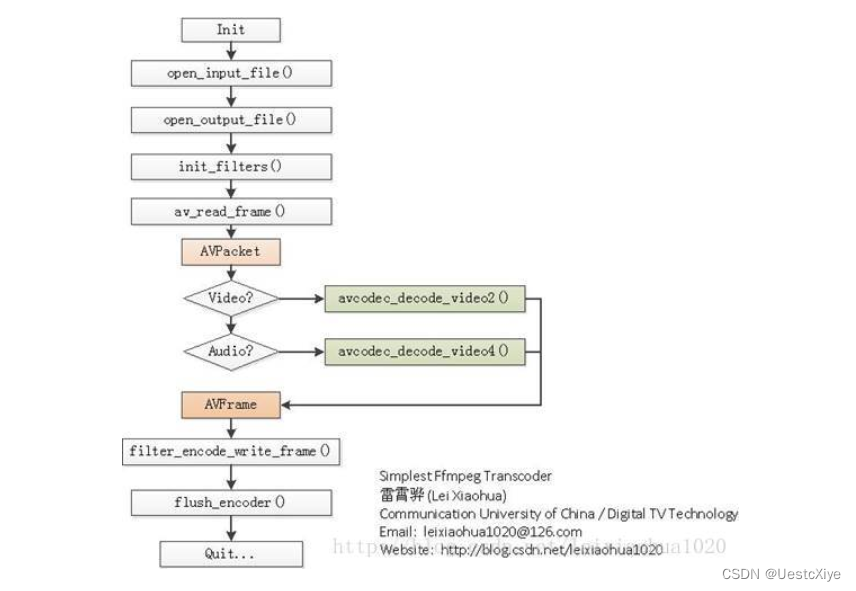
简单介绍一下流程中各个函数的意义:
- open_input_file():打开输入文件,并初始化相关的结构体。
- open_output_file():打开输出文件,并初始化相关的结构体。
- init_filters():初始化 AVFilter 相关的结构体。
- av_read_frame():从输入文件中读取一个 AVPacket。
- avcodec_decode_video2():解码一个视频 AVPacket(存储 H.264 等压缩码流数据)为 AVFrame(存储 YUV 等非压缩的像素数据)。
- avcodec_decode_audio4():解码一个音频 AVPacket(存储 MP3 等压缩码流数据)为 AVFrame(存储 PCM 采样数据)。
- filter_encode_write_frame():编码一个 AVFrame。
- flush_encoder():输入文件读取完毕后,输出编码器中剩余的 AVPacket。
以上函数中 open_input_file(),open_output_file(),init_filters() 中的函数在其他文章中都有所叙述,在这里不再重复:
open_input_file() 可参考:100行代码实现最简单的基于FFMPEG+SDL的视频播放器(SDL1.x)
open_output_file() 可参考:最简单的基于FFMPEG的视频编码器(YUV编码为H.264)
init_filters()可参考:最简单的基于FFmpeg的AVfilter例子(水印叠加)
在这里介绍一下其中编码的函数 filter_encode_write_frame()。filter_encode_write_frame() 函数的流程如下图所示,它完成了视频/音频的编码功能。
PS:视频和音频的编码流程中除了编码函数 avcodec_encode_video2() 和 avcodec_encode_audio2() 不一样之外,其他部分几乎完全一样。
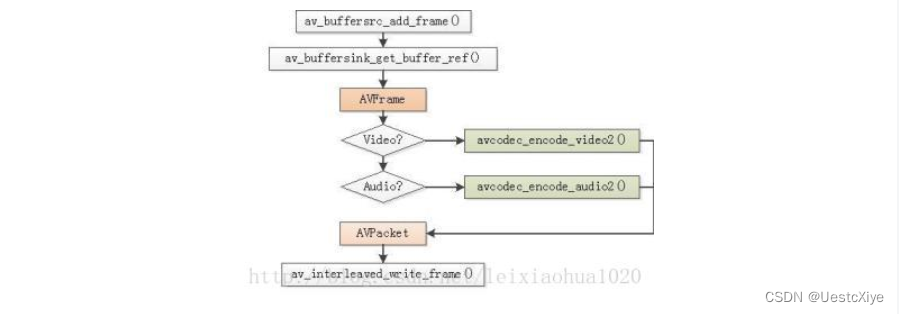
简单介绍一下 filter_encode_write_frame() 中各个函数的意义:
-
av_buffersrc_add_frame():将解码后的 AVFrame 加入 Filtergraph。
-
av_buffersink_get_buffer_ref():从 Filtergraph 中取一个 AVFrame。
-
avcodec_encode_video2():编码一个视频 AVFrame 为 AVPacket。
-
avcodec_encode_audio2():编码一个音频 AVFrame 为 AVPacket。
-
av_interleaved_write_frame():将编码后的 AVPacket 写入文件。
源程序
// Simplest FFmpeg Transcoder.cpp : 定义控制台应用程序的入口点。
//

/**
* 最简单的基于 FFmpeg 的转码器
* Simplest FFmpeg Transcoder
*
* 源程序:
* 雷霄骅 Lei Xiaohua
* leixiaohua1020@126.com
* 中国传媒大学/数字电视技术
* Communication University of China / Digital TV Technology
* http://blog.youkuaiyun.com/leixiaohua1020
*
* 修改:
* 刘文晨 Liu Wenchen
* 812288728@qq.com
* 电子科技大学/电子信息
* University of Electronic Science and Technology of China / Electronic and Information Science
* https://blog.youkuaiyun.com/ProgramNovice
*
* 本程序实现了视频格式之间的转换。
* 是一个最简单的视频转码程序。
*/

#include "stdafx.h"

#include <stdio.h>
#include <stdlib.h>

// 解决报错:'fopen': This function or variable may be unsafe.Consider using fopen_s instead.
#pragma warning(disable:4996)

// 解决报错:无法解析的外部符号 __imp__fprintf,该符号在函数 _ShowError 中被引用
#pragma comment(lib, "legacy_stdio_definitions.lib")
extern "C"
{
	// 解决报错:无法解析的外部符号 __imp____iob_func,该符号在函数 _ShowError 中被引用
	FILE __iob_func[3] = { *stdin, *stdout, *stderr };
}

#define __STDC_CONSTANT_MACROS

#ifdef _WIN32
// Windows
extern "C"
{
#include "libavcodec/avcodec.h"
#include "libavformat/avformat.h"
#include "libavfilter/avfiltergraph.h"
#include "libavfilter/avcodec.h"
#include "libavfilter/buffersink.h"
#include "libavfilter/buffersrc.h"
#include "libavutil/avutil.h"
#include "libavutil/opt.h"
#include "libavutil/pixdesc.h"
};
#else
// Linux...
#ifdef __cplusplus
extern "C"
{
#endif
#include <libavcodec/avcodec.h>
#include <libavformat/avformat.h>
#include <libavfilter/avfiltergraph.h>
#include <libavfilter/avcodec.h>
#include <libavfilter/buffersink.h>
#include <libavfilter/buffersrc.h>
#include <libavutil/avutil.h>
#include <libavutil/opt.h>
#include <libavutil/pixdesc.h>
#ifdef __cplusplus
};
#endif
#endif

static AVFormatContext *ifmt_ctx;
static AVFormatContext *ofmt_ctx;

typedef struct FilteringContext
{
	AVFilterContext *buffersrc_ctx;
	AVFilterContext *buffersink_ctx;
	AVFilterGraph *filter_graph;
} FilteringContext;

static FilteringContext *filter_ctx;

static int open_input_file(const char *filename)
{
	int ret;
	unsigned int i;
	ifmt_ctx = NULL;

	ret = avformat_open_input(&ifmt_ctx, filename, NULL, NULL);
	if (ret < 0)
	{
		av_log(NULL, AV_LOG_ERROR, "Can't openinput file.\n");
		return ret;
	}

	ret = avformat_find_stream_info(ifmt_ctx, NULL);
	if (ret < 0)
	{
		av_log(NULL, AV_LOG_ERROR, "Can't find stream information.\n");
		return ret;
	}
	for (i = 0; i < ifmt_ctx->nb_streams; i++)
	{
		AVStream*stream;
		AVCodecContext *codec_ctx;

		stream = ifmt_ctx->streams[i];
		codec_ctx = stream->codec;
		// Reencode video & audio and remux subtitles etc
		if (codec_ctx->codec_type == AVMEDIA_TYPE_VIDEO
			|| codec_ctx->codec_type == AVMEDIA_TYPE_AUDIO)
		{
			// Open decoder
			ret = avcodec_open2(codec_ctx,
				avcodec_find_decoder(codec_ctx->codec_id), NULL);
			if (ret < 0)
			{
				av_log(NULL, AV_LOG_ERROR, "Failed to open decoder for stream #%u.\n", i);
				return ret;
			}
		}
	}
	// Print some input information
	av_dump_format(ifmt_ctx, 0, filename, 0);

	return 0;
}
static int open_output_file(const char *filename)
{
	AVStream *out_stream;
	AVStream *in_stream;
	AVCodecContext *dec_ctx, *enc_ctx;
	AVCodec *encoder;
	int ret;
	unsigned int i;
	ofmt_ctx = NULL;

	avformat_alloc_output_context2(&ofmt_ctx, NULL, NULL, filename);
	if (!ofmt_ctx)
	{
		av_log(NULL, AV_LOG_ERROR, "Can't create output context.\n");
		return AVERROR_UNKNOWN;
	}
	for (i = 0; i < ifmt_ctx->nb_streams; i++)
	{
		out_stream = avformat_new_stream(ofmt_ctx, NULL);
		if (!out_stream)
		{
			av_log(NULL, AV_LOG_ERROR, "Failed allocating output stream.\n");
			return AVERROR_UNKNOWN;
		}
		in_stream = ifmt_ctx->streams[i];
		dec_ctx = in_stream->codec;
		enc_ctx = out_stream->codec;
		if (dec_ctx->codec_type == AVMEDIA_TYPE_VIDEO
			|| dec_ctx->codec_type == AVMEDIA_TYPE_AUDIO)
		{
			// in this example, we choose transcoding to same codec
			encoder = avcodec_find_encoder(dec_ctx->codec_id);
			/* In this example, we transcode to same properties(picture size,
			* sample rate etc.). These properties can be changed for output
			* streams easily using filters */
			if (dec_ctx->codec_type == AVMEDIA_TYPE_VIDEO)
			{
				enc_ctx->height = dec_ctx->height;
				enc_ctx->width = dec_ctx->width;
				enc_ctx->sample_aspect_ratio = dec_ctx->sample_aspect_ratio;
				// take first format from list of supported formats
				enc_ctx->pix_fmt = encoder->pix_fmts[0];
				// video time_base can be set to whatever is handy andsupported by encoder
				enc_ctx->time_base = dec_ctx->time_base;
			}
			else
			{
				enc_ctx->sample_rate = dec_ctx->sample_rate;
				enc_ctx->channel_layout = dec_ctx->channel_layout;
				enc_ctx->channels = av_get_channel_layout_nb_channels(enc_ctx->channel_layout);
				// take first format from list of supported formats
				enc_ctx->sample_fmt = encoder->sample_fmts[0];
				AVRational time_base = { 1, enc_ctx->sample_rate };
				enc_ctx->time_base = time_base;
			}
			// Third parameter can be used to pass settings to encoder
			ret = avcodec_open2(enc_ctx, encoder, NULL);
			if (ret < 0)
			{
				av_log(NULL, AV_LOG_ERROR, "Can't openvideo encoder for stream #%u.\n", i);
				return ret;
			}
		}
		else if (dec_ctx->codec_type == AVMEDIA_TYPE_UNKNOWN)
		{
			av_log(NULL, AV_LOG_FATAL, "Elementary stream #%d is of unknown type, can't proceed.\n", i);
			return AVERROR_INVALIDDATA;
		}
		else
		{
			// if this stream must be remuxed
			ret = avcodec_copy_context(ofmt_ctx->streams[i]->codec,
				ifmt_ctx->streams[i]->codec);
			if (ret < 0)
			{
				av_log(NULL, AV_LOG_ERROR, "Copying stream context failed.\n");
				return ret;
			}
		}
		if (ofmt_ctx->oformat->flags &AVFMT_GLOBALHEADER)
			enc_ctx->flags |= CODEC_FLAG_GLOBAL_HEADER;
	}

	// Print some output information
	av_dump_format(ofmt_ctx, 0, filename, 1);

	if (!(ofmt_ctx->oformat->flags &AVFMT_NOFILE))
	{
		ret = avio_open(&ofmt_ctx->pb, filename, AVIO_FLAG_WRITE);
		if (ret < 0)
		{
			av_log(NULL, AV_LOG_ERROR, "Can't open output file '%s'.", filename);
			return ret;
		}
	}
	// init muxer, write output file header
	ret = avformat_write_header(ofmt_ctx, NULL);
	if (ret < 0)
	{
		av_log(NULL, AV_LOG_ERROR, "Error occurred when opening output file.\n");
		return ret;
	}
	return 0;
}

static int init_filter(FilteringContext* fctx, AVCodecContext *dec_ctx,
	AVCodecContext *enc_ctx, const char *filter_spec)
{
	char args[512];
	int ret = 0;
	AVFilter *buffersrc = NULL;
	AVFilter *buffersink = NULL;
	AVFilterContext *buffersrc_ctx = NULL;
	AVFilterContext *buffersink_ctx = NULL;
	AVFilterInOut *outputs = avfilter_inout_alloc();
	AVFilterInOut *inputs = avfilter_inout_alloc();
	AVFilterGraph *filter_graph = avfilter_graph_alloc();

	if (!outputs || !inputs || !filter_graph)
	{
		ret = AVERROR(ENOMEM);
		goto end;
	}
	if (dec_ctx->codec_type == AVMEDIA_TYPE_VIDEO)
	{
		buffersrc = avfilter_get_by_name("buffer");
		buffersink = avfilter_get_by_name("buffersink");
		if (!buffersrc || !buffersink)
		{
			av_log(NULL, AV_LOG_ERROR, "filtering source or sink element not found.\n");
			ret = AVERROR_UNKNOWN;
			goto end;
		}
		_snprintf(args, sizeof(args),
			"video_size=%dx%d:pix_fmt=%d:time_base=%d/%d:pixel_aspect=%d/%d",
			dec_ctx->width, dec_ctx->height, dec_ctx->pix_fmt,
			dec_ctx->time_base.num, dec_ctx->time_base.den,
			dec_ctx->sample_aspect_ratio.num,
			dec_ctx->sample_aspect_ratio.den);
		ret = avfilter_graph_create_filter(&buffersrc_ctx, buffersrc, "in",
			args, NULL, filter_graph);
		if (ret < 0)
		{
			av_log(NULL, AV_LOG_ERROR, "Can't create buffer source.\n");
			goto end;
		}
		ret = avfilter_graph_create_filter(&buffersink_ctx, buffersink, "out",
			NULL, NULL, filter_graph);
		if (ret < 0)
		{
			av_log(NULL, AV_LOG_ERROR, "Can't create buffer sink.\n");
			goto end;
		}
		ret = av_opt_set_bin(buffersink_ctx, "pix_fmts",
			(uint8_t*)&enc_ctx->pix_fmt, sizeof(enc_ctx->pix_fmt),
			AV_OPT_SEARCH_CHILDREN);
		if (ret < 0)
		{
			av_log(NULL, AV_LOG_ERROR, "Can't set output pixel format.\n");
			goto end;
		}
	}
	else if (dec_ctx->codec_type == AVMEDIA_TYPE_AUDIO)
	{
		buffersrc = avfilter_get_by_name("abuffer");
		buffersink = avfilter_get_by_name("abuffersink");
		if (!buffersrc || !buffersink)
		{
			av_log(NULL, AV_LOG_ERROR, "filtering source or sink element not found.\n");
			ret = AVERROR_UNKNOWN;
			goto end;
		}
		if (!dec_ctx->channel_layout)
		{
			dec_ctx->channel_layout = av_get_default_channel_layout(dec_ctx->channels);
		}
		_snprintf(args, sizeof(args),
			"time_base=%d/%d:sample_rate=%d:sample_fmt=%s:channel_layout=0x%I64x",
			dec_ctx->time_base.num, dec_ctx->time_base.den, dec_ctx->sample_rate,
			av_get_sample_fmt_name(dec_ctx->sample_fmt),
			dec_ctx->channel_layout);
		ret = avfilter_graph_create_filter(&buffersrc_ctx, buffersrc, "in",
			args, NULL, filter_graph);
		if (ret < 0)
		{
			av_log(NULL, AV_LOG_ERROR, "Can't create audio buffer source.\n");
			goto end;
		}
		ret = avfilter_graph_create_filter(&buffersink_ctx, buffersink, "out",
			NULL, NULL, filter_graph);
		if (ret < 0)
		{
			av_log(NULL, AV_LOG_ERROR, "Can't create audio buffer sink.\n");
			goto end;
		}
		ret = av_opt_set_bin(buffersink_ctx, "sample_fmts",
			(uint8_t*)&enc_ctx->sample_fmt, sizeof(enc_ctx->sample_fmt),
			AV_OPT_SEARCH_CHILDREN);
		if (ret < 0)
		{
			av_log(NULL, AV_LOG_ERROR, "Can't set output sample format.\n");
			goto end;
		}
		ret = av_opt_set_bin(buffersink_ctx, "channel_layouts",
			(uint8_t*)&enc_ctx->channel_layout,
			sizeof(enc_ctx->channel_layout), AV_OPT_SEARCH_CHILDREN);
		if (ret < 0)
		{
			av_log(NULL, AV_LOG_ERROR, "Can't set output channel layout.\n");
			goto end;
		}
		ret = av_opt_set_bin(buffersink_ctx, "sample_rates",
			(uint8_t*)&enc_ctx->sample_rate, sizeof(enc_ctx->sample_rate),
			AV_OPT_SEARCH_CHILDREN);
		if (ret < 0)
		{
			av_log(NULL, AV_LOG_ERROR, "Can't set output sample rate.\n");
			goto end;
		}

	}
	else
	{
		ret = AVERROR_UNKNOWN;
		goto end;
	}
	// Endpoints for the filter graph
	outputs->name = av_strdup("in");
	outputs->filter_ctx = buffersrc_ctx;
	outputs->pad_idx = 0;
	outputs->next = NULL;
	inputs->name = av_strdup("out");
	inputs->filter_ctx = buffersink_ctx;
	inputs->pad_idx = 0;
	inputs->next = NULL;
	if (!outputs->name || !inputs->name)
	{
		ret = AVERROR(ENOMEM);
		goto end;
	}
	ret = avfilter_graph_parse_ptr(filter_graph, filter_spec, &inputs, &outputs, NULL);
	if (ret < 0)
		goto end;
	ret = avfilter_graph_config(filter_graph, NULL);
	if (ret < 0)
		goto end;
	// Fill FilteringContext
	fctx->buffersrc_ctx = buffersrc_ctx;
	fctx->buffersink_ctx = buffersink_ctx;
	fctx->filter_graph = filter_graph;

end:
	avfilter_inout_free(&inputs);
	avfilter_inout_free(&outputs);

	return ret;
}

static int init_filters(void)
{
	const char *filter_spec;
	unsigned int i;
	int ret;

	filter_ctx = (FilteringContext *)av_malloc_array(ifmt_ctx->nb_streams, sizeof(*filter_ctx));
	if (!filter_ctx)
		return AVERROR(ENOMEM);
	for (i = 0; i < ifmt_ctx->nb_streams; i++)
	{
		filter_ctx[i].buffersrc_ctx = NULL;
		filter_ctx[i].buffersink_ctx = NULL;
		filter_ctx[i].filter_graph = NULL;
		if (!(ifmt_ctx->streams[i]->codec->codec_type == AVMEDIA_TYPE_AUDIO
			|| ifmt_ctx->streams[i]->codec->codec_type == AVMEDIA_TYPE_VIDEO))
			continue;
		if (ifmt_ctx->streams[i]->codec->codec_type == AVMEDIA_TYPE_VIDEO)
		{
			// passthrough (dummy) filter for video
			filter_spec = "null";
		}
		else
		{
			// passthrough (dummy) filter for audio
			filter_spec = "anull";
		}
		ret = init_filter(&filter_ctx[i], ifmt_ctx->streams[i]->codec,
			ofmt_ctx->streams[i]->codec, filter_spec);
		if (ret)
			return ret;
	}

	return 0;
}
static int encode_write_frame(AVFrame *filt_frame, unsigned int stream_index, int *got_frame)
{
	int ret;
	int got_frame_local;
	AVPacket enc_pkt;

	int(*enc_func)(AVCodecContext *, AVPacket *, const AVFrame *, int *) =
		(ifmt_ctx->streams[stream_index]->codec->codec_type ==
			AVMEDIA_TYPE_VIDEO) ? avcodec_encode_video2 : avcodec_encode_audio2;
	if (!got_frame)
		got_frame = &got_frame_local;
	av_log(NULL, AV_LOG_INFO, "Encoding frame.\n");
	// encode filtered frame
	enc_pkt.data = NULL;
	enc_pkt.size = 0;
	av_init_packet(&enc_pkt);
	ret = enc_func(ofmt_ctx->streams[stream_index]->codec, &enc_pkt,
		filt_frame, got_frame);
	av_frame_free(&filt_frame);
	if (ret < 0)
		return ret;
	if (!(*got_frame))
		return 0;
	// prepare packet for muxing
	enc_pkt.stream_index = stream_index;
	enc_pkt.dts = av_rescale_q_rnd(enc_pkt.dts,
		ofmt_ctx->streams[stream_index]->codec->time_base,
		ofmt_ctx->streams[stream_index]->time_base,
		(AVRounding)(AV_ROUND_NEAR_INF | AV_ROUND_PASS_MINMAX));
	enc_pkt.pts = av_rescale_q_rnd(enc_pkt.pts,
		ofmt_ctx->streams[stream_index]->codec->time_base,
		ofmt_ctx->streams[stream_index]->time_base,
		(AVRounding)(AV_ROUND_NEAR_INF | AV_ROUND_PASS_MINMAX));
	enc_pkt.duration = av_rescale_q(enc_pkt.duration,
		ofmt_ctx->streams[stream_index]->codec->time_base,
		ofmt_ctx->streams[stream_index]->time_base);
	av_log(NULL, AV_LOG_DEBUG, "Muxing frame.\n");
	// mux encoded frame
	ret = av_interleaved_write_frame(ofmt_ctx, &enc_pkt);
	return ret;
}
static int filter_encode_write_frame(AVFrame *frame, unsigned int stream_index)
{
	int ret;
	AVFrame*filt_frame;
	av_log(NULL, AV_LOG_INFO, "Pushing decoded frame to filters.\n");
	// push the decoded frame into the filtergraph
	ret = av_buffersrc_add_frame_flags(filter_ctx[stream_index].buffersrc_ctx,
		frame, 0);
	if (ret < 0)
	{
		av_log(NULL, AV_LOG_ERROR, "Error while feeding the filtergraph.\n");
		return ret;
	}
	// pull filtered frames from the filtergraph
	while (1)
	{
		filt_frame = av_frame_alloc();
		if (!filt_frame)
		{
			ret = AVERROR(ENOMEM);
			break;
		}
		av_log(NULL, AV_LOG_INFO, "Pulling filtered frame from filters.\n");
		ret = av_buffersink_get_frame(filter_ctx[stream_index].buffersink_ctx,
			filt_frame);
		if (ret < 0)
		{
			/* if no more frames for output - returns AVERROR(EAGAIN)
			* if flushed and no more frames for output - returns AVERROR_EOF
			* rewrite retcode to 0 to show it as normal procedure completion
			*/
			if (ret == AVERROR(EAGAIN) || ret == AVERROR_EOF)
				ret = 0;
			av_frame_free(&filt_frame);
			break;
		}
		filt_frame->pict_type = AV_PICTURE_TYPE_NONE;
		ret = encode_write_frame(filt_frame, stream_index, NULL);
		if (ret < 0)
			break;
	}
	return ret;
}
static int flush_encoder(unsigned int stream_index)
{
	int ret;
	int got_frame;

	if (!(ofmt_ctx->streams[stream_index]->codec->codec->capabilities & CODEC_CAP_DELAY))
		return 0;
	while (1)
	{
		av_log(NULL, AV_LOG_INFO, "Flushing stream #%u encoder.\n", stream_index);
		ret = encode_write_frame(NULL, stream_index, &got_frame);
		if (ret < 0)
			break;
		if (!got_frame)
			return 0;
	}
	return ret;
}

int main(int argc, char* argv[])
{
	int ret;
	AVPacket packet;
	AVFrame *frame = NULL;
	enum AVMediaType type;
	unsigned int stream_index;
	unsigned int i;
	int got_frame;
	int(*dec_func)(AVCodecContext *, AVFrame *, int *, const AVPacket*);

	if (argc != 3)
	{
		av_log(NULL, AV_LOG_ERROR, "Usage: %s <input file> <output file>.\n", argv[0]);
		return 1;
	}

	av_register_all();
	avfilter_register_all();

	// Open input file
	ret = open_input_file(argv[1]);
	if (ret < 0)
		goto end;

	// Open output file
	ret = open_output_file(argv[2]);
	if (ret < 0)
		goto end;

	// Init filters
	ret = init_filters();
	if (ret < 0)
		goto end;

	// Read all packets
	while (1)
	{
		// Get a packet
		ret = av_read_frame(ifmt_ctx, &packet);
		if (ret < 0)
			break;
		stream_index = packet.stream_index;
		type = ifmt_ctx->streams[packet.stream_index]->codec->codec_type;
		av_log(NULL, AV_LOG_DEBUG, "Demuxer gave frame of stream index %u.\n",
			stream_index);
		if (filter_ctx[stream_index].filter_graph)
		{
			av_log(NULL, AV_LOG_DEBUG, "Going to reencode and filter the frame.\n");
			frame = av_frame_alloc();
			if (!frame)
			{
				ret = AVERROR(ENOMEM);
				break;
			}
			// 转换 DTS/PTS
			packet.dts = av_rescale_q_rnd(packet.dts,
				ifmt_ctx->streams[stream_index]->time_base,
				ifmt_ctx->streams[stream_index]->codec->time_base,
				(AVRounding)(AV_ROUND_NEAR_INF | AV_ROUND_PASS_MINMAX));
			packet.pts = av_rescale_q_rnd(packet.pts,
				ifmt_ctx->streams[stream_index]->time_base,
				ifmt_ctx->streams[stream_index]->codec->time_base,
				(AVRounding)(AV_ROUND_NEAR_INF | AV_ROUND_PASS_MINMAX));
			dec_func = (type == AVMEDIA_TYPE_VIDEO) ? avcodec_decode_video2 :
				avcodec_decode_audio4;
			ret = dec_func(ifmt_ctx->streams[stream_index]->codec, frame,
				&got_frame, &packet);
			if (ret < 0)
			{
				av_frame_free(&frame);
				av_log(NULL, AV_LOG_ERROR, "Decoding failed.\n");
				break;
			}
			if (got_frame)
			{
				frame->pts = av_frame_get_best_effort_timestamp(frame);
				ret = filter_encode_write_frame(frame, stream_index);
				av_frame_free(&frame);
				if (ret < 0)
					goto end;
			}
			else
			{
				av_frame_free(&frame);
			}
		}
		else
		{
			// remux this frame without reencoding
			packet.dts = av_rescale_q_rnd(packet.dts,
				ifmt_ctx->streams[stream_index]->time_base,
				ofmt_ctx->streams[stream_index]->time_base,
				(AVRounding)(AV_ROUND_NEAR_INF | AV_ROUND_PASS_MINMAX));
			packet.pts = av_rescale_q_rnd(packet.pts,
				ifmt_ctx->streams[stream_index]->time_base,
				ofmt_ctx->streams[stream_index]->time_base,
				(AVRounding)(AV_ROUND_NEAR_INF | AV_ROUND_PASS_MINMAX));
			ret = av_interleaved_write_frame(ofmt_ctx, &packet);
			if (ret < 0)
				goto end;
		}
		av_free_packet(&packet);
	}
	// flush filters and encoders
	for (i = 0; i < ifmt_ctx->nb_streams; i++)
	{
		// flush filter
		if (!filter_ctx[i].filter_graph)
			continue;
		ret = filter_encode_write_frame(NULL, i);
		if (ret < 0)
		{
			av_log(NULL, AV_LOG_ERROR, "Flushing filter failed.\n");
			goto end;
		}
		// flush encoder
		ret = flush_encoder(i);
		if (ret < 0)
		{
			av_log(NULL, AV_LOG_ERROR, "Flushing encoder failed.\n");
			goto end;
		}
	}

	// Write file trailer
	av_write_trailer(ofmt_ctx);

end:
	av_free_packet(&packet);
	av_frame_free(&frame);

	for (i = 0; i < ifmt_ctx->nb_streams; i++)
	{
		avcodec_close(ifmt_ctx->streams[i]->codec);
		if (ofmt_ctx && ofmt_ctx->nb_streams > i && ofmt_ctx->streams[i] && ofmt_ctx->streams[i]->codec)
			avcodec_close(ofmt_ctx->streams[i]->codec);
		if (filter_ctx && filter_ctx[i].filter_graph)
			avfilter_graph_free(&filter_ctx[i].filter_graph);
	}

	av_free(filter_ctx);
	avformat_close_input(&ifmt_ctx);
	if (ofmt_ctx &&!(ofmt_ctx->oformat->flags & AVFMT_NOFILE))
		avio_close(ofmt_ctx->pb);
	avformat_free_context(ofmt_ctx);
	if (ret < 0)
	{
		av_log(NULL, AV_LOG_ERROR, "Error occurred.\n");
		return -1;
	}

	system("pause");
	return 0;
}
结果
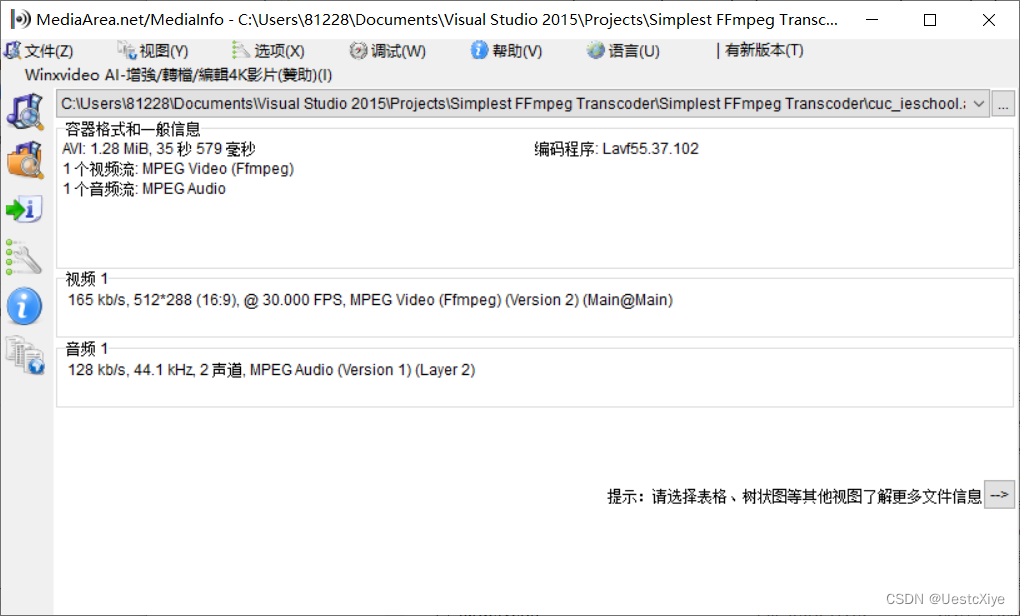
默认情况下运行程序,会将“cuc_ieschool.ts”转换为“cuc_ieschool.avi”。调试的时候,可以修改“配置属性->调试->命令参数”中的参数,即可改变转码的输入输出文件。

程序的运行结果如下:

输入文件:cuc_ieschool.ts
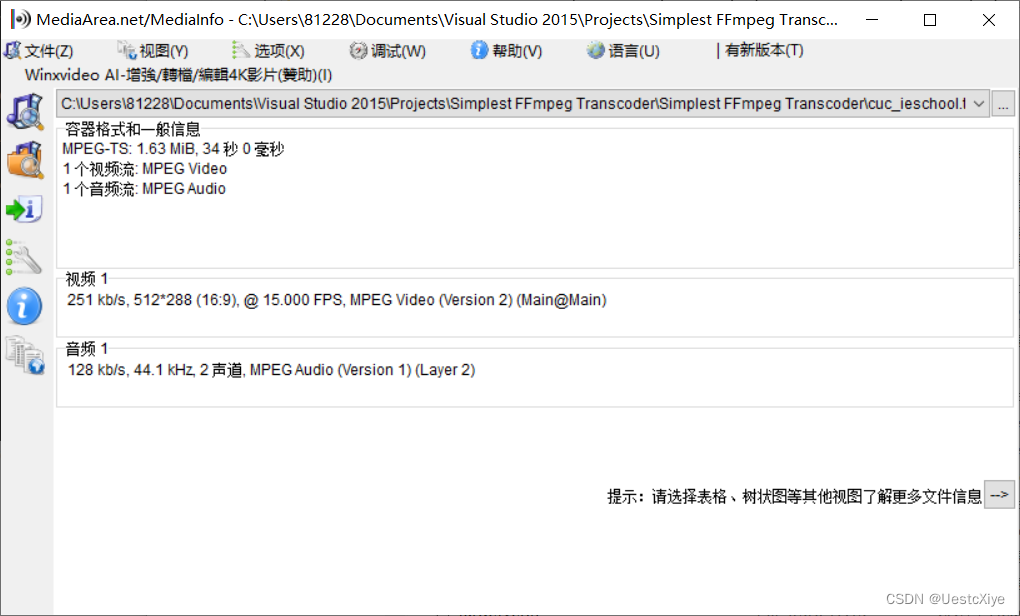
输出文件:cuc_ieschool.avi
工程文件下载
GitHub:UestcXiye / Simplest-FFmpeg-Transcoder
优快云:Simplest FFmpeg Transcoder.zip

 825


 扫一扫


 被折叠的 条评论
为什么被折叠?
 到【灌水乐园】发言


