



目录
泛型 generic
定义
定义类,接口,方法时,同时声明了一个或者多个类型变量(如:<T>,<K>,<E>,<V>)
称为泛型类,泛型接口,泛型方法,它们统称为泛型
作用
泛型提供了在编译阶段所能操作的数据类型,并自动进行检查的能力!
这样可以避免强制类型转换及其可能出现的异常
注:泛型的本质是把具体的数据类型作为参数传给类型变量
实例:
1)自定义泛型类
// 不使用泛型的容器类
public class ContainerWithoutGenerics {
    private Object item;

    public void setItem(Object item) {
        this.item = item;
    }

    public Object getItem() {
        return item;
    }
}

// 使用泛型的容器类
public class ContainerWithGenerics<T> {  // T 是类型变量
    private T item;

    public void setItem(T item) {
        this.item = item;
    }

    public T getItem() {
        return item;
    }
}

public class Main {
    public static void main(String[] args) {
        // 使用没有泛型的容器
        ContainerWithoutGenerics container1 = new ContainerWithoutGenerics();
        container1.setItem("Hello");
        String s1 = (String) container1.getItem();  // 需要强制类型转换
        System.out.println(s1);

        // 尝试放入错误类型的对象,编译器不会阻止
        container1.setItem(123);  // 这里是合法的
        String s2 = (String) container1.getItem();  // 运行时会抛出ClassCastException
        System.out.println(s2);

        // 使用泛型的容器
        ContainerWithGenerics<String> container2 = new ContainerWithGenerics<>();
        container2.setItem("World");
        String s3 = container2.getItem();  // 不需要强制类型转换
        System.out.println(s3);

        // 尝试放入错误类型的对象,编译器会阻止
        // 下面这行代码会导致编译错误
        // container2.setItem(456);
    }
}
2)自定义泛型接口
定义泛型接口
public interface DataProcessor<T> {
    void process(T data);  // 处理传入的数据
    T getResult();         // 获取处理后的结果
}
实现泛型接口 (实现功能:将输入的字符串转换为大写形式)
public class StringToUpperProcessor implements DataProcessor<String> {

    private String result;

    @Override
    public void process(String data) {
        if (data != null) {
            this.result = data.toUpperCase();
        } else {
            this.result = null;
        }
    }

    @Override
    public String getResult() {
        return result;
    }
}
使用泛型接口
public class Main {
    public static void main(String[] args) {
        DataProcessor<String> processor = new StringToUpperProcessor();
        processor.process("hello world");
        System.out.println(processor.getResult());  // 输出: HELLO WORLD
    }
}
泛型方法
修饰符 <类型变量> 返回值类型 方法名(形参列表){ }
实例:实现功能:交换两个对象的值
1)不使用泛型方法
public void swap(Integer a, Integer b) {
    Integer temp = a;
    a = b;
    b = temp;
}

public void swap(String a, String b) {
    String temp = a;
    a = b;
    b = temp;
}
// ... 对于其他类型也需要类似的实现
2)使用泛型方法
public class GenericMethodExample {

    // 定义一个泛型方法
    public <T> void swap(T a, T b) {
        T temp = a;
        a = b;
        b = temp;
        System.out.println("After swapping: a = " + a + ", b = " + b);
    }

    public static void main(String[] args) {
        GenericMethodExample example = new GenericMethodExample();

        // 交换整数
        Integer x = 10;
        Integer y = 20;
        example.swap(x, y);  // 输出: After swapping: a = 20, b = 10

        // 交换字符串
        String s1 = "Hello";
        String s2 = "World";
        example.swap(s1, s2);  // 输出: After swapping: a = World, b = Hello
    }
}
通配符
通配符就是 ? ,可以在"使用泛型"的时候代表一切
E,K,T,V是在定义泛型的时候使用
- 无界通配符
<?>:表示任何类型。- 上界通配符
<? extends T>:表示类型必须是T或T的子类型,主要用于读取数据。- 下界通配符
<? super T>:表示类型必须是T或T的父类型,主要用于写入数据。
实例:
import java.util.ArrayList;
import java.util.List;

public class WildcardExample {

    public static void main(String[] args) {
        List<Integer> intList = new ArrayList<>();
        intList.add(1);
        intList.add(2);

        List<Double> doubleList = new ArrayList<>();
        doubleList.add(1.5);
        doubleList.add(2.5);

        printList(intList);  // 输出: 1, 2
        printList(doubleList);  // 输出: 1.5, 2.5

        System.out.println("Sum of intList: " + sumOfNumbers(intList));  // 输出: 3.0
        System.out.println("Sum of doubleList: " + sumOfNumbers(doubleList));  // 输出: 4.0

        List<Number> numberList = new ArrayList<>();
        addNumbers(numberList, 1, 2, 3);
        System.out.println("numberList: " + numberList);  // 输出: [1, 2, 3]
    }

    public static void printList(List<?> list) {
        for (Object item : list) {
            System.out.println(item);
        }
    }

    public static double sumOfNumbers(List<? extends Number> numbers) {
        double sum = 0.0;
        for (Number num : numbers) {
            sum += num.doubleValue();
        }
        return sum;
    }

    public static void addNumbers(List<? super Integer> list, int... numbers) {
        for (int number : numbers) {
            list.add(number);
        }
    }
}
泛型支持的类型
泛型不支持基本数据类型,只能支持对象类型(引用数据类型)
解决方法:包装类
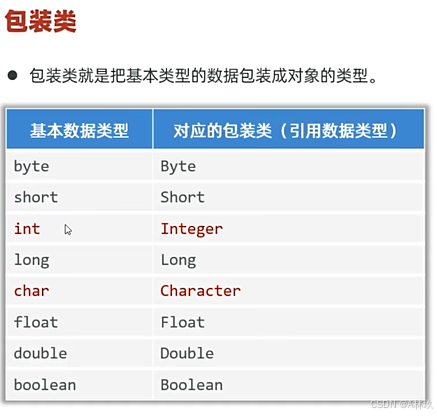
自动装箱:基本数据类型可以自动转换为包装类型
Integer i = 10; // int 被自动转换成 Integer自动拆箱:包装类型可以自动转换为基本数据类型
Integer i = new Integer(10);
int j = i; // Integer 被自动转换成 int
包装类具备的其他功能
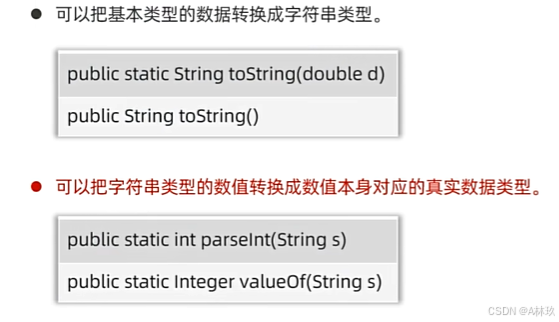
示例:
public class TypeConversionExample {
    public static void main(String[] args) {

        // 基本类型转字符串
        double num = 123.456;
        String strNum = Double.toString(num);
        System.out.println("基本类型转字符串: " + strNum);


        //1.字符串转基本类型(int)
        String strInt = "123";

        //使用 parseInt 方法
        int intValue = Integer.parseInt(strInt);
        System.out.println("String to integer using parseInt: " + intValue);

        // 使用 valueOf 方法
        Integer intValueObj = Integer.valueOf(strInt);
        System.out.println("String to integer using valueof: " + intValueObj);


        // 2.字符串转基本类型 (double)
        String strDouble = "123.456";

        // 使用 parseDouble 方法
        double doubleValue = Double.parseDouble(strDouble);
        System.out.println("String to double using parseDouble: " + doubleValue);

        // 使用 valueOf 方法
        Double doubleValueObj = Double.valueOf(strDouble);
        System.out.println("String to double using valueOf: " + doubleValueObj);
    }
}





 扫一扫
扫一扫


 938
938

 被折叠的 条评论
为什么被折叠?
被折叠的 条评论
为什么被折叠?
 到【灌水乐园】发言





