



 本文详细介绍了一种基于单链表实现的LinkedList数据结构,包括结点类定义、链表类实现以及各种链表操作如添加、删除、查找等。通过具体代码示例,展示了如何在Java中手动构建和维护链表。
LinkedList的底层本质是一个双向链表,它实现了List接口(其提供了相关的添加、删除、修改、遍历等功能)。此次模拟以简单的单链表为例。
1.新建Node类,用来保存数据和指针,此时的data属性和next属性不加private修饰,方便同一包中的其它类访问。
包及控制权限:
| 修饰符\权限 | 本类 | 同包子类 | 同包非子类 | 不同包子类 | 不同包非子类 |
|---|---|---|---|---|---|
| private | √ | × | × | × | × |
| 缺省 | √ | √ | √ | × | × |
| protected | √ | √ | √ | √ | × |
| public | √ | √ | √ | √ | √ |
package com.util;
/**
 * 单链表的结点
 */
public class Node {
    Object data;//要存储的数据
    Node next;

    public Node() {
    }

    public Node(Object data, Node next) {
        this.data = data;
        this.next = next;
    }

    public Node(Object data) {
        this.data = data;
    }

    public Object getData() {
        return data;
    }

    public void setData(Object data) {
        this.data = data;
    }

    public Node getNext() {
        return next;
    }

    public void setNext(Node next) {
        this.next = next;
    }
}
2.新建SingleLinkedList类并实现List接口
package com.util;

import com.data.List;
import com.exception.ArrayIndexOutOfBoundsException;

public class SingleLinkedList implements List {
    private Node head = new Node();//头节点,不存储数据,为了编程方便
    private int size;//表示单链表长度

    @Override
    public int size() {
        return this.size;
    }

    @Override
    public Object get(int index) {
        if(index>this.size){
            return null;
        }else{
            Node node = this.head;
            for(int x=0;x<=index;x++){
                node = node.next;
            }
            return node.data;
        }
    }

    @Override
    public boolean isEmpty() {
        return this.size==0;
    }

    @Override
    public boolean contains(Object e) {
        return this.indexOf(e)!=-1;
    }

    @Override
    public int indexOf(Object e) {
        Node currentNode = this.head;
        for(int x=0;x<this.size;x++){
            currentNode = currentNode.next;
            if(e.equals(currentNode.data)){
                return x;
            }
        }
        return -1;
    }

    @Override
    public void add(int index, Object e) {
        if(index>this.size||index<0){
            throw new ArrayIndexOutOfBoundsException("数组指针越界异常:"+index);
        }else{
            Node beforeNode = this.head;//找到前一个结点
            for(int x=0;x<index;x++){
                beforeNode = beforeNode.next;
            }
            Node newNode = new Node(e);//创建一个新结点,并赋值
            newNode.next = beforeNode.next;//指明新节点的后继节点
            beforeNode.next = newNode;//指明新节点的前驱节点
            this.size++;//列表长度+1
        }
    }

    @Override
    public void add(Object e) {
        this.add(this.size,e);
    }

    @Override
    public boolean addBefore(Object obj, Object e) {
        int index = this.indexOf(obj);
        if(index!=-1){
            this.add(index,e);
            return true;
        }
        return false;
    }

    @Override
    public boolean addAfter(Object obj, Object e) {
        int index = this.indexOf(obj);
        if(index!=-1){
            this.add(index+1,e);
            return true;
        }
        return false;
    }

    @Override
    public Object remove(int index) {
        if(index>=0&&index<this.size){
            Node beforeNode = this.head;
            for(int x=0;x<index;x++){
                beforeNode = beforeNode.next;
            }
            Node removedNode = beforeNode.next;
            beforeNode.next = beforeNode.next.next;
            this.size--;
            return removedNode.data;
        }else{
            throw new ArrayIndexOutOfBoundsException("链表指针越界:"+index);
        }
    }

    @Override
    public Object remove(Object e) {
        Node beforeNode = this.head;//要删除节点的前驱结点
        for(int x=0;x<this.size;x++){
            if(e.equals(beforeNode.next.data)){//如果下一个节点是要被删除的节点
                Node removedNode = beforeNode.next;//保存要被删除的节点
                beforeNode.next = beforeNode.next.next;//改变指针,删除节点
                this.size--;//链表长度-1
                return removedNode.data;
            }
            beforeNode = beforeNode.next;
        }
        return null;
    }

    @Override
    public Object replace(int index, Object e) {
        if(index>=0&&index<this.size){
            Node beforeNode = this.head;//要删除结点的前驱节点
            for(int x=0;x<index;x++){
                beforeNode = beforeNode.next;
            }
            Node newNode = new Node(e);//创建新节点
            Object data = beforeNode.next.data;//保存要删除的数据
            newNode.next = beforeNode.next.next;//新结点指针指向被删除节点指针的后继节点
            beforeNode.next = newNode;//被删除节点的前驱节点指针指向新结点
            return data;
        }else{
            throw new ArrayIndexOutOfBoundsException("链表指针越界:"+index);
        }
    }

    @Override
    public String toString() {
        if(this.size==0){
            return "[]";
        }
        StringBuilder builder = new StringBuilder();
        Node currentNode = this.head;
        builder.append("[");
        for(int x=0;x<this.size;x++){
            currentNode = currentNode.next;
            builder.append(currentNode.data).append(',');
        }
        builder.delete(builder.length()-1,builder.length()).append("]");
        return builder.toString();
    }
}
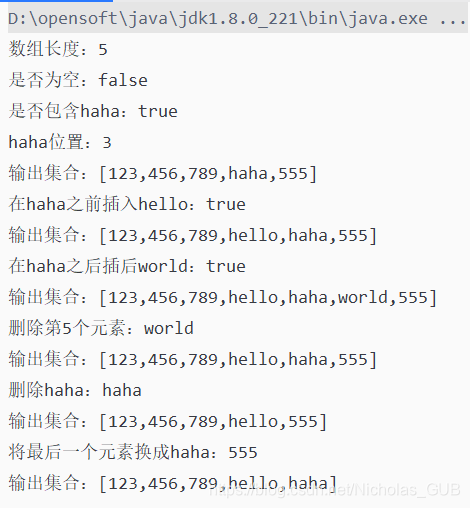
3.编写测试代码
package com.test;

import com.data.List;
import com.util.SingleLinkedList;

public class TestLinkedList {
    public static void main(String[] args) {
        List list = new SingleLinkedList();
        list.add("123");
        list.add(456);
        list.add(789);
        list.add("555");
        list.add(3,"haha");
        System.out.println("数组长度:"+list.size());
        System.out.println("是否为空:"+list.isEmpty());
        System.out.println("是否包含haha:"+list.contains("haha"));
        System.out.println("haha位置:"+list.indexOf("haha"));
        System.out.println("输出集合:"+list);
        System.out.println("在haha之前插入hello:"+list.addBefore("haha","hello"));
        System.out.println("输出集合:"+list);
        System.out.println("在haha之后插后world:"+list.addAfter("haha","world"));
        System.out.println("输出集合:"+list);
        System.out.println("删除第5个元素:"+list.remove(5));
        System.out.println("输出集合:"+list);
        System.out.println("删除haha:"+list.remove("haha"));
        System.out.println("输出集合:"+list);
        System.out.println("将最后一个元素换成haha:"+list.replace(list.size()-1,"haha"));
        System.out.println("输出集合:"+list);
    }
}
4.运行程序查看控制台输出,发现所有操作都能正常完成。





 扫一扫
扫一扫


 12万+
12万+

 被折叠的 条评论
为什么被折叠?
被折叠的 条评论
为什么被折叠?
 到【灌水乐园】发言





