





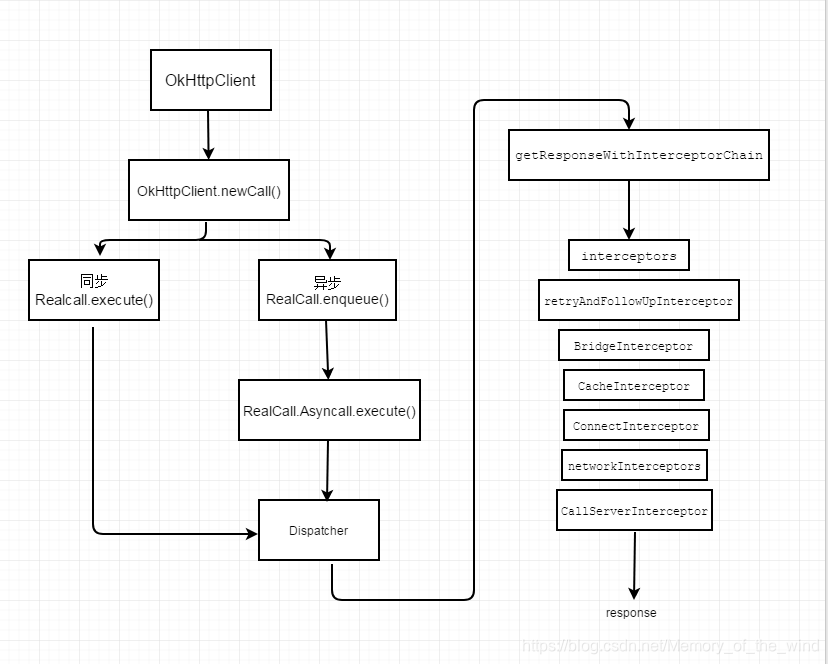
上面是Okhttp发起一个同步/异步请求时,方法调用流程图。
Okhttp的使用
//设置超时的时间
        OkHttpClient.Builder builder = new OkHttpClient.Builder()
                .connectTimeout(15, TimeUnit.SECONDS)
                .writeTimeout(20, TimeUnit.SECONDS)
                .readTimeout(20, TimeUnit.SECONDS)
                ;
        OkHttpClient okHttpClient = builder.build();
        Request request = new Request.Builder()
                .get() //设置请求模式
                .url("https://www.baidu.com/")
                .build();

        Call call = okHttpClient.newCall(request);
        call.enqueue(new Callback() {
            @Override
            public void onFailure(Call call, IOException e) {
            }
            @Override
            public void onResponse(Call call, Response response) throws IOException {
            }
        });
我们看到,通过okHttpClient.newCall()方法,拿到这个call对象,然后调用了Call.enqueue,我们先看看newCall是怎么走的。
@Override public Call newCall(Request request) {
    return new RealCall(this, request, false /* for web socket */);
  }
里面就new了一个RealCall,所以再看RealCall的enqueue方法。
@Override public void enqueue(Callback responseCallback) {
    synchronized (this) {
      if (executed) throw new IllegalStateException("Already Executed");
      executed = true;
    }
    captureCallStackTrace();
    client.dispatcher().enqueue(new AsyncCall(responseCallback));
  }
可以看到client.dispatcher().enqueue(new AsyncCall(responseCallback));这句代码,也就是说,最终是有的请求是有dispatcher来完成,我们看看dispatcher。
public final class Dispatcher {
  //最大请求的并发数
  private int maxRequests = 64;
  //每个主机最大请求数
  private int maxRequestsPerHost = 5;
  private @Nullable Runnable idleCallback;

  /** 消费线程池 */
  private @Nullable ExecutorService executorService;

  /** 准备运行的异步请求队列 */
  private final Deque<AsyncCall> readyAsyncCalls = new ArrayDeque<>();

  /** 正在运行的异步请求队列 */
  private final Deque<AsyncCall> runningAsyncCalls = new ArrayDeque<>();

  /** 正在运行的同步请求队列 */
  private final Deque<RealCall> runningSyncCalls = new ArrayDeque<>();
  /** 构造方法 */
  public Dispatcher(ExecutorService executorService) {
    this.executorService = executorService;
  }
  public Dispatcher() {
  }
  .........
  /**
   *设置并发执行最大的请求数量
   * <p>If more than {@code maxRequests} requests are in flight when this is invoked, those requests
   * will remain in flight.
   */
  public synchronized void setMaxRequests(int maxRequests) {
    if (maxRequests < 1) {
      throw new IllegalArgumentException("max < 1: " + maxRequests);
    }
    this.maxRequests = maxRequests;
    promoteCalls();
  }

  //获取到最大请求的数量
  public synchronized int getMaxRequests() {
    return maxRequests;
  }

  /**
   * 设置每个主机并发执行的请求的最大数量
   */
  public synchronized void setMaxRequestsPerHost(int maxRequestsPerHost) {
    if (maxRequestsPerHost < 1) {
      throw new IllegalArgumentException("max < 1: " + maxRequestsPerHost);
    }
    this.maxRequestsPerHost = maxRequestsPerHost;
    promoteCalls();
  }

  //获取每个主机最大并发数量
  public synchronized int getMaxRequestsPerHost() {
    return maxRequestsPerHost;
  }

  synchronized void enqueue(AsyncCall call) {
    if (runningAsyncCalls.size() < maxRequests && runningCallsForHost(call) < maxRequestsPerHost) {
      runningAsyncCalls.add(call);
      executorService().execute(call);
    } else {
      readyAsyncCalls.add(call);
    }
  }
 .........
}
可以发现Dispatcher是一个任务分发器,主要负责为每个网络请求找到合适的执行线程。下面主要看一下enqueue方法:
synchronized void enqueue(AsyncCall call) {
    if (runningAsyncCalls.size() < maxRequests && runningCallsForHost(call) < maxRequestsPerHost) {
      runningAsyncCalls.add(call);
      executorService().execute(call);
    } else {
      readyAsyncCalls.add(call);
    }
  }
当正在运行的异步请求队列中的数量小于64并且正在运行的请求主机数小于5时则把请求加载到runningAsyncCalls中并在线程池中执行,否则就再入到readyAsyncCalls中进行缓存等待。而runningAsyncCalls这个请求队列存放的就是AsyncCall对象,而这个AsyncCall就是RealCall的内部类,AsyncCall的execute源码如下。
@Override protected void execute() {
      boolean signalledCallback = false;
      try {
        Response response = getResponseWithInterceptorChain();
        if (retryAndFollowUpInterceptor.isCanceled()) {
          signalledCallback = true;
          responseCallback.onFailure(RealCall.this, new IOException("Canceled"));
        } else {
          signalledCallback = true;
          responseCallback.onResponse(RealCall.this, response);
        }
      } catch (IOException e) {
        if (signalledCallback) {
          // Do not signal the callback twice!
          Platform.get().log(INFO, "Callback failure for " + toLoggableString(), e);
        } else {
          responseCallback.onFailure(RealCall.this, e);
        }
      } finally {
        client.dispatcher().finished(this);
      }
    }
  }
可以发现是getResponseWithInterceptorChain()这句代码里面进行了网络请求。我们看看是怎么执行的。
Response getResponseWithInterceptorChain() throws IOException {
    // Build a full stack of interceptors.
    List<Interceptor> interceptors = new ArrayList<>();
    interceptors.addAll(client.interceptors());
    interceptors.add(retryAndFollowUpInterceptor);
    interceptors.add(new BridgeInterceptor(client.cookieJar()));
    interceptors.add(new CacheInterceptor(client.internalCache()));
    interceptors.add(new ConnectInterceptor(client));
    if (!forWebSocket) {
      interceptors.addAll(client.networkInterceptors());
    }
    interceptors.add(new CallServerInterceptor(forWebSocket));

    Interceptor.Chain chain = new RealInterceptorChain(
        interceptors, null, null, null, 0, originalRequest);
    return chain.proceed(originalRequest);
  }
}
1.创建一系列拦截器,并将其放入一个拦截器数组中。这部分拦截器即包括用户自定义的拦截器也包括框架内部拦截器;
2.创建一个拦截器链RealInterceptorChain,并执行拦截器链的proceed方法;
接下来再看看拦截器链的proceed方法:
  public Response proceed(Request request, StreamAllocation streamAllocation, HttpCodec httpCodec,
      RealConnection connection) throws IOException {
    ...
    // Call the next interceptor in the chain.
    RealInterceptorChain next = new RealInterceptorChain(
        interceptors, streamAllocation, httpCodec, connection, index + 1, request);
    Interceptor interceptor = interceptors.get(index);
    Response response = interceptor.intercept(next);
    ...
    return response;
  }
1.创建下一个拦截链。传入index + 1使得下一个拦截器链只能从下一个拦截器开始访问;
2.执行索引为index的拦截器的intercept方法,并将下一个拦截器链传入该方法;
接下来看一下Okhttp内部的第一个拦截器RetryAndFollowUpInterceptor的拦截方法:
public final class RetryAndFollowUpInterceptor implements Interceptor {
    @Override public Response intercept(Chain chain) throws IOException {
    Request request = chain.request();

    streamAllocation = new StreamAllocation(
        client.connectionPool(), createAddress(request.url()), callStackTrace);

    int followUpCount = 0;
    Response priorResponse = null;
    while (true) {
      if (canceled) {
        streamAllocation.release();
        throw new IOException("Canceled");
      }

      Response response = null;
      boolean releaseConnection = true;
      try {
       //执行下一个拦截器链的proceed方法
        response = ((RealInterceptorChain) chain).proceed(request, streamAllocation, null, null);
        releaseConnection = false;
      } catch (RouteException e) {
        // The attempt to connect via a route failed. The request will not have been sent.
        if (!recover(e.getLastConnectException(), false, request)) {
          throw e.getLastConnectException();
        }
        releaseConnection = false;
        continue;
      } catch (IOException e) {
        // An attempt to communicate with a server failed. The request may have been sent.
        boolean requestSendStarted = !(e instanceof ConnectionShutdownException);
        if (!recover(e, requestSendStarted, request)) throw e;
        releaseConnection = false;
        continue;
      } finally {
        // We're throwing an unchecked exception. Release any resources.
        if (releaseConnection) {
          streamAllocation.streamFailed(null);
          streamAllocation.release();
        }
      }
      ...
    }
  }
}
1.对request进行处理;
2.调用下一个拦截器链的proceed方法,获取response;
3.对response进行处理,返回给上一个拦截器;
到这里,我们可以发现所有的拦截器对request和response的操作,都是由拦截器链RealInterceptorChain的递归调用来实现的。那么真正的网络请求是在哪里进行的呢,可以猜到肯定是在最后一个拦截器。下面看一下最后一个拦截器CallServerInterceptor:
@Override public Response intercept(Chain chain) throws IOException {
    RealInterceptorChain realChain = (RealInterceptorChain) chain;
    HttpCodec httpCodec = realChain.httpStream();
    StreamAllocation streamAllocation = realChain.streamAllocation();
    RealConnection connection = (RealConnection) realChain.connection();
    Request request = realChain.request();

    long sentRequestMillis = System.currentTimeMillis();
    httpCodec.writeRequestHeaders(request);

    Response.Builder responseBuilder = null;
    if (HttpMethod.permitsRequestBody(request.method()) && request.body() != null) {
      if ("100-continue".equalsIgnoreCase(request.header("Expect"))) {
        httpCodec.flushRequest();
        responseBuilder = httpCodec.readResponseHeaders(true);
      }

      if (responseBuilder == null) {
        // Write the request body if the "Expect: 100-continue" expectation was met.
        Sink requestBodyOut = httpCodec.createRequestBody(request, request.body().contentLength());
        BufferedSink bufferedRequestBody = Okio.buffer(requestBodyOut);
        request.body().writeTo(bufferedRequestBody);
        bufferedRequestBody.close();
      } else if (!connection.isMultiplexed()) {
        streamAllocation.noNewStreams();
      }
    }

    httpCodec.finishRequest();

    if (responseBuilder == null) {
      responseBuilder = httpCodec.readResponseHeaders(false);
    }

    Response response = responseBuilder
        .request(request)
        .handshake(streamAllocation.connection().handshake())
        .sentRequestAtMillis(sentRequestMillis)
        .receivedResponseAtMillis(System.currentTimeMillis())
        .build();

    int code = response.code();
    if (forWebSocket && code == 101) {
      // Connection is upgrading, but we need to ensure interceptors see a non-null response body.
      response = response.newBuilder()
          .body(Util.EMPTY_RESPONSE)
          .build();
    } else {
      response = response.newBuilder()
          .body(httpCodec.openResponseBody(response))
          .build();
    }

    if ("close".equalsIgnoreCase(response.request().header("Connection"))
        || "close".equalsIgnoreCase(response.header("Connection"))) {
      streamAllocation.noNewStreams();
    }
    if ((code == 204 || code == 205) && response.body().contentLength() > 0) {
      throw new ProtocolException(
          "HTTP " + code + " had non-zero Content-Length: " + response.body().contentLength());
    }
    return response;
  }
可以发现真的网络请求确实是在CallServerInterceptor里面。





 扫一扫
扫一扫


 579
579

 被折叠的 条评论
为什么被折叠?
被折叠的 条评论
为什么被折叠?
 到【灌水乐园】发言





