


一、简介
在这里我想探讨一下“互相关”中的一些概念。正如卷积有线性卷积(linear convolution)和循环卷积(circular convolution)之分;互相关也有线性互相关(linear cross-correlation)和循环互相关(circular cross-correlation)。线性互相关和循环互相关的基本公式是一致的,不同之处在于如何处理边界数据。其本质的不同在于它们对原始数据的看法不同。通过这篇文章,我想整理一下相关概念,并给出示例。
1 线性相关(Linear Cross-Correlation)的定义和计算
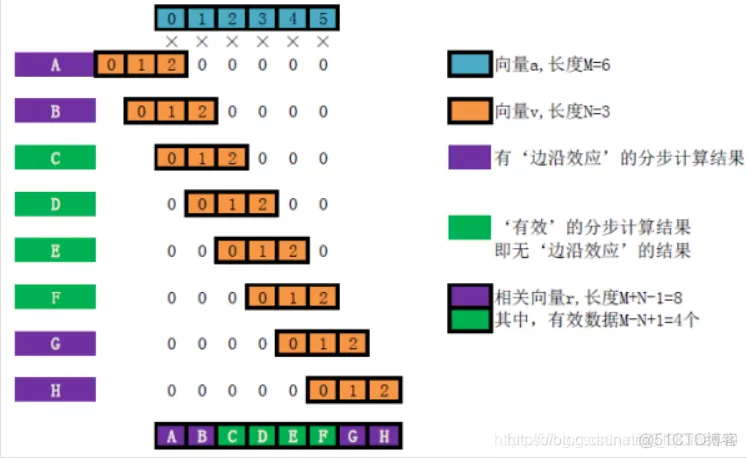
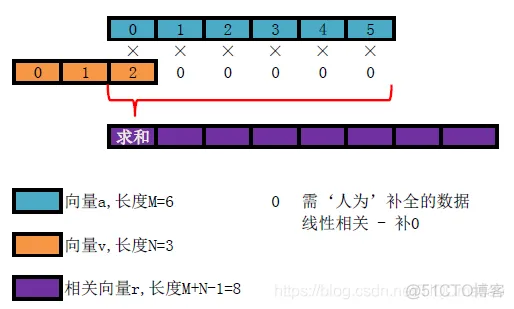
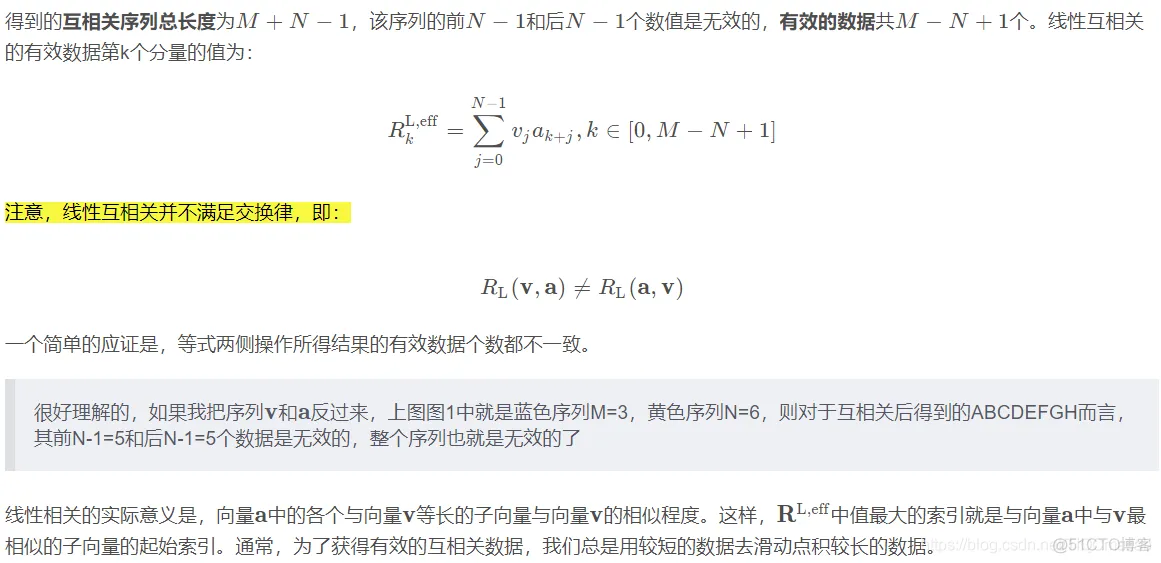
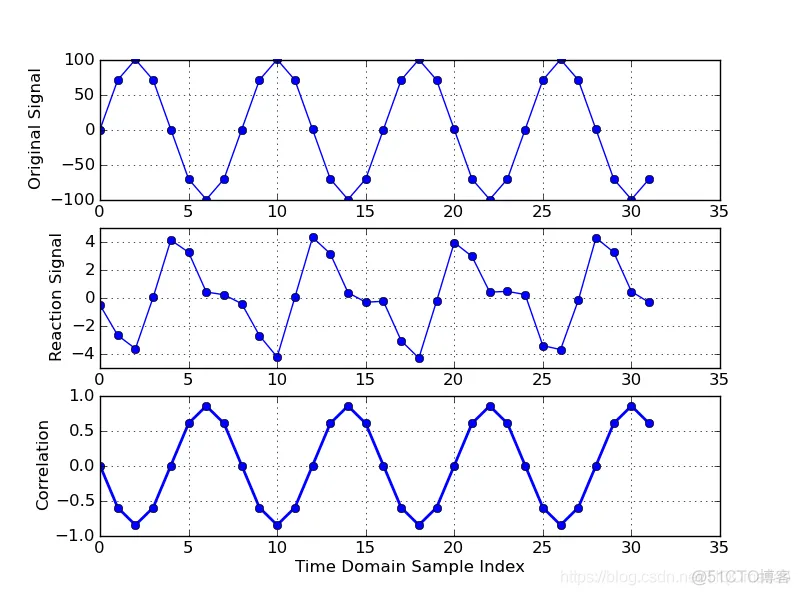
用一个实际的应用例子来验证一下吧。如图3的第一个子图表示雷达声纳发射了一个探测信号。经过一段时间之后,收到了如图3的第二个子图所示的回波(带有一定的噪声)。此时我们关注的是如何确定回波中从何时开始是对探测信号的响应,以便计算目标距雷达的距离,这就需要用到线性互相关。在第三个子图中的‘Valid’曲线即是有效互相关数据,其中清晰地呈现出两处与探测信号相似的回波的位置。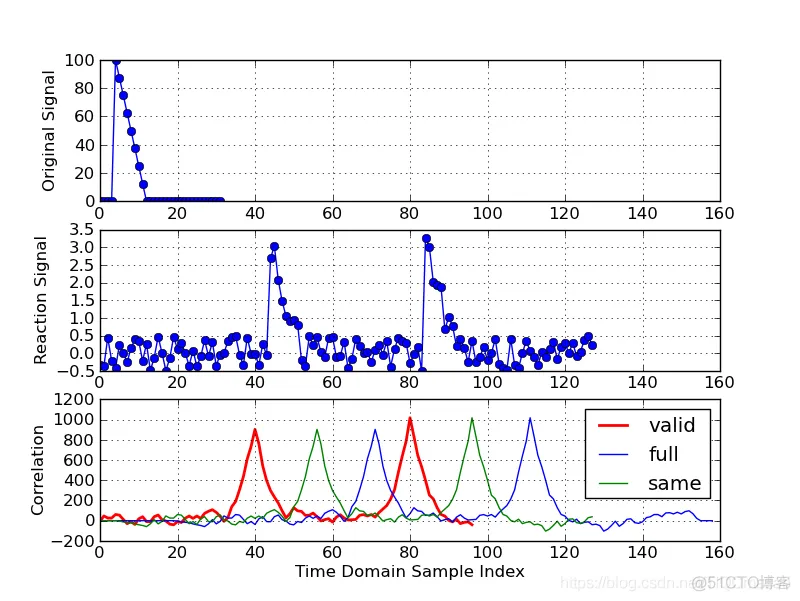
线性互相关中,还有一些概念值得注意:
1 补零。由线性相关的计算式不难发现,为了计算出个完整的相关系数序列(包含那些“无效数据”在内的所有结果),需要用到一些“不存在”的点。这就需要人为地对这些值进行补充,在线性相关的计算中,对这些超出原始数据储存的区域取值为零。
2 末端效应。由图1可以发现,一头一尾的个互相关数据并没有完全“嵌入”两个原始数组的全部信息,它们或多或少地受到了人为补零的影响。因此一般认为这些数据是不可用的。
3 计算模式的选择。这个问题其实是由问题二衍生而来的,就Python语言中的函数而言,至少有两个可以直接计算线性相关: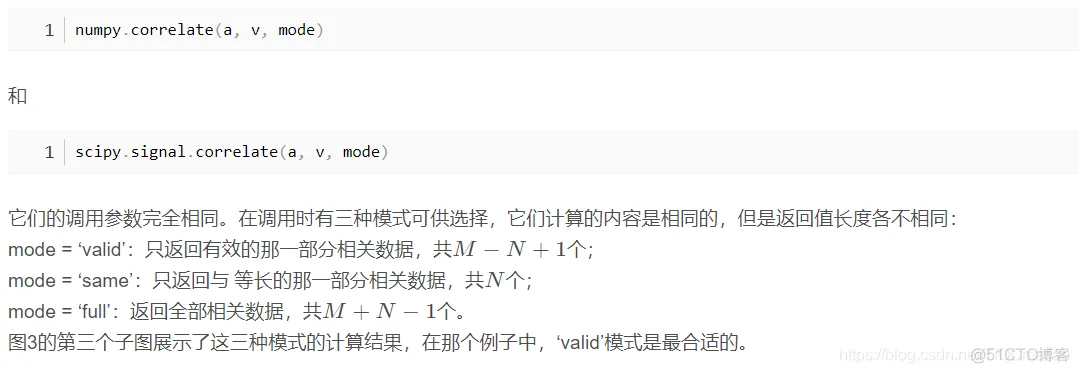
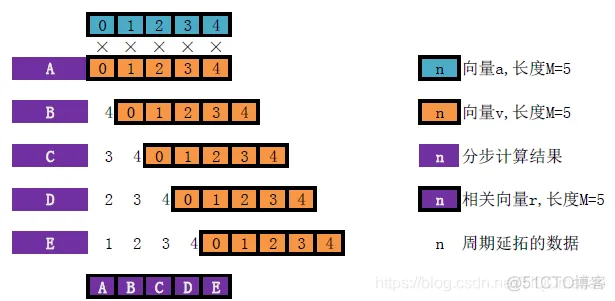
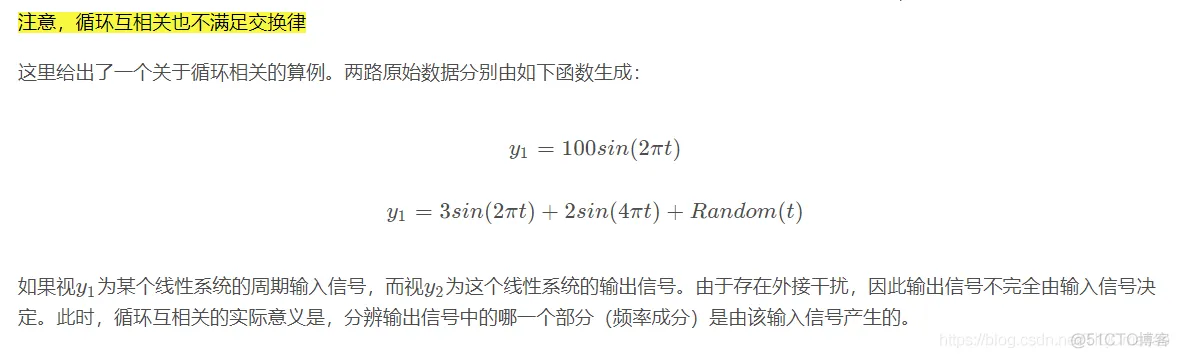
2 循环互相关(Circular Cross-Correlation)的定义和计算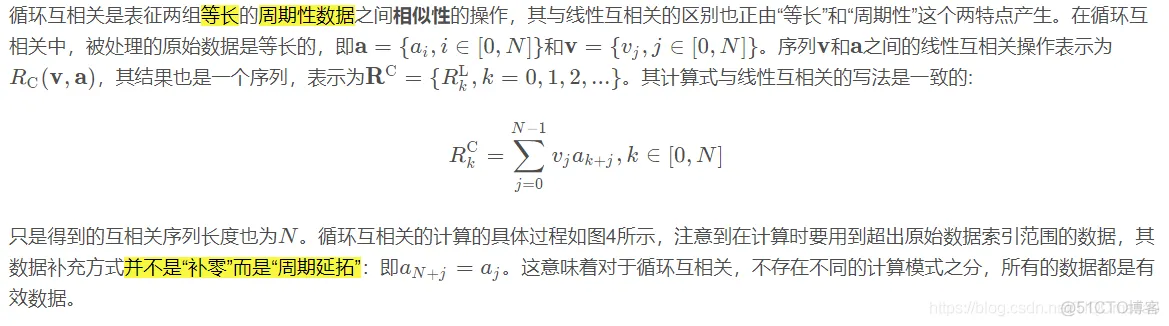
二、源代码
function varargout = xiangguan(varargin)
% XIANGGUAN M-file for xiangguan.fig
%      XIANGGUAN, by itself, creates a new XIANGGUAN or raises the existing
%      singleton*.
%
%      H = XIANGGUAN returns the handle to a new XIANGGUAN or the handle to
%      the existing singleton*.
%
%      XIANGGUAN('CALLBACK',hObject,eventData,handles,...) calls the local
%      function named CALLBACK in XIANGGUAN.M with the given input arguments.
%
%      XIANGGUAN('Property','Value',...) creates a new XIANGGUAN or raises the
%      existing singleton*.  Starting from the left, property value pairs are
%      applied to the GUI before xiangguan_OpeningFunction gets called.  An
%      unrecognized property name or invalid value makes property application
%      stop.  All inputs are passed to xiangguan_OpeningFcn via varargin.
%
%      *See GUI Options on GUIDE's Tools menu.  Choose "GUI allows only one
%      instance to run (singleton)".
%
% See also: GUIDE, GUIDATA, GUIHANDLES

% Edit the above text to modify the response to help xiangguan

% Last Modified by GUIDE v2.5 20-Apr-2014 10:31:06

% Begin initialization code - DO NOT EDIT
gui_Singleton = 1;
gui_State = struct('gui_Name',       mfilename, ...
                   'gui_Singleton',  gui_Singleton, ...
                   'gui_OpeningFcn', @xiangguan_OpeningFcn, ...
                   'gui_OutputFcn',  @xiangguan_OutputFcn, ...
                   'gui_LayoutFcn',  [] , ...
                   'gui_Callback',   []);
if nargin && ischar(varargin{1})
    gui_State.gui_Callback = str2func(varargin{1});
end

if nargout
    [varargout{1:nargout}] = gui_mainfcn(gui_State, varargin{:});
else
    gui_mainfcn(gui_State, varargin{:});
end
% End initialization code - DO NOT EDIT


% --- Executes just before xiangguan is made visible.
function xiangguan_OpeningFcn(hObject, eventdata, handles, varargin)
% This function has no output args, see OutputFcn.
% hObject    handle to figure
% eventdata  reserved - to be defined in a future version of MATLAB
% handles    structure with handles and user data (see GUIDATA)
% varargin   command line arguments to xiangguan (see VARARGIN)

% Choose default command line output for xiangguan
handles.output = hObject;

% Update handles structure
guidata(hObject, handles);

% UIWAIT makes xiangguan wait for user response (see UIRESUME)
% uiwait(handles.figure1);


% --- Outputs from this function are returned to the command line.
function varargout = xiangguan_OutputFcn(hObject, eventdata, handles)
% varargout  cell array for returning output args (see VARARGOUT);
% hObject    handle to figure
% eventdata  reserved - to be defined in a future version of MATLAB
% handles    structure with handles and user data (see GUIDATA)

% Get default command line output from handles structure
varargout{1} = handles.output;


% --- Executes on button press in first_picture.
function first_picture_Callback(hObject, eventdata, handles)
% hObject    handle to first_picture (see GCBO)
% eventdata  reserved - to be defined in a future version of MATLAB
% handles    structure with handles and user data (see GUIDATA)
subplot(3,3,2)
[filename,pathname]=uigetfile({'*.jpg;*.tif;*.png;*.gif','All Image Files';...
    '*.*','All Files' },'open');    %打开路径下要检索的图像
if isequal([filename,pathname],[0,0])
    return
else
    %读取图片
    pic = fullfile(pathname,filename);
   global onion;
   onion = imread(pic);
     imshow(onion);
end

% --- Executes on button press in second_picture.
function second_picture_Callback(hObject, eventdata, handles)
% hObject    handle to second_picture (see GCBO)
% eventdata  reserved - to be defined in a future version of MATLAB
% handles    structure with handles and user data (see GUIDATA)

subplot(3,3,3)
[filename,pathname]=uigetfile({'*.jpg;*.tif;*.png;*.gif','All Image Files';...
    '*.*','All Files' },'open');    %打开路径下要检索的图像
if isequal([filename,pathname],[0,0])
    return
else
    %读取图片
    pict = fullfile(pathname,filename);
   global peppers;
   peppers = imread(pict);
     imshow(peppers);
end

% --- Executes on button press in correlation.
function correlation_Callback(hObject, eventdata, handles)
% hObject    handle to correlation (see GCBO)
% eventdata  reserved - to be defined in a future version of MATLAB
% handles    structure with handles and user data (see GUIDATA)
subplot(3,3,5)
global onion;
global peppers;
% non-interactively
rect_onion = [111 33 65 58];
rect_peppers = [163 47 143 151];
sub_onion = imcrop(onion,rect_onion);
sub_peppers = imcrop(peppers,rect_peppers);
c = normxcorr2(sub_onion(:,:,1),sub_peppers(:,:,1));
 surf(c), shading flat

% --- Executes on button press in overlay.
function overlay_Callback(hObject, eventdata, handles)
% hObject    handle to overlay (see GCBO)
% eventdata  reserved - to be defined in a future version of MATLAB
% handles    structure with handles and user data (see GUIDATA)
subplot(3,3,6)
global onion;
global peppers;
% non-interactively
rect_onion = [111 33 65 58];
rect_peppers = [163 47 143 151];
sub_onion = imcrop(onion,rect_onion);
sub_peppers = imcrop(peppers,rect_peppers);
c = normxcorr2(sub_onion(:,:,1),sub_peppers(:,:,1));

 % offset found by correlation
[max_c, imax] = max(abs(c(:)));
[ypeak, xpeak] = ind2sub(size(c),imax(1));
corr_offset = [(xpeak-size(sub_onion,2))
               (ypeak-size(sub_onion,1))];
% relative offset of position of subimages
rect_offset = [(rect_peppers(1)-rect_onion(1))
               (rect_peppers(2)-rect_onion(2))];
% total offset
offset = corr_offset + rect_offset;
xoffset = offset(1);
yoffset = offset(2);
xbegin = round(xoffset+1);
xend   = round(xoffset+ size(onion,2));
ybegin = round(yoffset+1);
yend   = round(yoffset+size(onion,1));
% extract region from peppers and compare to onion
extracted_onion = peppers(ybegin:yend,xbegin:xend,:);
if isequal(onion,extracted_onion)
   disp('onion.png was extracted from peppers.png')
end
recovered_onion = uint8(zeros(size(peppers)));
recovered_onion(ybegin:yend,xbegin:xend,:) = onion;
imshow(recovered_onion)


% --- Executes on button press in transparent.
function transparent_Callback(hObject, eventdata, handles)
% hObject    handle to transparent (see GCBO)
% eventdata  reserved - to be defined in a future version of MATLAB
% handles    structure with handles and user data (see GUIDATA)
subplot(3,3,8)
global onion;
global peppers;
% non-interactively
rect_onion = [111 33 65 58];
rect_peppers = [163 47 143 151];
sub_onion = imcrop(onion,rect_onion);
sub_peppers = imcrop(peppers,rect_peppers);
c = normxcorr2(sub_onion(:,:,1),sub_peppers(:,:,1));
 % offset found by correlation
[max_c, imax] = max(abs(c(:)));
[ypeak, xpeak] = ind2sub(size(c),imax(1));
corr_offset = [(xpeak-size(sub_onion,2))
               (ypeak-size(sub_onion,1))];
% relative offset of position of subimages
rect_offset = [(rect_peppers(1)-rect_onion(1))
               (rect_peppers(2)-rect_onion(2))];
- 1.
- 2.
- 3.
- 4.
- 5.
- 6.
- 7.
- 8.
- 9.
- 10.
- 11.
- 12.
- 13.
- 14.
- 15.
- 16.
- 17.
- 18.
- 19.
- 20.
- 21.
- 22.
- 23.
- 24.
- 25.
- 26.
- 27.
- 28.
- 29.
- 30.
- 31.
- 32.
- 33.
- 34.
- 35.
- 36.
- 37.
- 38.
- 39.
- 40.
- 41.
- 42.
- 43.
- 44.
- 45.
- 46.
- 47.
- 48.
- 49.
- 50.
- 51.
- 52.
- 53.
- 54.
- 55.
- 56.
- 57.
- 58.
- 59.
- 60.
- 61.
- 62.
- 63.
- 64.
- 65.
- 66.
- 67.
- 68.
- 69.
- 70.
- 71.
- 72.
- 73.
- 74.
- 75.
- 76.
- 77.
- 78.
- 79.
- 80.
- 81.
- 82.
- 83.
- 84.
- 85.
- 86.
- 87.
- 88.
- 89.
- 90.
- 91.
- 92.
- 93.
- 94.
- 95.
- 96.
- 97.
- 98.
- 99.
- 100.
- 101.
- 102.
- 103.
- 104.
- 105.
- 106.
- 107.
- 108.
- 109.
- 110.
- 111.
- 112.
- 113.
- 114.
- 115.
- 116.
- 117.
- 118.
- 119.
- 120.
- 121.
- 122.
- 123.
- 124.
- 125.
- 126.
- 127.
- 128.
- 129.
- 130.
- 131.
- 132.
- 133.
- 134.
- 135.
- 136.
- 137.
- 138.
- 139.
- 140.
- 141.
- 142.
- 143.
- 144.
- 145.
- 146.
- 147.
- 148.
- 149.
- 150.
- 151.
- 152.
- 153.
- 154.
- 155.
- 156.
- 157.
- 158.
- 159.
- 160.
- 161.
- 162.
- 163.
- 164.
- 165.
- 166.
- 167.
- 168.
- 169.
- 170.
- 171.
- 172.
- 173.
- 174.
- 175.
- 176.
- 177.
- 178.
- 179.
- 180.
- 181.
- 182.
- 183.
- 184.
- 185.
- 186.
- 187.
- 188.
- 189.
- 190.
- 191.
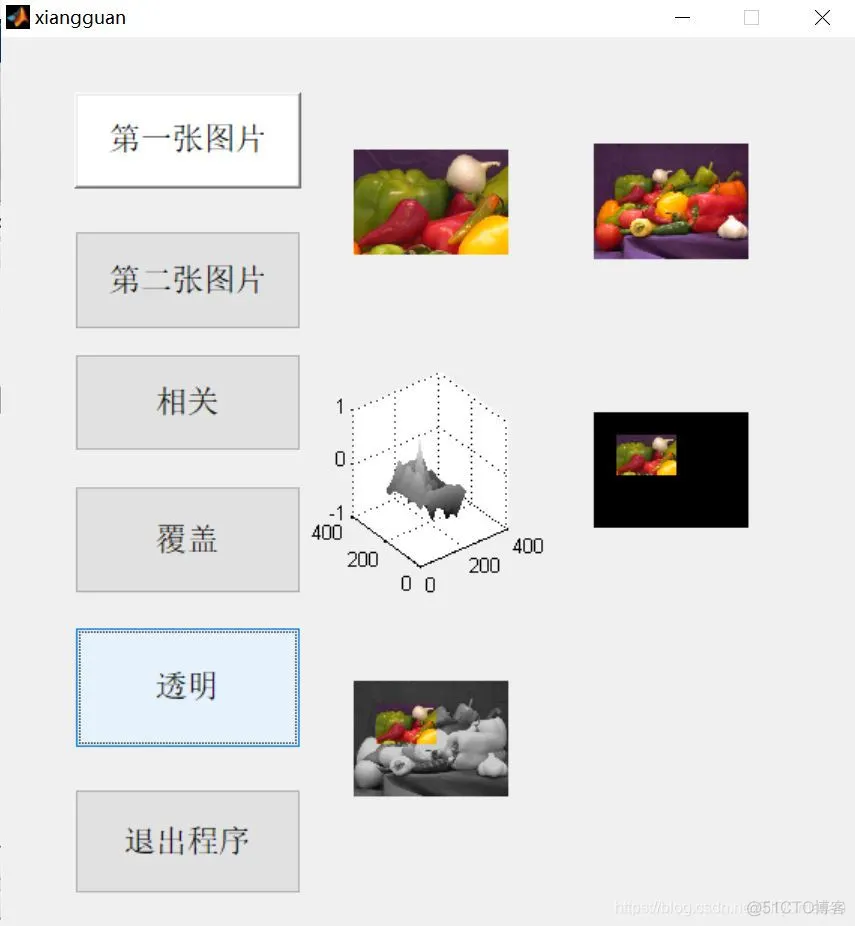
三、运行结果





 扫一扫
扫一扫


 941
941

 被折叠的 条评论
为什么被折叠?
被折叠的 条评论
为什么被折叠?
 到【灌水乐园】发言





