


iOS 底层探索篇 ——alloc 流程
1. alloc
+ (id)alloc {
    return _objc_rootAlloc(self);
}
在 alloc 中实际调用了 _objc_rootAlloc的方法,并把自己作为参数传入方法中。
2. _objc_rootAlloc
id
_objc_rootAlloc(Class cls)
{
    return callAlloc(cls, false/*checkNil*/, true/*allocWithZone*/);
}
在_objc_rootAlloc 实际调用了 callAlloc 方法,并传入三个参数
- 对象的
class - 是否
checkNil - 以及是否
allocWithZone
3. callAlloc
static ALWAYS_INLINE id
callAlloc(Class cls, bool checkNil, bool allocWithZone=false)
{
#if __OBJC2__
    if (slowpath(checkNil && !cls)) return nil;
    if (fastpath(!cls->ISA()->hasCustomAWZ())) {
        return _objc_rootAllocWithZone(cls, nil);
    }
#endif


    // No shortcuts available.
    if (allocWithZone) {
        return ((id(*)(id, SEL, struct _NSZone *))objc_msgSend)(cls, @selector(allocWithZone:), nil);
    }
    return ((id(*)(id, SEL))objc_msgSend)(cls, @selector(alloc));
}
在 callAlloc 中,
- 如果编译器处于不优化模式,并且
checkNil为true 以及 cls 不为空的情况下,返回空。 - 如果编译器处于优化模式,并且
cls没有自定义的allocWithZone,没有的话就调用,_objc_rootAllocWithZone方法。 - 如果编译器有自定义的
allocWithZone,则调用自定义的allocWithZone。
4. _objc_rootAllocWithZone
id
_objc_rootAllocWithZone(Class cls, malloc_zone_t *zone __unused)
{
    // allocWithZone under __OBJC2__ ignores the zone parameter
    return _class_createInstanceFromZone(cls, 0, nil,
                                         OBJECT_CONSTRUCT_CALL_BADALLOC);
}
这里调用 _class_createInstanceFromZone方法
5. _class_createInstanceFromZone
static ALWAYS_INLINE id
_class_createInstanceFromZone(Class cls, size_t extraBytes, void *zone,
                              int construct_flags = OBJECT_CONSTRUCT_NONE,
                              bool cxxConstruct = true,
                              size_t *outAllocatedSize = nil)
{
    ASSERT(cls->isRealized());

    // Read class's info bits all at once for performance
    bool hasCxxCtor = cxxConstruct && cls->hasCxxCtor();
    bool hasCxxDtor = cls->hasCxxDtor();
    bool fast = cls->canAllocNonpointer();
    size_t size;

    size = cls->instanceSize(extraBytes);
    if (outAllocatedSize) *outAllocatedSize = size;

    id obj;
    if (zone) {
        obj = (id)malloc_zone_calloc((malloc_zone_t *)zone, 1, size);
    } else {
        obj = (id)calloc(1, size);
    }
    if (slowpath(!obj)) {
        if (construct_flags & OBJECT_CONSTRUCT_CALL_BADALLOC) {
            return _objc_callBadAllocHandler(cls);
        }
        return nil;
    }

    if (!zone && fast) {
        obj->initInstanceIsa(cls, hasCxxDtor);
    } else {
        // Use raw pointer isa on the assumption that they might be
        // doing something weird with the zone or RR.
        obj->initIsa(cls);
    }

    if (fastpath(!hasCxxCtor)) {
        return obj;
    }

    construct_flags |= OBJECT_CONSTRUCT_FREE_ONFAILURE;
    return object_cxxConstructFromClass(obj, cls, construct_flags);
}
在这个方法中
- 声明 obj 时候(id obj)会有一个地址,系统会分配一个
脏地址。 size = cls->instanceSize(extraBytes); ,这个决定了开辟内存的大小,大小由成员变量决定,如果小于16则返回16。如果大于16,需要用字节对齐,返回8的倍数。- 在calloc 之后,会
申请内存,并将地址返回替换掉obj的脏地址,此时地址还未绑定类,关联类的是isa。 - 在
obj->initInstanceIsa(cls, hasCxxDtor);之后,地址绑定类
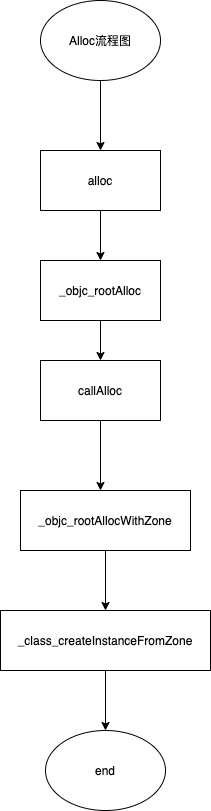
流程图





 扫一扫
扫一扫


 482
482

 被折叠的 条评论
为什么被折叠?
被折叠的 条评论
为什么被折叠?
 到【灌水乐园】发言





