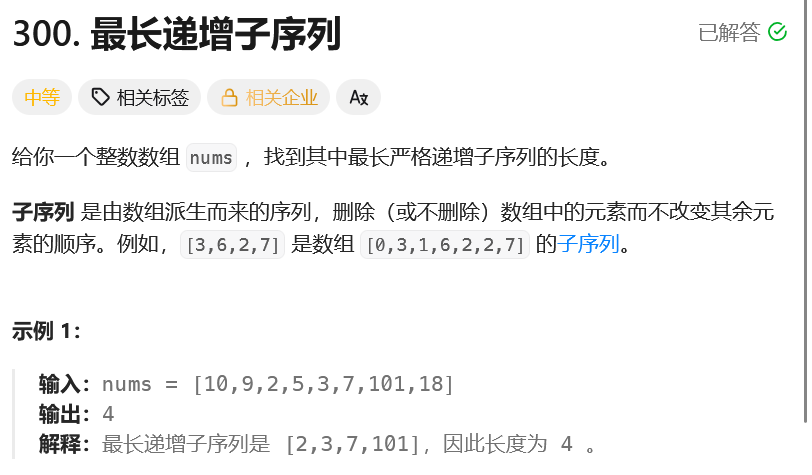
动态规划----7.最长递增子序列

[DP题解] 最长递增子序列问题 [DP题解] 最长递增子序列问题 [问题] 最长递增子序列 给出长度为N的数组,找出这个数组的最长递增子序列。 子序列的元素是递增的。 举例: 5 7 1 8 3 5 7 9, 最长递增子序列是 1 3 5 7 9 输入样例: 2 8 5 7 1 8 3 5 7 9 9 2 1 5 3 6 4... 阅读详情

300. 最长递增子序列 - 力扣(LeetCode)

/**

        动态规划O():

                maxSubseq[]:记录结果,maxSubseq[i],代表以下标为i的元素结尾,最长递增子序列的长度

                全部初始化为1,每个元素本身都是一个长度为1的子序列

                以下标为0结尾:maxSubseq[0] = 1; 只有一个元素只能是1

                以下标为1结尾:maxSubseq[1]---> if(nums[1] > nums[0]) ---> maxSubseq[0] + 1

                以下标为2结尾:maxSubseq[2]---> if(nums[2] > nums[0,1]) ---> Math.max(maxSubseq[0,1] + 1 )

                以下标为3结尾:maxSubseq[3]---> if(nums[3] > nums[0,1,2]) ---> Math.max(maxSubseq[0,1,2] + 1 )

                .......

                以下标为i结尾:maxSubseq[i]---> if(nums[i] > nums[0...i-1]) ---> Math.max(maxSubseq[0...i-1] + 1 )

                即,比nums[i]小的元素(j)都进入待选,选择maxSubseq[j] + 1中最大的那个

        二分查找+贪心:

                维护一个List,遍历nums[],若nums[i] 大于List中的所有元素就将nums[i]插入到List的末尾

                若不大于List中的所有元素,则在List中找到第一个小于等于nums[i]的元素进行替换

            注意:

                由于可能后出现的元素替换之前的元素,该方法只能保证找到最长子序列的长度,但最终List中不一定是最长子序列

*/

class Solution {
    /**
        动态规划O():
                maxSubseq[]:记录结果,maxSubseq[i],代表以下标为i的元素结尾,最长递增子序列的长度
                全部初始化为1,每个元素本身都是一个长度为1的子序列

                以下标为0结尾:maxSubseq[0] = 1; 只有一个元素只能是1
                以下标为1结尾:maxSubseq[1]---> if(nums[1] > nums[0]) ---> maxSubseq[0] + 1 
                以下标为2结尾:maxSubseq[2]---> if(nums[2] > nums[0,1]) ---> Math.max(maxSubseq[0,1] + 1 )
                以下标为3结尾:maxSubseq[3]---> if(nums[3] > nums[0,1,2]) ---> Math.max(maxSubseq[0,1,2] + 1 )
                .......
                以下标为i结尾:maxSubseq[i]---> if(nums[i] > nums[0...i-1]) ---> Math.max(maxSubseq[0...i-1] + 1 )
                即,比nums[i]小的元素(j)都进入待选,选择maxSubseq[j] + 1中最大的那个

        二分查找+贪心:
                维护一个List,遍历nums[],若nums[i] 大于List中的所有元素就将nums[i]插入到List的末尾
                若不大于List中的所有元素,则在List中找到第一个小于等于nums[i]的元素进行替换
            注意:
                由于可能后出现的元素替换之前的元素,该方法只能保证找到最长子序列的长度,但最终List中不一定是最长子序列
    */
    public int lengthOfLIS(int[] nums) {
        //动态规划
        //return DP(nums);

        //二分查找+贪心
        return GreedyBinarySearch(nums);
    }

    //动态规划
    private int DP(int[] nums) {
        int len = nums.length;

        //maxSubseq[i],代表以下标为i的元素结尾,最长递增子序列的长度
        int maxSubseq[] = new int[len];

        //全部初始化为1,每个元素本身都是一个长度为1的子序列
        Arrays.fill(maxSubseq,1);

        //nums[i]小的元素(j)都进入待选,选择maxSubseq[j] + 1中最大的那个
        int maxLen = 1; //记录最长子序列
        for(int i = 0; i < len; i++) {
            for(int j = 0; j < i; j++) {
                if(nums[j] < nums[i]) {
                    maxSubseq[i] = Math.max(maxSubseq[i],maxSubseq[j] + 1); //过程中maxSubseq[i]中存储的是前[0,j - 1]最大的
                }
            }
            maxLen = Math.max(maxLen,maxSubseq[i]); //迭代记录
        }

        return maxLen;
    }

    //二分查找+贪心
    private int GreedyBinarySearch(int[] nums) {
        //维护一个List,辅助记录最长子序列长度
        List<Integer> tails = new ArrayList<>();

        //二分查找寻找nums中元素应该的位置
        for(int num : nums) {
            int left = 0, right = tails.size() - 1;
            //二分查找
            while(left <= right) {
                int mid = (left + right) / 2;
                if(tails.get(mid) < num) {
                    left = mid + 1;
                } else { //tails[mid] >= num 都向左半区搜索(找到第一个小于等于nums[i]的元素)
                    right = mid - 1; 
                }
            }

            //应该插入的位置就在最后
            if(left == tails.size()) {
                tails.add(num);
            } else { //进行替换
                tails.set(left,num);
            }
        }

        return tails.size();
    }
}

python 最长递增子串:动态规划 问题描述: 给定一个数组str=[5, 3, 4, 8, 6, 7,9],求出其最长递增子串:LongestIncreaseSub=[3,4,6,7,9] 解决思路: 解决最长子序列(Longest Increase Subset, LIS)问题,使用动态规划(Dynamic Programming,DP),之前说到动态规划的规划(Programming)是表格的意思,是对递归的一种优化,递... 阅读详情

相关推荐

Unity游戏开发客户端Lua基础

Unity游戏开发客户端面经之 lua 篇

Sea3752的博客 1万+

【算法|动态规划No.7】leetcode300. 最长递增子序列

【算法|动态规划No.7】leetcode300. 最长递增子序列

m0_74352571的博客 751

EMC测试案例分析——晶振对辐射发射的影响

本文分析了某产品350MHz辐射发射超标问题,发现源头是50MHz晶振的7次谐波通过连接器泄漏。主要原因是:1)防水非导电垫圈形成屏蔽缝隙;2)晶振下方地平面不完整且信号线穿过;3)晶振离接口过近。改进措施包括:完善晶振下方地平面、增大晶振与接口距离、使用导电密封圈等。最终辐射降低10dB以上达标。文章总结了晶振EMC设计要点:保持地平面完整、远离接口、外壳接地、合理布局滤波电路等,并强调防水与屏蔽的协调统一。

u012526819的博客 669

动态规划7,等差数列划分,湍流子数组,唯一的子字符串,最长递增子序列

f[i] 表示:以i 位置为结尾的所有子数组中,最后呈现 “ 上升” 状态下的最长湍流数组的长度。g[i] 表示:以i 位置为结尾的所有子数组中,最后呈现 “ 下降” 状态下的最长湍流数组的长度。2.状态转移方程。

weixin_74461263的博客 1086

S7-1200PLC 2轴直线插补详细算法(完整源代码)

速度轴V90PN总线伺服梯形加减速速度控制(标准报文1应用)_v90伺服加减速时间怎么调整-优快云博客文章浏览阅读288次。

RXXW_Dor的博客 4261

基于PCL的电力线点云提取与分割实现

本文基于PCL库实现电力线点云提取与分割,包含6个核心处理阶段:文件读取与结果文件夹创建、高程滤波分割候选点云、欧式聚类去噪、电力线分段提取、球形邻域搜索补全点云、最终分割与可视化保存。通过PCA计算点云线性特征(阈值0.91)筛选电力线点,采用欧式聚类(容忍度3.0)去除噪点,并针对不同规模聚类差异化设置球形搜索半径(4.0/6.0)补全点云。最终通过欧式聚类分割并可视化带颜色点云。算法对高程滤波阈值、聚类参数等具有敏感性,需根据点云特性调整优化。

weixin_45196569的博客 193

刷题记录 动态规划-41 HOT100 动态规划-7:300. 最长递增子序列

难度:中等给你一个整数数组nums,找到其中最长严格递增子序列的长度。是由数组派生而来的序列,删除(或不删除)数组中的元素而不改变其余元素的顺序。例如,[3,6,2,7]是数组的子序列。4最长递增子序列是 [2,3,7,101],因此长度为 4。41。

weixin_44610684的博客 339

手把手写深度学习(27):如果获得相机位姿态的plücker embedding?以RealEstate10K为例

用plücker embedding表示相机的位姿是一种非常常用的方法,这篇博客以RealEstate10K数据集为例子,详细讲解如何从相机的轨迹坐标中获得plücker embedding,用于下一步模型的学习。

沉迷单车的追风少年 2239

数组中最长递增子序列-java

 求数组中最长递增子序列写一个时间复杂度尽可能低的程序,求一个一维数组(N个元素)中的最长递增子序列的长度。例如:在序列1,-1,2,-3,4,-5,6,-7中,其最长的递增子序列为1,2,4,6。 分析与解法       根据题目的要求,求一维数组中的最长递增子序列,也就是找一个标号的序列b[0],b[1],…,b[m](0  解法一

terry84fun的专栏 8914

新能源汽车动力总成研发测试技术全景深度报告(2025版)

本文所有企业案例数据均来自上市公司财报、工信部备案信息及权威媒体报道,技术参数经第三方检测报告交叉验证。研发测试人员能力矩阵重构(T型人才进阶路径)[10] 全球动力总成市场2035年预测报告。[9] NI电动汽车HIL测试架构技术文档。[3] 东风汽车智能化研发体系深度报告。[5] 混合动力测功机发明专利技术细节。[1] 领克动力总成试验中心技术解析。[7] 新能源汽车产业迭代趋势白皮书。测试架构师-数字工程。测试架构师-安全合规。测试架构师-人工智能。

优快云-新能源汽车研发测试专业博主 779

电力负荷预测 | 电力系统负荷预测模型(Python线性回归、随机森林、支持向量机、BP神经网络、GRU、LSTM)

电力负荷预测 | 电力系统负荷预测模型(Python线性回归、随机森林、支持向量机、BP神经网络、GRU、LSTM)

天天酷科研的博客 3189

2025-2-7-算法学习(一) 动态规划-习题1 300.最长递增子序列

算法学习(一) 动态规划-习题1 300.最长递增子序列

weixin_42269028的博客 466

【数据集】MODIS 的 MOD07 大气廓线产品概述及下载

MODIS 的 MOD07 大气廓线产品概述及下载

WW、forever的博客 552

7-4 最长递增子序列 (30 分)

7-4 最长递增子序列 (30 分) 给你一个整数数组 nums ,找到其中最长严格递增子序列的长度。 子序列是由数组派生而来的序列,删除(或不删除)数组中的元素而不改变其余元素的顺序。例如,[3,6,2,7] 是数组 [0,3,1,6,2,2,7] 的子序列。 输入格式: 输入包含两行。第一行给出一个正整数n(1≤n≤2500)。第二行给出n个由空格分隔的整数(-104≤nums[i]≤104)。 输出格式: 在一行中输出最长递增子序列的长度。 思路: 一般想法是,从一点向右找,找比他大的, 但是太耗

qq_53843555的博客 2738

深度学习工具包 DeepLearningToolbox

深度学习工具包Deprecation notice.-----This toolbox is outdated and no longer maintained.There are much better tools available for deep learning than this toolbox, e.g. [Theano](http://deeplearning.net/software/theano/), [torch](http://torch.ch/) or [tensorflow](http://www.tensorflow.org/)I would suggest you use one of the tools mentioned above rather than use this toolbox.Best, Rasmus.DeepLearnToolbox================A Matlab toolbox for Deep Learning.Deep Learning is a new subfield of machine learning that focuses on learning deep hierarchical models of data.It is inspired by the human brain's apparent deep (layered, hierarchical) architecture.A good overview of the theory of Deep Learning theory is[Learning Deep Architectures for AI](http://www.iro.umontreal.ca/~bengioy/papers/ftml_book.pdf)For a more informal introduction, see the following videos by Geoffrey Hinton and Andrew Ng.* [The Next Generation of Neural Networks](http://www.youtube.com/watch?v=AyzOUbkUf3M) (Hinton, 2007)* [Recent Developments in Deep Learning](http://www.youtube.com/watch?v=VdIURAu1-aU) (Hinton, 2010)* [Unsupervised Feature Learning and Deep Learning](http://www.youtube.com/watch?v=ZmNOAtZIgIk) (Ng, 2011)If you use this toolbox in your research please cite [Prediction as a candidate for learning deep hierarchical models of data](http://www2.imm.dtu.dk/pubdb/views/publication_details.php?id=6284)```@MASTERSTHESIS\{IMM2012-06284, author = "R. B. Palm", title = "Prediction as a candidate for learning deep hierarchical models of data", year = "2012",}```Contact: rasmusbergpalm at gmail dot comDirectories included in the toolbox-----------------------------------`NN/` - A library for Feedforward Backpropagation Neural Networks`CNN/` - A library for Convolutional Neural Networks`DBN/` - A library for Deep Belief Networks`SAE/` - A library for Stacked Auto-Encoders`CAE/` - A library for Convolutional Auto-Encoders`util/` - Utility functions used by the libraries`data/` - Data used by the examples`tests/` - unit tests to verify toolbox is workingFor references on each library check REFS.mdSetup-----1. Download.2. addpath(genpath('DeepLearnToolbox'));Example: Deep Belief Network---------------------```matlabfunction test_example_DBNload mnist_uint8;train_x = double(train_x) / 255;test_x = double(test_x) / 255;train_y = double(train_y);test_y = double(test_y);%% ex1 train a 100 hidden unit RBM and visualize its weightsrand('state',0)dbn.sizes = [100];opts.numepochs = 1;opts.batchsize = 100;opts.momentum = 0;opts.alpha = 1;dbn = dbnsetup(dbn, train_x, opts);dbn = dbntrain(dbn, train_x, opts);figure; visualize(dbn.rbm{1}.W'); % Visualize the RBM weights%% ex2 train a 100-100 hidden unit DBN and use its weights to initialize a NNrand('state',0)%train dbndbn.sizes = [100 100];opts.numepochs = 1;opts.batchsize = 100;opts.momentum = 0;opts.alpha = 1;dbn = dbnsetup(dbn, train_x, opts);dbn = dbntrain(dbn, train_x, opts);%unfold dbn to nnnn = dbnunfoldtonn(dbn, 10);nn.activation_function = 'sigm';%train nnopts.numepochs = 1;opts.batchsize = 100;nn = nntrain(nn, train_x, train_y, opts);[er, bad] = nntest(nn, test_x, test_y);assert(er < 0.10, 'Too big error');```Example: Stacked Auto-Encoders---------------------```matlabfunction test_example_SAEload mnist_uint8;train_x = double(train_x)/255;test_x = double(test_x)/255;train_y = double(train_y);test_y = double(test_y);%% ex1 train a 100 hidden unit SDAE and use it to initialize a FFNN% Setup and train a stacked denoising autoencoder (SDAE)rand('state',0)sae = saesetup([784 100]);sae.ae{1}.activation_function = 'sigm';sae.ae{1}.learningRate = 1;sae.ae{1}.inputZeroMaskedFraction = 0.5;opts.numepochs = 1;opts.batchsize = 100;sae = saetrain(sae, train_x, opts);visualize(sae.ae{1}.W{1}(:,2:end)')% Use the SDAE to initialize a FFNNnn = nnsetup([784 100 10]);nn.activation_function = 'sigm';nn.learningRate = 1;nn.W{1} = sae.ae{1}.W{1};% Train the FFNNopts.numepochs = 1;opts.batchsize = 100;nn = nntrain(nn, train_x, train_y, opts);[er, bad] = nntest(nn, test_x, test_y);assert(er < 0.16, 'Too big error');```Example: Convolutional Neural Nets---------------------```matlabfunction test_example_CNNload mnist_uint8;train_x = double(reshape(train_x',28,28,60000))/255;test_x = double(reshape(test_x',28,28,10000))/255;train_y = double(train_y');test_y = double(test_y');%% ex1 Train a 6c-2s-12c-2s Convolutional neural network %will run 1 epoch in about 200 second and get around 11% error. %With 100 epochs you'll get around 1.2% errorrand('state',0)cnn.layers = { struct('type', 'i') %input layer struct('type', 'c', 'outputmaps', 6, 'kernelsize', 5) %convolution layer struct('type', 's', 'scale', 2) %sub sampling layer struct('type', 'c', 'outputmaps', 12, 'kernelsize', 5) %convolution layer struct('type', 's', 'scale', 2) %subsampling layer};cnn = cnnsetup(cnn, train_x, train_y);opts.alpha = 1;opts.batchsize = 50;opts.numepochs = 1;cnn = cnntrain(cnn, train_x, train_y, opts);[er, bad] = cnntest(cnn, test_x, test_y);%plot mean squared errorfigure; plot(cnn.rL);assert(er<0.12, 'Too big error');```Example: Neural Networks---------------------```matlabfunction test_example_NNload mnist_uint8;train_x = double(train_x) / 255;test_x = double(test_x) / 255;train_y = double(train_y);test_y = double(test_y);% normalize[train_x, mu, sigma] = zscore(train_x);test_x = normalize(test_x, mu, sigma);%% ex1 vanilla neural netrand('state',0)nn = nnsetup([784 100 10]);opts.numepochs = 1; % Number of full sweeps through dataopts.batchsize = 100; % Take a mean gradient step over this many samples[nn, L] = nntrain(nn, train_x, train_y, opts);[er, bad] = nntest(nn, test_x, test_y);assert(er < 0.08, 'Too big error');%% ex2 neural net with L2 weight decayrand('state',0)nn = nnsetup([784 100 10]);nn.weightPenaltyL2 = 1e-4; % L2 weight decayopts.numepochs = 1; % Number of full sweeps through dataopts.batchsize = 100; % Take a mean gradient step over this many samplesnn = nntrain(nn, train_x, train_y, opts);[er, bad] = nntest(nn, test_x, test_y);assert(er < 0.1, 'Too big error');%% ex3 neural net with dropoutrand('state',0)nn = nnsetup([784 100 10]);nn.dropoutFraction = 0.5; % Dropout fraction opts.numepochs = 1; % Number of full sweeps through dataopts.batchsize = 100; % Take a mean gradient step over this many samplesnn = nntrain(nn, train_x, train_y, opts);[er, bad] = nntest(nn, test_x, test_y);assert(er < 0.1, 'Too big error');%% ex4 neural net with sigmoid activation functionrand('state',0)nn = nnsetup([784 100 10]);nn.activation_function = 'sigm'; % Sigmoid activation functionnn.learningRate = 1; % Sigm require a lower learning rateopts.numepochs = 1; % Number of full sweeps through dataopts.batchsize = 100; % Take a mean gradient step over this many samplesnn = nntrain(nn, train_x, train_y, opts);[er, bad] = nntest(nn, test_x, test_y);assert(er < 0.1, 'Too big error');%% ex5 plotting functionalityrand('state',0)nn = nnsetup([784 20 10]);opts.numepochs = 5; % Number of full sweeps through datann.output = 'softmax'; % use softmax outputopts.batchsize = 1000; % Take a mean gradient step over this many samplesopts.plot = 1; % enable plottingnn = nntrain(nn, train_x, train_y, opts);[er, bad] = nntest(nn, test_x, test_y);assert(er < 0.1, 'Too big error');%% ex6 neural net with sigmoid activation and plotting of validation and training error% split training data into training and validation datavx = train_x(1:10000,:);tx = train_x(10001:end,:);vy = train_y(1:10000,:);ty = train_y(10001:end,:);rand('state',0)nn = nnsetup([784 20 10]); nn.output = 'softmax'; % use softmax outputopts.numepochs = 5; % Number of full sweeps through dataopts.batchsize = 1000; % Take a mean gradient step over this many samplesopts.plot = 1; % enable plottingnn = nntrain(nn, tx, ty, opts, vx, vy); % nntrain takes validation set as last two arguments (optionally)[er, bad] = nntest(nn, test_x, test_y);assert(er < 0.1, 'Too big error');```[![Bitdeli Badge](https://d2weczhvl823v0.cloudfront.net/rasmusbergpalm/deeplearntoolbox/trend.png)](https://bitdeli.com/free "Bitdeli Badge")

廖雪峰Python教程[完整版]

廖雪峰的python教程整理的,已经排好版了,而且还是完整的,适合小白

【算法概论】动态规划:最长递增子序列

最长递增子序列(Longest increasing subsequences) 问题描述: the input is a sequence of numbers a1, a2, ……, an. A subsequence is any subset of these numbers taken in order, of the form ai1, ai2, ……, aik wh...

t11383的博客 278

SIMATIC S7-1200, S7-1500 PID 控制[手册]

SIMATIC S7-1200, S7-1500 PID 控制[手册]

最长递增子序列

最长递增子序列 给你一个整数数组 nums ,找到其中最长严格递增子序列的长度。 子序列是由数组派生而来的序列,删除(或不删除)数组中的元素而不改变其余元素的顺序。例如,[3,6,2,7] 是数组 [0,3,1,6,2,2,7] 的子序列。 输入:nums = [10,9,2,5,3,7,101,18] 输出:4 解释:最长递增子序列是 [2,3,7,101],因此长度为 4 。 class Solution { public int lengthOfLIS(int[] nums) {

寒潭清 112

锂电池充电器电路设计 里面有电路

锂电池充电器电路设计 里面有电路 3.7V升压到5V电路设计。

最长递增子序列Python解法

给你一个整数数组 nums ,找到其中最长严格递增子序列的长度。 子序列是由数组派生而来的序列,删除(或不删除)数组中的元素而不改变其余元素的顺序。例如,[3,6,2,7] 是数组 [0,3,1,6,2,2,7] 的子序列。 来源:力扣(LeetCode) 链接:https://leetcode-cn.com/problems/longest-increasing-subsequence 列: 输入:nums = [10,9,2,5,3,7,101,18] 输出:4 解释:最长递增子序列是 [.

皮_客的博客 941

最长上升子序列

Problem Description A numeric sequence of ai is ordered if a1 < a2 < ... < aN. Let the subsequence of the given numeric sequence (a1, a2, ..., aN) be any sequence (ai1, ai2, ..., aiK), where 1 <= i1

博文的专栏 1023

【读书笔记:算法小抄】最长递增子序列——Java实现

简介   最长递增子序列:输入一个无序的整数数组,请你找到其中最长递增子序列的长度。例如,输入nums=[10, 9, 2, 5, 3, 7, 101, 18],其中最长的递增子序列是[2, 3, 7, 101],算法输出4。   该题有两种主流的解法,一种是使用动态规划法,另一种为二分搜索解法。 动态规划解法代码 package com.company; import static java.lang.System.out; import java.util.*; public class Main {

Read by heart 292

动态规划小题——最长递增子序列

给定一个长度为N的数组,找出一个最长的单调自增子序列(不一定连续,但是顺序不能乱)。例如:给定一个长度为6的数组A{5, 6, 7, 1, 2, 8},则其最长的单调递增子序列为{5,6,7,8},长度为4. 这边给出动态规划DP数组 的算法:首先将问题转换,dp[i]表示以A[i]结尾的最长递增子序列(注意:这边与最长公共子串不一样,子序列可以是夹断的序列)根据数学归纳思想一般到特殊:可以先假设i之前的子序列长度已知,那么如何求dp[i]? 动态转移方程为: !!可以想象为当前的dp值...

m0_46591995的博客 330

最长递增子序列。给你一个整数数组 nums ,找到其中最长严格递增子序列的长度。(PHP、GO)

给你一个整数数组 nums ,找到其中最长严格递增子序列的长度。 子序列是由数组派生而来的序列,删除(或不删除)数组中的元素而不改变其余元素的顺序。例如,[3,6,2,7] 是数组 [0,3,1,6,2,2,7] 的子序列。 示例 1: 输入:nums = [10,9,2,5,3,7,101,18] 输出:4 解释:最长递增子序列是 [2,3,7,101],因此长度为 4 。 示例 2: 输入:nums = [0,1,0,3,2,3] 输出:4 示例 3: 输入:nums = [7,7,7,7,7

wyisgoodman的博客 2777

最长上升子序列2(DP)

题目 给定一个长度为N的数列,求数值严格单调递增的子序列的长度最长是多少。 输入格式 第一行包含整数N。 第二行包含N个整数,表示完整序列。 输出格式 输出一个整数,表示最大长度。 数据范围 1≤N≤100000, −109≤数列中的数≤109 输入样例: 7 3 1 2 1 8 5 6 输出样例: 4 思路 代码 #include<iostream> using namespace std; const int N = 1e5 + 10;...

falldeep的算法世界 2万+

动态规划:300. 最长递增子序列、DP7 连续子数组的最大乘积、DP13 [NOIP2002 普及组] 过河卒、DP23 不相邻取数、801. 使序列递增的最小交换次数

给你一个整数数组nums,找到其中最长严格递增子序列的长度。 #状态转移方程 dp[i]=max(dp[j]+1,d[i]) j=1,...,i 且满足nums[i]>nums[j] class Solution: def lengthOfLIS(self, nums: List[int]) -> int: res=1 dp=[1 for i in range(len(nums))] for i in range(len(n...

zingghalo的博客 578

300. 最长递增子序列

输入:nums = [10,9,2,5,3,7,101,18] 输出:4 解释:最长递增子序列是 [2,3,7,101],因此长度为 4 。 动态规划解法 使用dp记录递增子序列的个数 def lengthOfLIS(self, nums: List[int]) -> int: dp=[0]*len(nums) for i in range(len(nums)): for j in range(i): if nums[i]>num[j]: dp[i]=max(dp[i],d

life_is_too_long的博客 128

求数组中最长递增子序列的长度

题目:写一个时间复杂度尽可能低的程序,求一个一维数组(N个元素)中最长递增子序列的长度。 例:在序列[1, -1, 2, -3, 4, -5, 6, -7]中,其最长递增子序列的长度为4([1, 2, 4, 6])。分析:根据题目的要求,求一维数组中的最长递增子序列,也就是找一个标号的序列b[0], b[1], … ,b[m](0 <= b[0] < b[1] < … < b[m] < N),使

清风恋歌的博客 665

7-9 最长上升子序列

最长上升子序列 题目链接 一个数的序列bi,当b1<b2<…<bs的时候,我们称这个序列是上升的。对于给定的一个序列(a1,a2,…,aN),我们可以得到一些上升的子序列(ai1 ,ai2,…,aik),这里1≤i1<i2<…<iK≤N。比如,对于序列(1,7,3,5,9,4,8),有它的一些上升子序列,如(1,7),(3,4,8)等等。这些子序列中最长的长度是4,比如子序列(1,3,5,8)。 你的任务,就是对于给定的序列,求出最长上升子序列的长度。 输入格式: 输入的

qq_55788088的博客 731
上一篇: 动态规划----6.单词拆分
下一篇: 动态规划----8.乘积最大子数组
码破苍穹ovo
博客等级 码龄2年 377粉丝 114原创
评论
成就一亿技术人!
拼手气红包6.0元
还能输入1000个字符
 
 条评论被折叠 查看
添加红包

请填写红包祝福语或标题

个

红包个数最小为10个

元

红包金额最低5元

当前余额3.43元 前往充值 >
需支付:10.00元
成就一亿技术人!
领取后你会自动成为博主和红包主的粉丝 规则
hope_wisdom
发出的红包
实付元
使用余额支付
点击重新获取
扫码支付
钱包余额 0

抵扣说明:

1.余额是钱包充值的虚拟货币,按照1:1的比例进行支付金额的抵扣。
2.余额无法直接购买下载,可以购买VIP、付费专栏及课程。

余额充值