


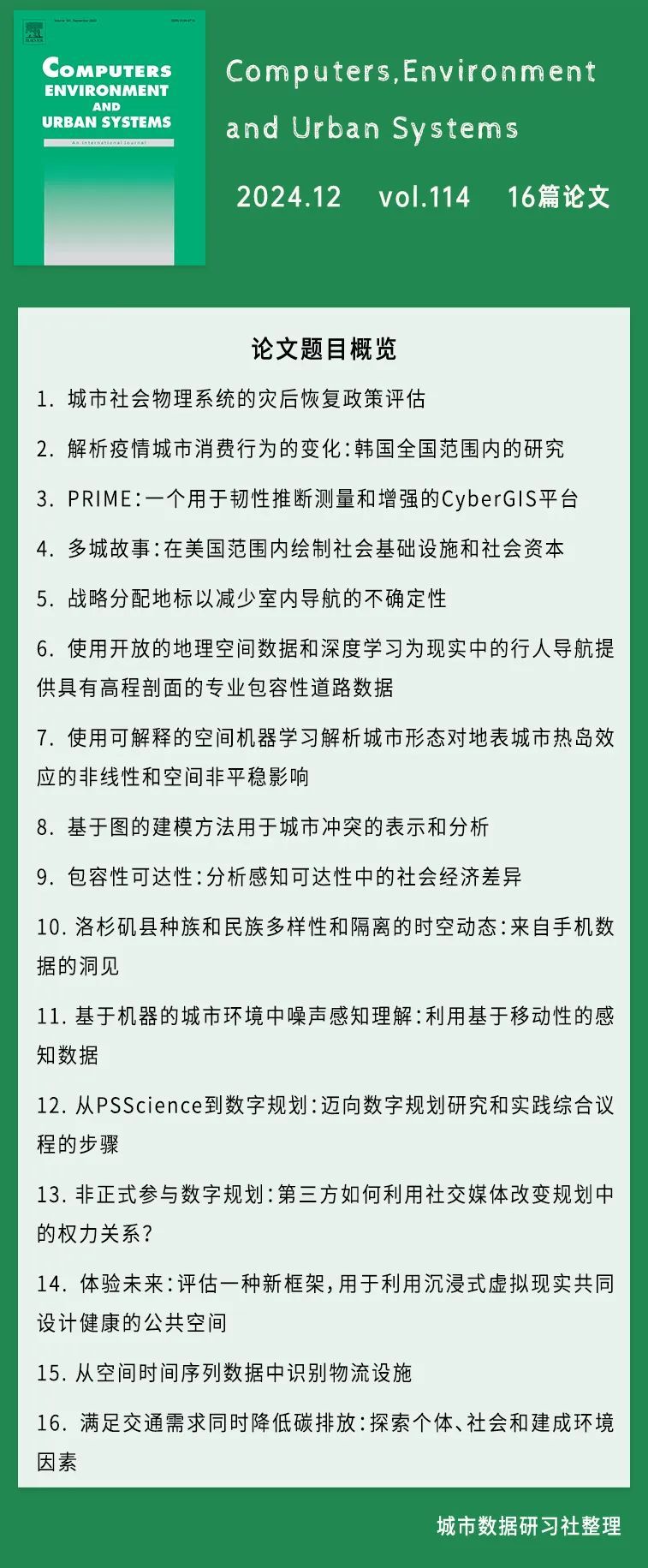
本次给大家整理的是《Computers, Environment and Urban Systems》杂志2024年12月第114期的论文的题目和摘要,一共包括16篇SCI论文!
论文1
Post-disaster recovery policy assessment of urban socio-physical systems
城市社会物理系统的灾后恢复政策评估
【摘要】
The post-disaster recovery system is composed of the complex interplay between physical and social infrastructures. Despite the rise of coupled physical and social post-disaster recovery systems, less attention has been paid to the interdependent role of social support ties and physical infrastructure. This paper analyzes the data-driven models of post-disaster recovery system dynamics with the interdependence between the social and physical coupling to assess the post-disaster recovery policies. This paper utilizes the large-scale mobile phone location data, power outages, and socio-economic attributes for modeling the recovery dynamics during Hurricane Harvey in 2017. Parameter estimation results show that the model has regional heterogeneity and disparate impacts on socio-economic attributes to the model. The model's budget allocation scenarios also demonstrate that different budget allocation strategies affect the recovery period. The proposed model emphasizes the complex properties of the post-disaster recovery system and the importance of heterogeneous recovery policies across regions.
【摘要翻译】
灾后恢复系统是由物理和社会基础设施之间复杂的相互作用构成的(Post-disaster recovery system)。尽管耦合的物理和社会灾后恢复系统日益受到关注,但对社会支持网络与物理基础设施相互依赖作用的关注却相对较少。本文分析了基于数据驱动的灾后恢复系统动态模型,该模型考虑了社会与物理之间的相互依赖性,以评估灾后恢复政策。本文利用2017年飓风哈维(Hurricane Harvey)期间的大规模手机定位数据、停电情况以及社会经济属性来模拟恢复动态。参数估计结果表明,模型具有区域异质性,并且对社会经济属性的影响各不相同。模型的预算分配方案也表明,不同的预算分配策略会影响恢复期。提出的模型强调了灾后恢复系统的复杂属性以及跨区域异质性恢复政策的重要性。
论文2
Unraveling changes of spending behavior in pandemic cities: A nationwide study of South Korea
解析疫情城市消费行为的变化:韩国全国范围内的研究
【摘要】
The COVID-19 pandemic, unprecedented in scale and impact, has significantly influenced consumer spending. This study leverages a longitudinal transaction dataset from South Korea to analyze how the pandemic, social distancing policies, and pandemic-related search interest have shaped spending within and across cities. We examine transaction volume and expenditure amount as city-level indicators of activity intensity and consumption demand across four stages of the early pandemic. The study finds that: (1) Social distancing caused reductions in both residents' and travelers' spending. The increase in search interest coincided with a rise in residents' spending but a decline in travelers' spending; (2) Resident transactions experienced a moderate and persistent decline across all stages, while expenditure rebounded after the 1st national outbreak. Traveler transactions and expenditure showed similar trends, with declines during outbreaks and recoveries during stable periods; (3) Disparities across cities were associated with proximity to outbreak centers and socioeconomic attributes. Cities with larger populations or those closer to epicenters experienced greater reductions in spending, while less densely populated cities saw increased traveler spending during the 2nd stable period; (4) Travelers' spending from distant cities significantly decreased during the 1st outbreak but gradually recovered as the pandemic continued, indicating evolving behavior and adaptation; (5) Changes across spending categories exhibited significant heterogeneity. Residents showed increased demand for essential goods and online shopping, while recreation-related industries struggled throughout. These findings highlight the characteristics and disparities among consumers, cities, and industries, providing information for policymakers to formulate tailored support programs for industries experiencing increased demand or significant impacts. This study emphasizes the need to develop robust strategies for crisis management and economic resilience to mitigate the impacts of future health crises.
【摘要翻译】
COVID-19对消费者支出行为产生了显著影响。本研究利用韩国的纵向交易数据集(longitudinal transaction dataset),分析了全球性流行病、社交距离政策(和与全球性流行病相关的搜索兴趣如何塑造城市内部及城市间的消费行为。研究发现:
-
社交距离政策导致居民和旅行者的支出减少。搜索兴趣的增加与居民支出的增加同时发生,但旅行者支出却下降;
-
居民交易在所有阶段都经历了适度且持续的下降,而支出在第一次全国性爆发后有所反弹。旅行者的交易和支出显示了类似的趋势,在爆发期间下降,在稳定期间恢复;
-
城市间的差异与疫情中心的接近程度和社会经济属性有关。人口较多的城市或那些靠近疫情中心的城市支出减少更多,而人口密度较低的城市在第二次稳定期间旅行者支出增加。
这些发现突出了消费者、城市和行业之间的特点和差异,为政策制定者提供了信息,以制定针对需求增加或受到重大影响的行业量身定制的支持计划。本研究强调了制定强大的危机管理和经济恢复策略的必要性,以减轻未来健康危机的影响。
论文3
PRIME: A CyberGIS Platform for Resilience Inference Measurement and Enhancement
PRIME:一个用于韧性推断测量和增强的CyberGIS平台
【摘要】
In an era of increased climatic disasters, there is an urgent need to develop reliable frameworks and tools for evaluating and improving community resilience to climatic hazards at multiple geographical and temporal scales. Defining and quantifying resilience in the social domain is relatively subjective due to the intricate interplay of socioeconomic factors with disaster resilience. To broaden upon it, the choice of indicators and their subsequent ranking for the aggregation into an index is subjective in nature. This aggregation is not empirically validated and is prone to omit the nuances of localized resilience changes and causal factors affecting it, while leading to oversimplified conclusions. Meanwhile, there is a lack of scientifically and computationally rigorous, user-friendly tools that can support customized resilience assessment with consideration of local conditions. This study addresses these gaps through the power of CyberGIS with three objectives: 1) To develop an empirically validated disaster resilience model - Customizable Resilience Inference Measurement (RIM), designed for multi-scale community resilience assessment and influential socioeconomic factors identification; 2) To implement a Platform for Resilience Inference Measurement and Enhancement (PRIME) module in the CyberGISX platform backed by high-performance computing, enabling users to apply and customize RIM to compute and visualize disaster resilience; 3) To demonstrate the utility of PRIME through a representative study to understand the geographical disparities of county-level community resilience to natural hazards in the United States and identifying the driving factors of resilience in the social domain. Customizable RIM generates vulnerability, adaptability, and overall resilience scores derived from empirical parameters—hazard threat, damage, and recovery. Computationally intensive Machine Learning (ML) methods are employed to explain the intricate relationships between these scores and socioeconomic driving factors. PRIME provides a web-based notebook interface guiding users to select study areas, configure parameters, calculate and geo-visualize resilience scores, and interpret socioeconomic factors shaping resilience capacities. A representative study showcases the efficiency of the platform while explaining how the visual results obtained may be interpreted. The essence of this work lies in its comprehensive architecture that encapsulates the requisite data, analytical and geo-visualization functions, and ML models for resilience assessment. This setup provides a foundation for assessing resilience and strategizing enhancement interventions.
【摘要翻译】
在气候变化灾害日益增多的时代,迫切需要开发可靠的框架和工具,以在多个地理和时间尺度上评估和提高社区对气候灾害的韧性。在社会领域定义和量化韧性相对主观,因为社会经济因素与灾害韧性之间的相互作用复杂。为了进一步探讨这一问题,选择指标及其随后的排名以聚合为一个指数是主观的。这种聚合没有经过实证验证,容易忽略本地韧性变化的细微差别和影响它的因果因素,同时导致过于简化的结论。与
 最低0.47元/天 解锁文章






 扫一扫
扫一扫


 被折叠的 条评论
为什么被折叠?
被折叠的 条评论
为什么被折叠?
 到【灌水乐园】发言





