


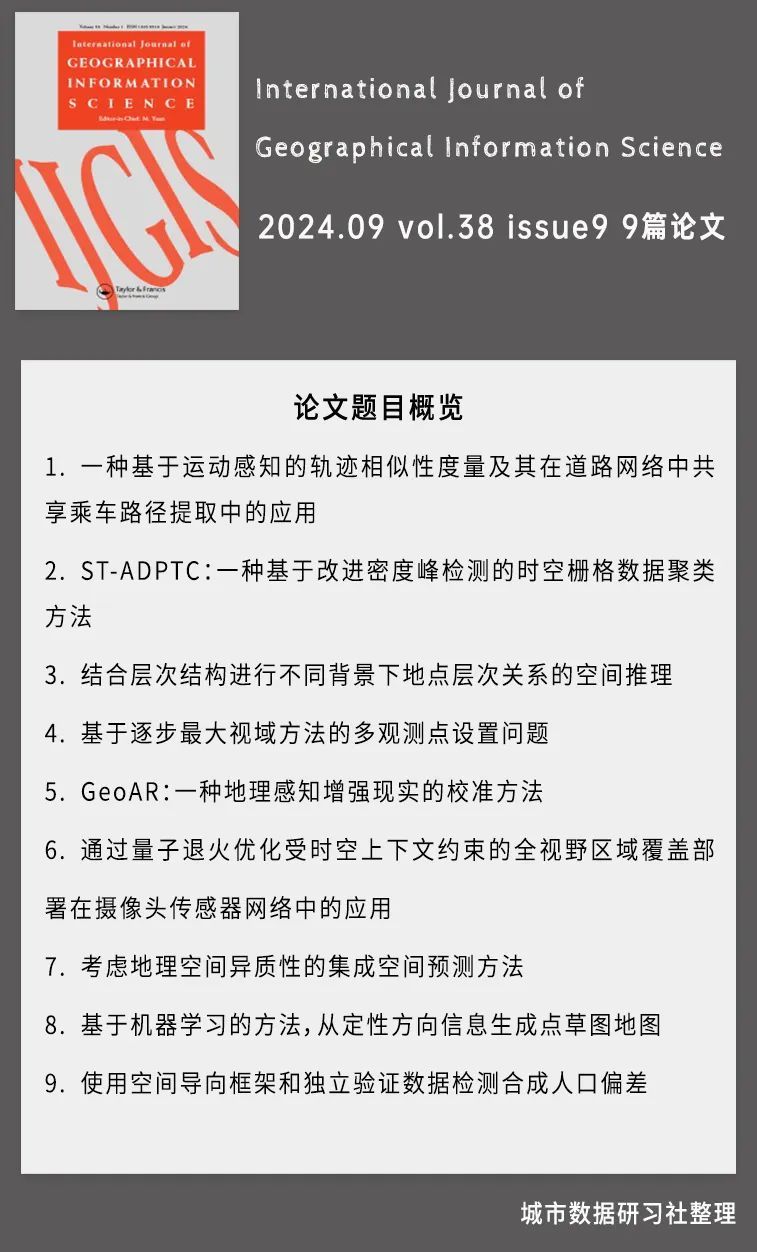
本次给大家整理的是《International Journal of Geographical Information Science》杂志2024年第38卷第9期的论文的题目和摘要,一共包括9篇SCI论文!
论文1
A movement-aware measure for trajectory similarity and its application for ride-sharing path extraction in a road network
一种基于运动感知的轨迹相似性度量及其在道路网络中共享乘车路径提取中的应用
【摘要】
Recognizing common travel paths of crowds in a road network is valuable for understanding human mobility patterns and developing intelligent ride-sharing services. To achieve this, it is critical to measure the similarity of their trajectories. Although many measures have been proposed in the past decades, they often ignore movement consistency, exhibit one or more deficiencies in the face of noise and misaligned trajectories, or require extra parameters to tune predictions. In this paper, we propose an improved similarity measure called the directed segment path distance (DSPD), which considers the spatial proximity and movement consistency of trajectories. By integrating the spatial proximity distance and moving direction similarity between trajectories, the DSPD is a competitive parameter-free similarity measure that can effectively distinguish trajectories with different movement characteristics. To verify the effectiveness of the DSPD, we conducted a quantitative comparative study between the DSPD measure and 11 state-of-the-art trajectory similarity measures on six simulated trajectory datasets and applied the DSPD to two typical application scenarios: trajectory clustering for road network generation and retrieving common trajectories for ride-sharing path planning. The results demonstrate the effectiveness, robustness, and superiority of the DSPD and its great potential in trajectory search, clustering, and classification.
【摘要翻译】
在道路网络中识别人群的常见旅行路径对于理解人类移动模式和开发智能共享乘车服务具有重要价值。为了实现这一目标,关键在于测量其轨迹的相似性。尽管在过去几十年中提出了许多度量方法,但它们往往忽视了运动的一致性,在面对噪声和错位轨迹时表现出一种或多种缺陷,或者需要额外的参数来调优预测。本文提出了一种改进的相似性度量,称为定向段路径距离(DSPD),该度量考虑了轨迹的空间接近性和运动一致性。通过整合轨迹之间的空间接近距离和运动方向相似性,DSPD是一种具有竞争力的无参数相似性度量,可以有效区分具有不同运动特征的轨迹。为了验证DSPD的有效性,我们对DSPD度量与11种最先进的轨迹相似性度量在六个模拟轨迹数据集上进行了定量比较研究,并将DSPD应用于两个典型应用场景:道路网络生成的轨迹聚类和共享乘车路径规划中的常见轨迹检索。结果证明了DSPD的有效性、鲁棒性和优越性,以及其在轨迹搜索、聚类和分类中的巨大潜力。
【doi】
https://doi.org/10.1080/13658816.2024.2353695
【作者信息】
Ju Peng,中南大学,地理信息学系,中国湖南长沙
Min Deng,中南大学,地理信息学系;湖南省地理空间信息工程技术研究中心,中国湖南长沙
Jianbo Tang,中南大学,地理信息学系;湖南省地理空间信息工程技术研究中心,中国湖南长沙
Zhiyuan Hu,中南大学,地理信息学系,中国湖南长沙
Heyan Xia,中南大学,地理信息学系,中国湖南长沙
Huimin Liu,中南大学,地理信息学系,中国湖南长沙
Xiaoming Mei,中南大学,地理信息学系,中国湖南长沙
论文2
ST-ADPTC: a method for clustering spatiotemporal raster data based on improved density peak detection
ST-ADPTC:一种基于改进密度峰检测的时空栅格数据聚类方法
【摘要】
Spatiotemporal raster (STR) data employ an array of grids to represent temporally varying and spatially distributed information, commonly utilized for recording environmental variables and socioeconomic indices. To reveal the geographic patterns embedded in STR data, the clustering by fast search and finding of density peaks (CFSFDP) algorithm is considered effective and suitable. However, this algorithm encounters limitations in identifying cluster centers, handling large data volumes, and measuring the coupled spatial-temporal-attribute distance when applied to STR data. To overcome these challenges, we propose an improved method named spatial temporal-adaptive density peak tree clustering (ST-ADPTC). This method leverages adaptive density peak tree segmentation to identify cluster centers and optimizes memory usage through the k-nearest neighbors (kNN) technique. By constructing a neighborhood that incorporates both spatiotemporal and thematic attribute similarities, ST-ADPTC computes the local density of STR data, facilitating the discovery of time-varying clusters. Based on the proposed method, we develop an open-source Python package (Geo_ADPTC). Experiments conducted using benchmarking datasets illustrate improvements in cluster identification and memory reduction. Additionally, a cas
 最低0.47元/天 解锁文章






 扫一扫
扫一扫


 2065
2065

 被折叠的 条评论
为什么被折叠?
被折叠的 条评论
为什么被折叠?
 到【灌水乐园】发言





