



 转载文章介绍Go语言编译器会进行逃逸分析,自动决定变量放在栈还是堆。若变量作用域未超出函数范围,可分配在栈,反之则在堆。动态new的局部变量也依逃逸行为分配。且Go有垃圾回收机制,可让程序员更关注程序功能逻辑。
转载:https://blog.youkuaiyun.com/li_101357/article/details/80209413
How do I know whether a variable is allocated on the heap or the stack?

From a correctness standpoint, you don't need to know. Each variable in Go exists as long as there are references to it. The storage location chosen by the implementation is irrelevant to the semantics of the language.

The storage location does have an effect on writing efficient programs. When possible, the Go compilers will allocate variables that are local to a function in that function's stack frame. However, if the compiler cannot prove that the variable is not referenced after the function returns, then the compiler must allocate the variable on the garbage-collected heap to avoid dangling pointer errors. Also, if a local variable is very large, it might make more sense to store it on the heap rather than the stack.

In the current compilers, if a variable has its address taken, that variable is a candidate for allocation on the heap. However, a basic escape analysis recognizes some cases when such variables will not live past the return from the function and can reside on the stack.
go语言编译器会自动决定把一个变量放在栈还是放在堆,编译器会做逃逸分析(escape analysis),当发现变量的作用域没有跑出函数范围,就可以在栈上,反之则必须分配在堆。所以不用担心会不会导致memory leak,因为GO语言有强大的垃圾回收机制。go语言声称这样可以释放程序员关于内存的使用限制,更多的让程序员关注于程序功能逻辑本身。
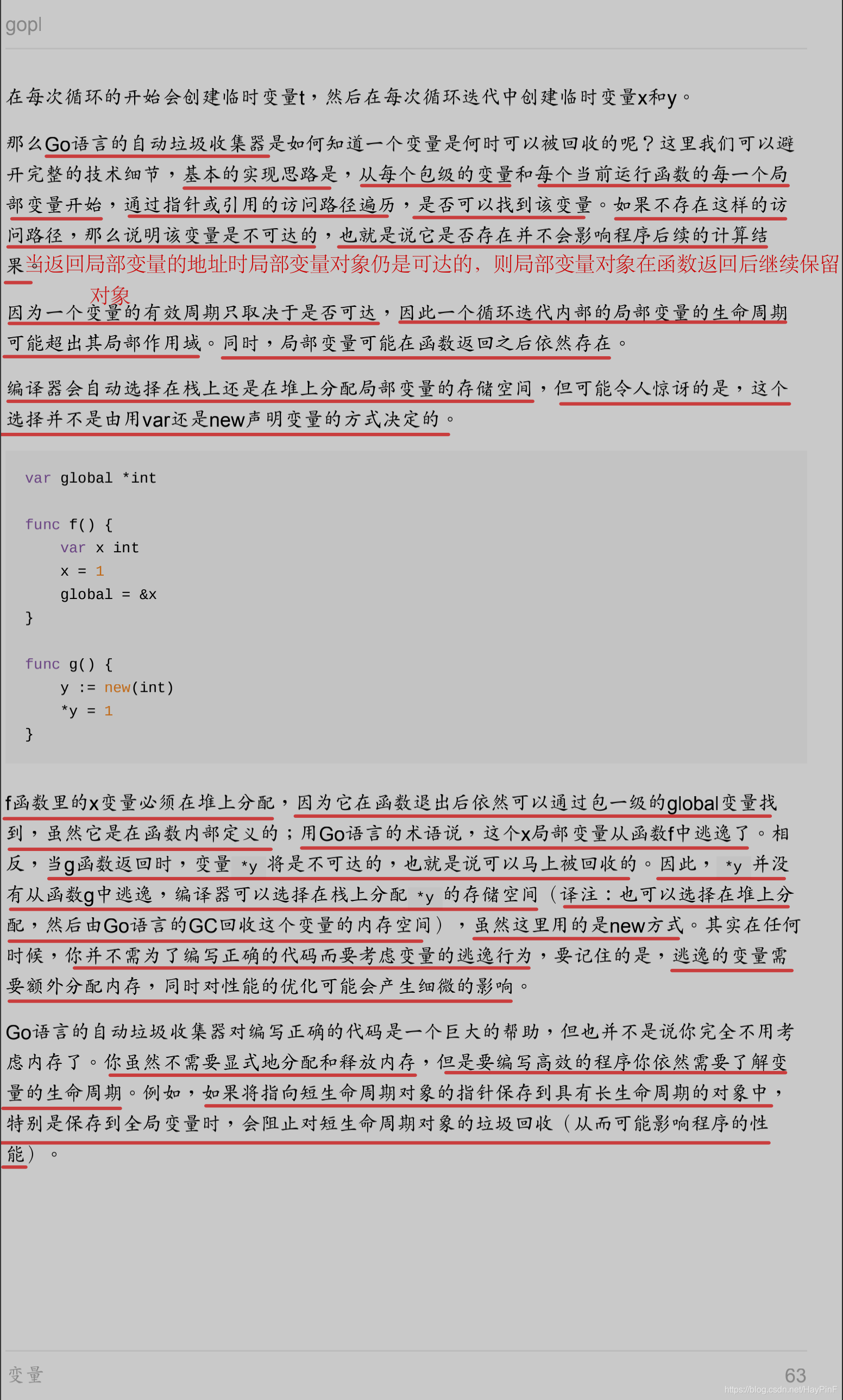
对于动态new出来的局部变量,go语言编译器也会根据是否有逃逸行为来决定是分配在堆还是栈,而不是直接分配在堆中。
《Go Programming Language》(Go语言圣经):





 扫一扫
扫一扫


 到【灌水乐园】发言



