



 博客介绍了两种处理方法,递归和迭代。递归有bottom - up和top - down两种,top - down时间复杂度为n,空间复杂度为logn;bottom - up时间复杂度为nlogn,空间复杂度为n^2。迭代时间复杂度为n,空间复杂度为n。还提醒做字符串拼接时用stringbuilder代替+。
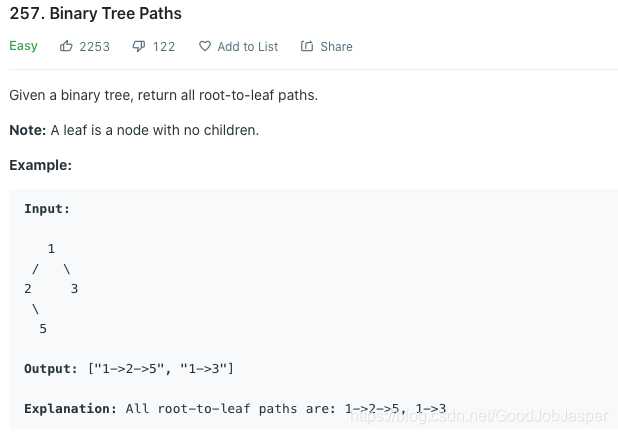
方法1: recursion。这里其实有两种recursion,一种是我自己写的bottom-up,还有一种是lc的答案top-down。这里很明显top-down要好,因为如果bottom-up的话就存在要copy children to parent这个操作,这个操作复杂度是logn,所以bottom-up会慢很多。总结一下:top-down时间复杂n,空间复杂logn。bottom-up时间复杂nlogn,空间复杂n^2.
/**
 * Definition for a binary tree node.
 * public class TreeNode {
 *     int val;
 *     TreeNode left;
 *     TreeNode right;
 *     TreeNode() {}
 *     TreeNode(int val) { this.val = val; }
 *     TreeNode(int val, TreeNode left, TreeNode right) {
 *         this.val = val;
 *         this.left = left;
 *         this.right = right;
 *     }
 * }
 */
 // bottom-up
class Solution {
    public List<String> binaryTreePaths(TreeNode root) {
        List<String> list = new ArrayList<>();
        if(root == null) return list;
        if(root.left == null && root.right == null){
            list.add(Integer.toString(root.val));
            return list;
        }
        if(root.left != null){
            List<String> list1 = binaryTreePaths(root.left);
            for(String s : list1){
                s = root.val + "->" + s;
                list.add(s);
            }
        }
        if(root.right != null){
            List<String> list2 = binaryTreePaths(root.right);
            for(String s : list2){
                s = root.val + "->" + s;
                list.add(s);
            }
        }
        return list;
    }
}
// top-down
class Solution {
  public void construct_paths(TreeNode root, String path, LinkedList<String> paths) {
    if (root != null) {
      path += Integer.toString(root.val);
      if ((root.left == null) && (root.right == null))  // if reach a leaf
        paths.add(path);  // update paths
      else {
        path += "->";  // extend the current path
        construct_paths(root.left, path, paths);
        construct_paths(root.right, path, paths);
      }
    }
  }

  public List<String> binaryTreePaths(TreeNode root) {
    LinkedList<String> paths = new LinkedList();
    construct_paths(root, "", paths);
    return paths;
  }
}
方法2: iteration。时间复杂n,空间复杂n。
/**
 * Definition for a binary tree node.
 * public class TreeNode {
 *     int val;
 *     TreeNode left;
 *     TreeNode right;
 *     TreeNode() {}
 *     TreeNode(int val) { this.val = val; }
 *     TreeNode(int val, TreeNode left, TreeNode right) {
 *         this.val = val;
 *         this.left = left;
 *         this.right = right;
 *     }
 * }
 */
class Solution {
    public List<String> binaryTreePaths(TreeNode root) {
        List<String> list = new ArrayList<>();
        if(root == null){
            return list;
        }
        Stack<TreeNode> node_stack = new Stack<>();
        Stack<String> path_stack = new Stack<>();
        node_stack.push(root);
        path_stack.push(Integer.toString(root.val));
        while(!node_stack.isEmpty()){
            TreeNode node = node_stack.pop();
            String path = path_stack.pop();
            if(node.left == null && node.right == null){
                list.add(path);
            }
            if(node.left != null){
                node_stack.push(node.left);
                path_stack.push(path + "->" + Integer.toString(node.left.val));
            }
            if(node.right != null){
                node_stack.push(node.right);
                path_stack.push(path + "->" + Integer.toString(node.right.val));
            }
        }
        return list;
    }
}
总结:
- 在做string contact的时候要避免+,我们要去使用stringbuilder。





 扫一扫
扫一扫


 430
430

 被折叠的 条评论
为什么被折叠?
被折叠的 条评论
为什么被折叠?
 到【灌水乐园】发言





