



 介绍Redis中压缩列表(ziplist)的结构与实现原理,包括存储结构、编码方式及基本操作。
0.reference
1.压缩列表初识
1.1 简介
压缩列表ziplist本质上就是一个字节数组,是Redis为了节约内存而设计的一种线性数据结构,可以包含多个元
素,每个元素可以是一个字节数组或一个整数。Redis的有序集合、散列和列表都直接或者间接使用了压缩列表。
当有序集合或散列表的元素个数比较少,且元素都是短字符串时,Redis便使用压缩列表作为其底层数据存储结
构。列表使用快速链表(quicklist)数据结构存储,而快速链表就是双向链表与压缩列表的组合。
1.2 测试相关命令
redis-server
redis-cli
hmset person name zhangsan gender 1 age 22
object encoding person

127.0.0.1:6379> hmset person name zhangsan gender 1 age 22
OK
127.0.0.1:6379> object encoding person
"ziplist"

注释与复习:
hmset是hset的批量设置形式,成功返回ok
2. 压缩列表的设计与源码分析
2.1 压缩列表的存储结构
2.1.1 示意与字段含义
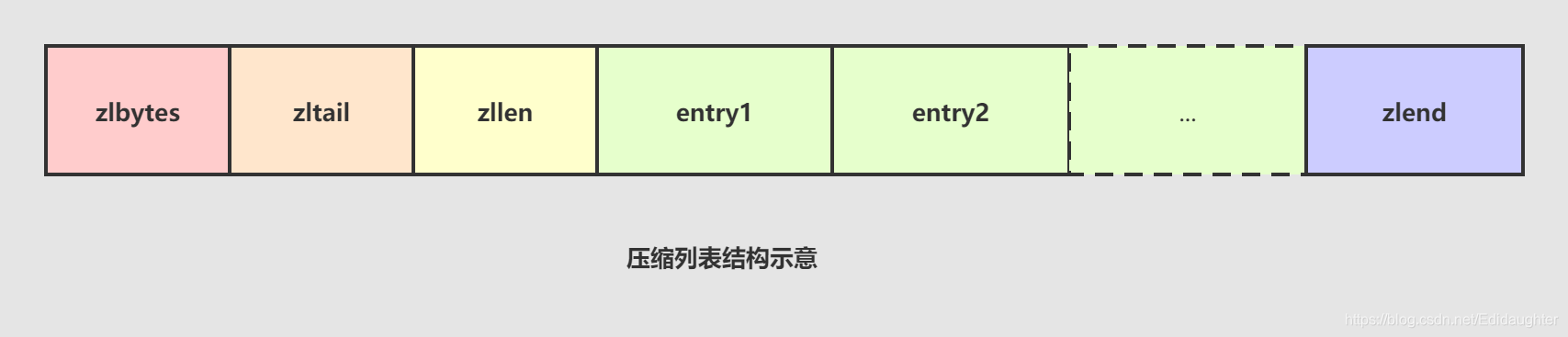
1)zlbytes:压缩列表的字节长度,占4个字节,因此压缩列表最多有2^32-1个字节。
2)zltail:压缩列表尾元素相对于压缩列表起始地址的偏移量,占4个字节。
3)zllen:压缩列表的元素个数,占2个字节。zllen无法存储元素个数超过65535(2^16-1)的压缩列表,必须
遍历整个压缩列表才能获取到元素个数。
4)entryX:压缩列表存储的元素,可以是字节数组或者整数,长度不限。entry的编码结构将在后面详细介绍。
5)zlend:压缩列表的结尾,占1个字节,恒为0xFF。
2.1.2 字段的存取操作
假设char * zl(zl应该是ziplist的缩写)指向压缩列表首地址,Redis可通过以下宏定义实现压缩列表各个字段的存取操作:
/* Macro to determine if the entry is a string. String entries never start
 * with "11" as most significant bits of the first byte. */
#define ZIP_IS_STR(enc) (((enc) & ZIP_STR_MASK) < ZIP_STR_MASK)

/* Utility macros. zl指向zlbytes字段*/
#define ZIPLIST_BYTES(zl)       (*((uint32_t*)(zl)))/* Return total bytes a ziplist is composed of. */

/* Return the offset of the last item inside the ziplist. */
/*zl+4 指向zltail字段*/
#define ZIPLIST_TAIL_OFFSET(zl) (*((uint32_t*)((zl)+sizeof(uint32_t))))

/* Return the length of a ziplist, or UINT16_MAX if the length cannot be
 * determined without scanning the whole ziplist. */
/*zl+8 指向zllen字段*/
#define ZIPLIST_LENGTH(zl)      (*((uint16_t*)((zl)+sizeof(uint32_t)*2)))

/* The size of a ziplist header: two 32 bit integers for the total
 * bytes count and last item offset. One 16 bit integer for the number
 * of items field. */
#define ZIPLIST_HEADER_SIZE     (sizeof(uint32_t)*2+sizeof(uint16_t))

/* Size of the "end of ziplist" entry. Just one byte. */
#define ZIPLIST_END_SIZE        (sizeof(uint8_t))

/* Return the pointer to the first entry of a ziplist. */
#define ZIPLIST_ENTRY_HEAD(zl)  ((zl)+ZIPLIST_HEADER_SIZE)

/* Return the pointer to the last entry of a ziplist, using the
 * last entry offset inside the ziplist header. */
/*zl+zltail指向尾元素首地址,intrev32ifbe使得数据存储统一采用小端法*/
#define ZIPLIST_ENTRY_TAIL(zl)  ((zl)+intrev32ifbe(ZIPLIST_TAIL_OFFSET(zl)))

/* Return the pointer to the last byte of a ziplist, which is, the
 * end of ziplist FF entry. */
/*压缩列表最后一个字段即为zlend字段*/
#define ZIPLIST_ENTRY_END(zl)   ((zl)+intrev32ifbe(ZIPLIST_BYTES(zl))-1)

/* Increment the number of items field in the ziplist header. Note that this
 * macro should never overflow the unsigned 16 bit integer, since entries are
 * always pushed one at a time. When UINT16_MAX is reached we want the count
 * to stay there to signal that a full scan is needed to get the number of
 * items inside the ziplist. */
#define ZIPLIST_INCR_LENGTH(zl,incr) { \
    if (ZIPLIST_LENGTH(zl) < UINT16_MAX) \
        ZIPLIST_LENGTH(zl) = intrev16ifbe(intrev16ifbe(ZIPLIST_LENGTH(zl))+incr); \
}


部分注释摘抄:
(1)ZIPLIST_BYTES(zl)      --zl指向zlbytes字段
(2)ZIPLIST_TAIL_OFFSET(zl)--zl+4 指向zltail字段
(3)ZIPLIST_LENGTH(zl)     --zl+8 指向zllen字段
(4)ZIPLIST_ENTRY_TAIL(zl) --zl+zltail指向尾元素首地址,intrev32ifbe使得数据存储统一采用小端法
(5)ZIPLIST_ENTRY_END(zl)  --压缩列表最后一个字段即为zlend字段
2.1.3 压缩列表元素entryX的编码结构
了解了压缩列表的基本结构,我们可以很容易地获得压缩列表的字节长度、元素个数等,那么如何遍历压缩列表
呢?对于任意一个元素,我们如何判断其存储的是什么类型呢?我们又如何获取字节数组的长度呢?回答这些问
题之前,需要先了解压缩列表元素的编码结构: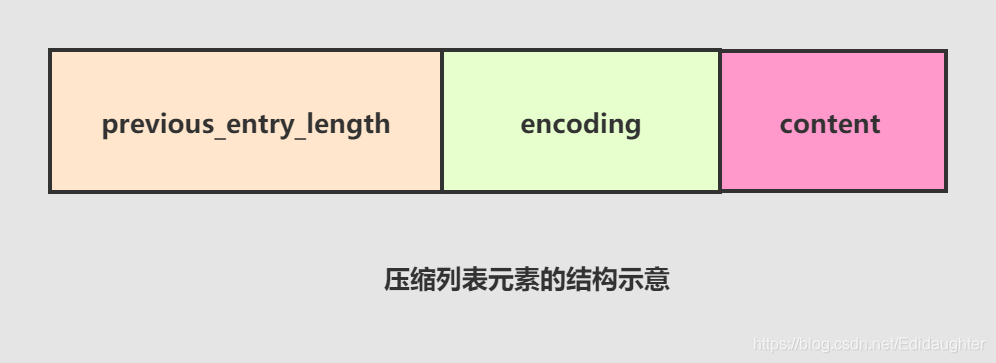
1.previous_entry_length
表示前一个元素的字节长度,占1个或者5个字节.
当前一个元素的长度小于254字节时,用1个字节表示;
当前一个元素的长度大于或等于254字节时,用5个字节来表示,此时previous_entry_length字段的第1个字节是
固定的0xFE,后面4个字节才真正表示前一个元素的长度;
假设已知当前元素的首地址为p,那么p-previous_entry_length就是前一个元素的首地址,从而实现压缩列表从
尾到头的遍历.

2.encoding
表示当前元素的编码,即content字段存储的数据类型(整数或者字节数组),数据内容存储在content字段.
为了节约内存,encoding字段同样长度可变.

2.1
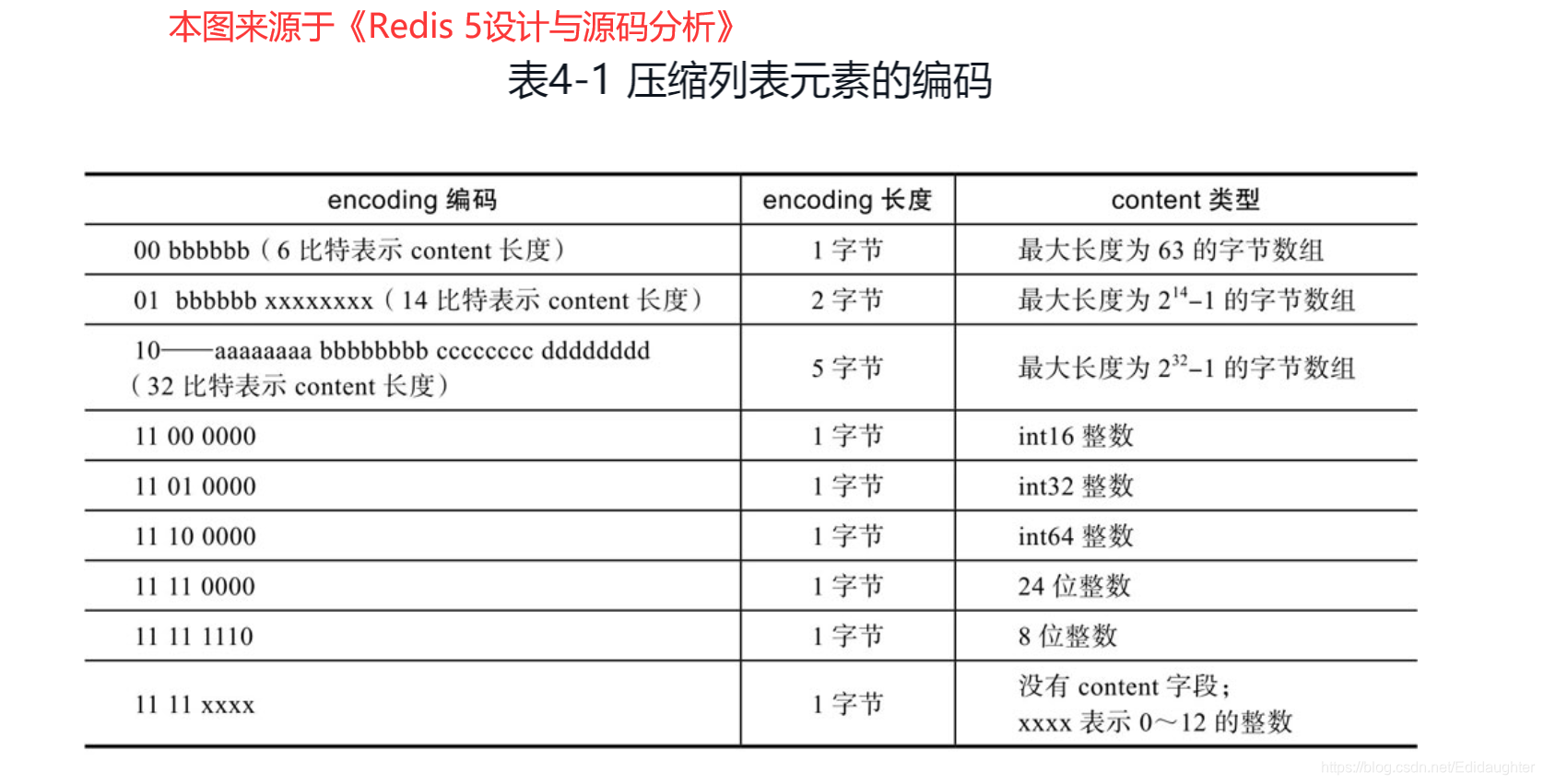
分析上面从书中截取来的图中的encoding编码,可以看出,encoding字段的
第1个字节的前2位,可以判断content字段存储的是整数或者字节数组(及其最大长度),
00-长度范围为0-63的字节数组;
01-长度范围为64-16383的字节数组;
11-长度方位为16384-4294967295的字节数组;
11-整数

2.2
content存储的是字节数组时,后续字节标识字节数组的实际长度;当content存储的是整数时,可根据第3、
第4位判断整数的具体类型。而当encoding字段标识当前元素存储的是0~12的立即数时,数据直接存储在
encoding字段的最后4位,此时没有content字段。

2.3
参照encoding字段的编码表格,Redis预定义了以下常量对应encoding字段的各编码类型:
#define ZIP_STR_MASK 0xc0
#define ZIP_INT_MASK 0x30
#define ZIP_STR_06B (0 << 6)
#define ZIP_STR_14B (1 << 6)
#define ZIP_STR_32B (2 << 6)
#define ZIP_INT_16B (0xc0 | 0<<4)
#define ZIP_INT_32B (0xc0 | 1<<4)
#define ZIP_INT_64B (0xc0 | 2<<4)
#define ZIP_INT_24B (0xc0 | 3<<4)
#define ZIP_INT_8B 0xfe


说明:
2^6  - 1 = 63
2^14 - 1 = 16383
2^32 - 1 = 4294967295
2.1.4 entryX经解码后的结构体定义zlentry
typedef struct zlentry {
    unsigned int prevrawlensize; // previous_entry_length字段的长度
    unsigned int prevrawlen;     // previous_entry_length字段存储的内容
    unsigned int lensize;        // encoding字段的长度
    unsigned int len;            // encoding字段的存储的内容
    unsigned int headersize;     // 当前元素的首部长度,是previous_entry_length字段长度与encoding字段长度之和
    unsigned char encoding;      // 当前元素的编码
    unsigned char *p;            // 当前元素首地址
} zlentry;


说明:
1.encoding的含义
Set to ZIP_STR_* or ZIP_INT_* depending on the entry encoding.
However for 4 bits immediate integers this can assume a range
of values and must be range-checked.
根据entry的解码被设置成ZIP_STR_*或 ZIP_INT_*.
但是对于4个bits位以内的数据可以被视为一个范围并且必须要检查范围.
2.1.5 函数zipEntry解码压缩列表的元素,存储于zlentry结构体
函数zipEntry用来解码压缩列表的元素,存储于zlentry结构体.

/* Return a struct with all information about an entry. */
void zipEntry(unsigned char *p, zlentry *e) {

    ZIP_DECODE_PREVLEN(p, e->prevrawlensize, e->prevrawlen);
    ZIP_DECODE_LENGTH(p + e->prevrawlensize, e->encoding, e->lensize, e->len);
    e->headersize = e->prevrawlensize + e->lensize;
    e->p = p;
}
第一步.解码previous_entry_length字段,此时入参ptr指向元素首地址;
/* Return the length of the previous element, and the number of bytes that
 * are used in order to encode the previous element length.
 * 'ptr' must point to the prevlen prefix of an entry (that encodes the
 * length of the previous entry in order to navigate the elements backward).
 * The length of the previous entry is stored in 'prevlen', the number of
 * bytes needed to encode the previous entry length are stored in
 * 'prevlensize'. */
#define ZIP_DECODE_PREVLEN(ptr, prevlensize, prevlen) do {                     \
    ZIP_DECODE_PREVLENSIZE(ptr, prevlensize);                                  \
    if ((prevlensize) == 1) {                                                  \
        (prevlen) = (ptr)[0];                                                  \
    } else if ((prevlensize) == 5) {                                           \
        assert(sizeof((prevlen)) == 4);                                        \
        memcpy(&(prevlen), ((char*)(ptr)) + 1, 4);                             \
        memrev32ifbe(&prevlen);                                                \
    }                                                                          \
} while(0);
第二步 解码encoding字段逻辑,此时入参ptr指向元素首地址偏移previous_entry_length字段长度的位置;
/* Decode the entry encoding type and data length (string length for strings,
 * number of bytes used for the integer for integer entries) encoded in 'ptr'.
 * The 'encoding' variable will hold the entry encoding, the 'lensize'
 * variable will hold the number of bytes required to encode the entry
 * length, and the 'len' variable will hold the entry length. */
#define ZIP_DECODE_LENGTH(ptr, encoding, lensize, len) do {                    \
    ZIP_ENTRY_ENCODING((ptr), (encoding));                                     \
    if ((encoding) < ZIP_STR_MASK) {                                           \
        if ((encoding) == ZIP_STR_06B) {                                       \
            (lensize) = 1;                                                     \
            (len) = (ptr)[0] & 0x3f;                                           \
        } else if ((encoding) == ZIP_STR_14B) {                                \
            (lensize) = 2;                                                     \
            (len) = (((ptr)[0] & 0x3f) << 8) | (ptr)[1];                       \
        } else if ((encoding) == ZIP_STR_32B) {                                \
            (lensize) = 5;                                                     \
            (len) = ((ptr)[1] << 24) |                                         \
                    ((ptr)[2] << 16) |                                         \
                    ((ptr)[3] <<  8) |                                         \
                    ((ptr)[4]);                                                \
        } else {                                                               \
            panic("Invalid string encoding 0x%02X", (encoding));               \
        }                                                                      \
    } else {                                                                   \
        (lensize) = 1;                                                         \
        (len) = zipIntSize(encoding);                                          \
    }                                                                          \
} while(0);
字节数组只根据ptr[0]的前2个比特即可判断类型,而判断整数类型需要ptr[0]的前4个比特,代码如下:
/* Return bytes needed to store integer encoded by 'encoding'. */
unsigned int zipIntSize(unsigned char encoding) {
    switch(encoding) {
    case ZIP_INT_8B:  return 1;
    case ZIP_INT_16B: return 2;
    case ZIP_INT_24B: return 3;
    case ZIP_INT_32B: return 4;
    case ZIP_INT_64B: return 8;
    }
    if (encoding >= ZIP_INT_IMM_MIN && encoding <= ZIP_INT_IMM_MAX)
        return 0; /* 4 bit immediate */
    panic("Invalid integer encoding 0x%02X", encoding);
    return 0;
}
3.基本操作
3.1 创建压缩列表ziplistNew
#define ZIPLIST_HEADER_SIZE (sizeof(uint32_t)*2+sizeof(uint16_t))
#define ZIPLIST_END_SIZE (sizeof(uint8_t))
#define ZIP_END 255

/* Create a new empty ziplist. */
unsigned char *ziplistNew(void) {
    // ZIPLIST_HEADER_SIZE = zlbytes + zltail + zllen
    unsigned int bytes = ZIPLIST_HEADER_SIZE+ZIPLIST_END_SIZE;
    unsigned char *zl = zmalloc(bytes);
    ZIPLIST_BYTES(zl) = intrev32ifbe(bytes);
    ZIPLIST_TAIL_OFFSET(zl) = intrev32ifbe(ZIPLIST_HEADER_SIZE);
    ZIPLIST_LENGTH(zl) = 0;
    zl[bytes-1] = ZIP_END; // ZIP_END 结尾标识符0XFF
    return zl;
}


zlbytes,zltail,zllen见本文【2.1.1】所示内容.
3.2 插入元素ziplistInsert
插入元素可以简要分为3个步骤:
① 将元素内容编码;
② 重新分配空间;
③ 复制数据。
3.3 删除元素ziplistDelete
压缩列表删除元素的API定义如下,函数输入参数zl指向压缩列表首地址;*p指向待删除元素的首地址(参数p同时可以作为输出参数);返回参数为压缩列表首地址。
unsigned char *ziplistDelete(unsigned char *zl, unsigned char **p) {
    size_t offset = *p-zl;
    zl = __ziplistDelete(zl,*p,1);
    return zl;
}
3.4 遍历压缩列表ziplistNext&ziplistPrev
遍历就是从头到尾(后向遍历)或者从尾到头(前向遍历)访问压缩列表中的每个元素。
压缩列表的遍历API定义如下,函数输入参数zl指向压缩列表首地址,p指向当前访问元素的首地址;
ziplistNext函数返回后一个元素的首地址,ziplistPrev返回前一个元素的首地址.
// 后向遍历
unsigned char *ziplistNext(unsigned char *zl, unsigned char *p) {
    ((void) zl);
    if (p[0] == ZIP_END) {
        return NULL;
    }
    p += zipRawEntryLength(p);
    if (p[0] == ZIP_END) {
        return NULL;
    }
    return p;
}

// 前向遍历
unsigned char *ziplistPrev(unsigned char *zl, unsigned char *p) {
    unsigned int prevlensize, prevlen = 0;
    if (p[0] == ZIP_END) {
        p = ZIPLIST_ENTRY_TAIL(zl);
        return (p[0] == ZIP_END) ? NULL : p;
    } else if (p == ZIPLIST_ENTRY_HEAD(zl)) {
        return NULL;
    } else {
        ZIP_DECODE_PREVLEN(p, prevlensize, prevlen);
        assert(prevlen > 0);
        return p-prevlen;
    }
}





 扫一扫
扫一扫


 3151
3151

 被折叠的 条评论
为什么被折叠?
被折叠的 条评论
为什么被折叠?
 到【灌水乐园】发言





