


海山数据库(He3DB)源码详解:ResourceOwnerData及ResourceArray结构体解析
本文介绍了事务执行过程中,检查一个堆元组是否对当前事务可见,用于确保事务可以看到正确的数据版本。
ResourceOwnerData 结构体的作用
ResourceOwnerData 是 PostgreSQL 中用于管理资源所有权的核心结构体。它定义了一个资源所有者(ResourceOwner)的内部数据结构,用于跟踪和管理事务或子事务中占用的各种资源。这些资源包括缓冲区、缓存引用、文件、锁等。以下是对 ResourceOwnerData 结构体及其成员的详细解读:
1. 树状结构
所有的ResourceOwnerData数据会构成树状结构,如下图所示:
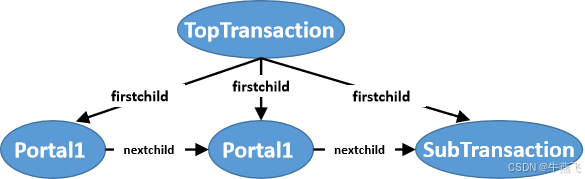
TopTransaction作为父节点,通过firstchild指针连接三个子节点;- 三个子节点分别通过
nextchild指针构成链表;
2. 结构体定义
typedef struct ResourceOwnerData
{
	ResourceOwner parent;		/* NULL if no parent (toplevel owner) */
	ResourceOwner firstchild;	/* head of linked list of children */
	ResourceOwner nextchild;	/* next child of same parent */
	const char *name;			/* name (just for debugging) */

	/* We have built-in support for remembering: */
	ResourceArray bufferarr;	/* owned buffers */
	ResourceArray catrefarr;	/* catcache references */
	ResourceArray catlistrefarr;	/* catcache-list pins */
	ResourceArray relrefarr;	/* relcache references */
	ResourceArray planrefarr;	/* plancache references */
	ResourceArray tupdescarr;	/* tupdesc references */
	ResourceArray snapshotarr;	/* snapshot references */
	ResourceArray filearr;		/* open temporary files */
	ResourceArray dsmarr;		/* dynamic shmem segments */
	ResourceArray jitarr;		/* JIT contexts */
	ResourceArray cryptohasharr;	/* cryptohash contexts */
	ResourceArray hmacarr;		/* HMAC contexts */

	/* We can remember up to MAX_RESOWNER_LOCKS references to local locks. */
	int			nlocks;			/* number of owned locks */
	LOCALLOCK  *locks[MAX_RESOWNER_LOCKS];	/* list of owned locks */
}			ResourceOwnerData;
1. 树状结构成员
-
ResourceOwner parent;- 类型:
ResourceOwner(指向另一个ResourceOwnerData的指针) - 作用:指向当前资源所有者的父节点。如果当前所有者
- 类型:
 最低0.47元/天 解锁文章






 扫一扫
扫一扫


 1292
1292

 被折叠的 条评论
为什么被折叠?
被折叠的 条评论
为什么被折叠?
 到【灌水乐园】发言





