



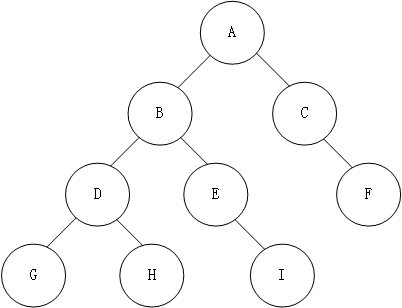
以此树为demo
先序遍历
定义:优先访问根节点,然后访问左子树,最后访问右子树,根节点->左子树->右子树
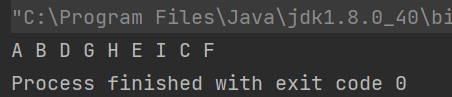
按照定义,那么上述demo的结果可以很好得出来:A->B->D->G->H->E->I->C->F
那么算法怎么实现呢?这里使用递归方法:
public static void nlr(TreeNode rootNode) {
    TreeNode leftChild;
    TreeNode rightNode;
    if (rootNode != null) {
        System.out.print(rootNode.data+" ");
        leftChild = rootNode.leftChild;
        nlr(leftChild);

        rightNode = rootNode.rightChild;
        nlr(rightNode);
    }
}
运行结果如下:
中序遍历
定义:优先访问左子树,然后访问根节点,然后访问右子树,左子树->根节点->右子树
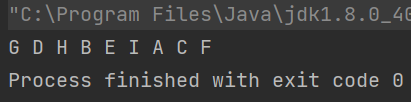
按照定义,那么上述demo的结果可以很好得出来:G->D->H->B->E-I->A->C->F
public static void lnr(TreeNode rootNode) {
    TreeNode leftChild;
    TreeNode rightNode;
    if (rootNode != null) {
        leftChild = rootNode.leftChild;
        lnr(leftChild);
        System.out.print(rootNode.data+" ");
        rightNode = rootNode.rightChild;
        lnr(rightNode);
    }
}
运行结果如下:
后续遍历
定义:优先访问左子树,然后访问右子树,然后访问根节点,左子树->右子树->根节点
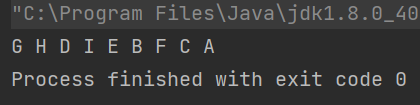
按照定义,那么上述demo的结果可以很好得出来:G->H->D->I->E->B->F->C->A
public static void lrn(TreeNode rootNode) {
    TreeNode leftChild;
    TreeNode rightNode;
    if (rootNode != null) {
        leftChild = rootNode.leftChild;
        lrn(leftChild);
        rightNode = rootNode.rightChild;
        lrn(rightNode);
        System.out.print(rootNode.data+" ");
    }
}
运行结果如下:
按层遍历
定义:广度优先遍历,优先访问节点的左子树和右子树
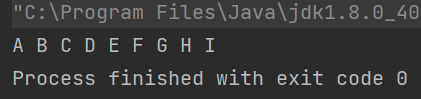
使用队列方式来,每个节点判断一下有没有左右子树,有的话直接offer进队列,然后不停的输出队列即可
public static void storey(TreeNode rootNode) {
    //使用队列,先进先出
    Queue<TreeNode> queue = new LinkedList<>();
    queue.offer(rootNode);
    while (!queue.isEmpty()) {
        TreeNode t = queue.poll();
        System.out.print(t.data+" ");
        if (t.leftChild != null) {
            queue.offer(t.leftChild);
        }
        if (t.rightChild != null) {
            queue.offer(t.rightChild);
        }
    }
}
运行结果:
获取层数(获取二叉树最大深度)
相当于按层遍历的进阶了
public static void storey2(TreeNode rootNode) {
    //使用队列,先进先出
    Queue<TreeNode> queue = new LinkedList<>();
    queue.offer(rootNode);
    int n;
    int levelN =  1;
    int count = 0;
    System.out.print(rootNode.data);
    while (!queue.isEmpty()) {
        n = levelN;    //上一层的节点数量赋值给n
        levelN = 0;   //清空leveN,开始重新计算当前行的节点数,给下一层使用
        System.out.println();
        for (int i=0;i<n;i++) {   //n表示这一行的所有节点数量,n的值依赖于上一层的levelN的值
            TreeNode t = queue.poll();
            if (t.leftChild != null) {
                queue.offer(t.leftChild);
                levelN++;   //节点数量+1
                System.out.print(t.leftChild.data+" ");
            }
            if (t.rightChild != null) {
                queue.offer(t.rightChild);
                levelN++;   //节点数量+1
                System.out.print(t.rightChild.data+" ");
            }
        }
        count++;   //开始换行
    }
    System.out.print("行数:"+count);
}
运行结果如下:
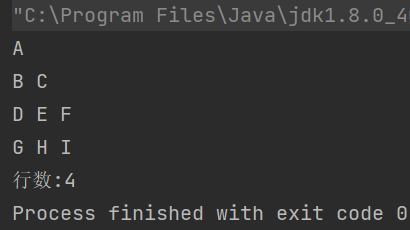
优化写法:leftchild和rightchild offer进队列的时候,不急着poll出来,等到当前层的所有节点的左右子树都offer进去的时候,再进行下一次循环,这时候队列数量就是当前层的节点数量,然后继续下一层遍历,本质上和上文写的逻辑一样,只不过不需要额外的变量了。
public static void storey2(TreeNode rootNode) {
    //使用队列,先进先出
    Queue<TreeNode> queue = new LinkedList<>();
    queue.offer(rootNode);
    int count = 0;
    System.out.print(rootNode.data);
    while (!queue.isEmpty()) {
        int n = queue.size();   //临时保存队列数量,队列数量就是当前层节点数量
        System.out.println();
        for (int i=0;i<n;i++) {   //循环当前层的节点数量
            TreeNode t = queue.poll();
            if (t.leftChild != null) {
                queue.offer(t.leftChild);
                System.out.print(t.leftChild.data+" ");
            }
            if (t.rightChild != null) {
                queue.offer(t.rightChild);
                System.out.print(t.rightChild.data+" ");
            }
        }
        count++;
    }
    System.out.print("行数:"+count);
}
其他二叉树的进阶算法,后续记录在leetcode分类栏目中





 扫一扫
扫一扫


 1261
1261

 被折叠的 条评论
为什么被折叠?
被折叠的 条评论
为什么被折叠?
 到【灌水乐园】发言





