


 该篇博客通过一个Java编程的例子介绍了抽象类和抽象方法的概念。文章指出,为了实现多态,可以将基类Shape定义为抽象类,包含抽象方法getArea()。抽象方法在基类中不包含实现,而强制要求子类进行重写。通过这种方式,可以确保在运行时根据对象的实际类型执行相应的行为。同时,抽象类不能被实例化,防止了基类对象的创建。博客强调了抽象类和抽象方法在实现多态和强制重写中的作用,并提供了代码示例进行说明。
在了解抽象类和抽象方法前,我们先来看一个多态的例子:
public class Shape {

    private String type;

    public Shape(String type) {
        this.type = type;
    }

    public void getArea() {
        System.out.println("get shape area === 0");
    }

    public void getType() {
        System.out.println("shape type is " + type);
    }

}
public class Square extends Shape {

    private int length;

    private int width;

    public Square(String type, int length, int width) {
        super(type);
        this.length = length;
        this.width = width;
    }

    @Override
    public void getArea() {
        int area = length * width;
        System.out.println("get square area === " + area);
    }

}
public class Circle extends Shape {

    private int radius;

    public Circle(String type, int radius) {
        super(type);
        this.radius = radius;
    }

    @Override
    public void getArea() {
        double area = radius * radius * 3.14;
        System.out.println("get circle area === " + area);
    }

}
    public static void main(String[] args) {
        Shape shape = new Shape("shape");
        shape.getArea();
        Shape square = new Square("square", 4, 2);
        square.getArea();
        Shape circle = new Circle("circle", 3);
        circle.getArea();
    }
get shape area === 0
get square area === 8
get circle area === 28.26
上述例子中,将几何形状定义为基类 Shape ,将矩形 Square 和 圆形 Circle 作为其导出类,通过对 getArea() 方法传入不同类型的对象,执行不同的方法行为,从而达到多态的目的。
我们注意到,基类 Shape 中的 getArea() 几乎没有任何意义,在实际应用过程中通常需要指定具体的几何类型(导出类)。
所以,我们并不想让其他人直接调用 Shape 类中的 getArea()方法,但仍想保留多态的特性。此时,可以将基类中的 getArea() 方法定义为抽象方法。
定义抽象方法的形式也非常简单:只需在方法名前加上 abstract 关键字即可,抽象方法内不能书写任何具体的代码。但需要注意的是,一旦类中包含一个抽象方法,此类必须强制定义为抽象类,需要在 class 关键字前加上 abstract 关键字,表示这是一个抽象类。
public abstract class Shape {

    private String type;

    public Shape(String type) {
        this.type = type;
    }

    public abstract void getArea();

    public void getType() {
        System.out.println("shape type is " + type);
    }

}
被定义为抽象的方法在导出类中强制要求其重写,不能直接被复用。

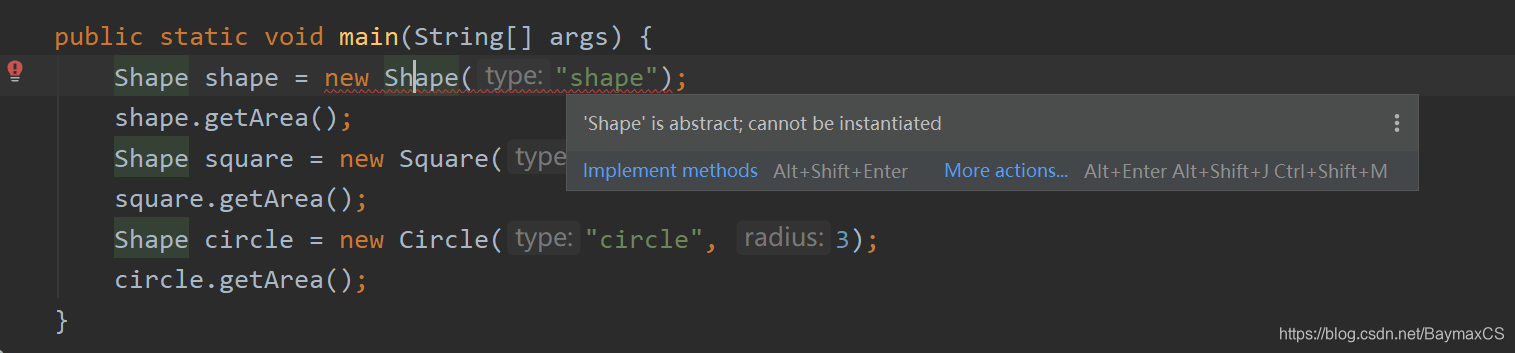
此外,抽象类也不允许被实例化。
抽象类中的非抽象方法,仍可以通过继承直接使用。
    public static void main(String[] args) {
        Shape square = new Square("square", 4, 2);
        square.getArea();
        square.getType();
        Shape circle = new Circle("circle", 3);
        circle.getArea();
        circle.getType();
    }
get square area === 8
shape type is square
get circle area === 28.26
shape type is circle
小结
定义抽象类,可以阻止的基类对象被创建;定义抽象方法,可以强制要求导出类重写方法。
本次分享至此结束,希望本文对你有所帮助,若能点亮下方的点赞按钮,在下感激不尽,谢谢您的【精神支持】。
若有任何疑问,也欢迎与我交流,若存在不足之处,也欢迎各位指正!





 扫一扫
扫一扫


 1万+
1万+

 被折叠的 条评论
为什么被折叠?
被折叠的 条评论
为什么被折叠?
 到【灌水乐园】发言





