code::block编译错误converting to execution character set

本文解决了在使用Code::Blocks编译器时遇到的中文字符串编译错误问题,通过调整编译器的字符集设置,成功消除了converting to execution character set的错误提示。

code::block编译错误converting to execution character set


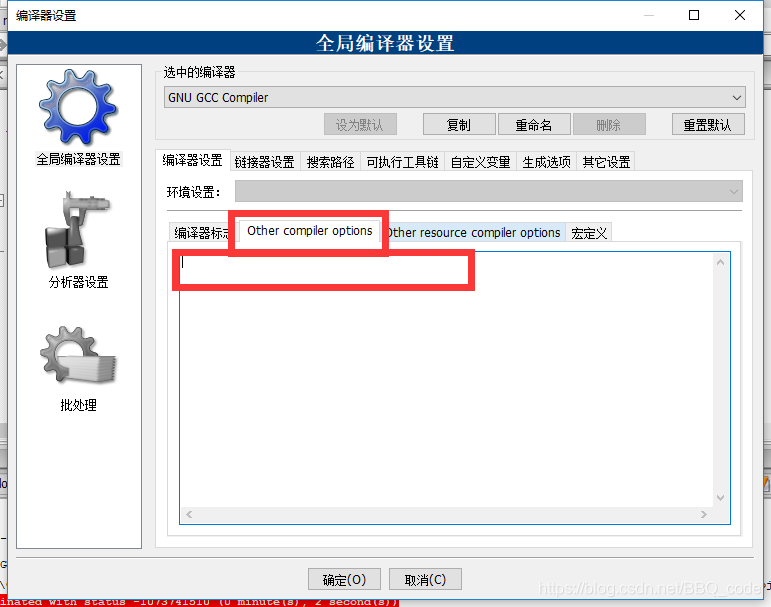
今天利用cout打印中文字符串报了这么一个错误,然后发现是编译器设置的问题

编译器设置问题

我在此处添加了
-finput-charset=GB2312
-finput-charset=UTF-8
我也忘了当初怎么加这个的删掉就好了,也许你的问题不在这,我这给自己留个记录。
在这里插入图片描述

1. What is an IDE (Integrated Development Environment), and what are its main components? 2. What is the role of a compiler in the C++ development process? 3. What is the difference between source code (e.g., a .cpp file) and an executable file? 4. In the "Hello, World!" program, what is the purpose of the line #include <iostream>? 5. What is special about the main() function in a C++ program? 6. Why do computers fundamentally operate using the binary (base-2) system? 7. What is the base of the hexadecimal system? Why is it often used by programmers as a shorthand for binary numbers? 8. Explain the "triad" method for converting an octal number to binary. 9. Briefly describe the "division by 2" method for converting a decimal number to binary. 10. What is the decimal value of the binary number 1011? 1. What is the purpose of the std::cout object? Which header file must be included to use it? 2.What is the difference between an escape sequence like \n and a manipulator like std::endl? (Hint: Both create a new line, but they have a subtle difference). 3.How would you print the following text to the console, including the quotes and the backslash: He said: "The file is in C:\Users\"? 4.Is it possible to write an entire multi-line text output using only one std::cout statement? If yes, how? 5.What is a syntax error? Give an example of a syntax error from Task 2. (Task 2: Debugging The following program contains several syntax errors. Copy the code into your IDE, identify the errors, fix them, and run the program to ensure it works correctly. Incorrect Code: */ Now you should not forget your glasses // #include <stream> int main { cout << "If this text" , cout >> " appears on your display, cout << " endl;" cout << 'you can pat yourself on ' << " the back!" << endl. return 0; "; ) Hint: Pay close attention to comments, header files, brackets ({}), operators (<<), semicolons, and how strings and manipulators are written.) 1. What is the difference between variable declaration and initialization? 2.What will be the result of the expression 7 / 2 in C++? Why? 3.What will be the result of the expression 10 % 3? What is the main purpose of the modulus operator? 4. What is the purpose of std::cin and the >> operator? 5. A beginner tries to swap two integer variables a and b with the code a = b; b = a;. Why will this not work correctly? 1. What is an algorithm? Name the primary ways to represent an algorithm. 2.List the main flowchart symbols and explain their purpose. 3.What are the three fundamental types of algorithm structures? Briefly describe each. 4.In a branching algorithm, what determines the flow of execution? 5.What is the key characteristic of a linear algorithm? 6.When is a cyclic algorithm structure used?7. 8. 9. 7.Explain the purpose of a connector in a flowchart. 8.What is the difference between a predefined process block and a standard process block? 9.In the context of solving a quadratic equation algorithm, what condition must be checked before calculating the roots? Why? 1. What are the three main approaches to data input and output offered by C++? 2. What is the purpose of the SetConsoleOutputCP(65001) and SetConsoleCP(65001)
functions in the provided C++ program example? 3. Explain the difference between the cin and cout objects in Stream 1/0. 4. When using formatted 1/0, which header file must be included to use manipulators like setw and setprecision? 5. List three manipulators used for data output in C++ and briefly describe what each one does. 6. In Formatted I/0 using printf), what are the conversion specifications for a decimal integer and a real number in exponential form? 7. What is the difference in how the & (address-of) operator is used when inputting a value for an integer variable versus a string variable using the scanf() function? 8. Which Character I/O function is used to output a single character to the screen, and which is used to output a string? 9. Describe the syntax and function of the ternary operator in C++. 10. What is the difference between the logical AND (&&) and logical OR (I|) operators when combining multiple conditions? 11. When is the default label executed in a C++ switch statement? 12. What is the primary purpose of the break statement within a switch block? 1. What is the main purpose of using loops in programming? 2. Explain the key difference between the for, while, and do while loops. 3. What happens if you forget to include the increment/decrement statement in a while loop? 4. How can you interrupt an infinite loop during program execution? 5. What is the role of the setw() and setfill) manipulators in C++? 6. In a nested loop, how does the inner loop behave relative to the outer loop? 7. What is type casting, and why is it used in loop calculations? 8. How does the do while loop differ from the while loop in terms of condition checking? 9. What output formatting options can be used to align numerical results in columns? 10*. How would you modify a loop to skip certain iterations based on a condition? 1. List the six main biwise operators in C++ and explain the function of each. 2. Why cannot bitwise operations be applied to variables of floating-point type? 3. Explain the purpose of the << (left shift) and >> (right shift) operators. What is the typical effect on the decimal value of a number when it is shifted left by 1? Shifted right by 1? 4. Describe the process of using a mask to check the value of a specific bit within an
integer. 5. How can you use the bitwise AND operator (&) to check if a number is even or odd?
Explain the logic. 6. What is the difference between the logical AND (&&) and the bitwise AND (&)? Provide an example scenario for each. 7. Explain the purpose of the ~ (bitwise NOT) operator. What is the result of applying it to a mask, and how can this be useful? 1. What is the primary goal of program debugging? What types of errors can it help identify? 2. Describe the difference between Step Over (F10) and Step Into (F11) debugging commands. When would you choose one over the other? 3. What is the purpose of a breakpoint in planned debugging? How do you set and remove a breakpoint in Visual Studio? 4. Explain the utility of the "Watch" window compared to the "Autos" or "Locals" windows during a debugging session. 5. What is the key difference between the Debug and Release configurations when building a project? Why is it necessary to create a Release version after successful debugging? 6. List at least three types of files commonly found in a project's Debug folder and briefly state their purpose (e.g., *.pdb). 7. During debugging, you notice a variable has an incorrect value. How can you change its value during runtime to test a hypothesis without modifying the source code? 8. What command is used to exit the debug mode and stop the current debugging session? 1. What is an array in C++? List its three main characteristics. 2. How are array elements numbered in C++? What is the valid index range for an array declared as int data[25];? 3. Explain the difference between array declaration and initialization. Provide an example of each. 4. What is an initializer list? What happens if the initializer list is shorter than the array size? 5. How can you let the compiler automatically determine the size of an array during initialization? 6. What values do elements of a local array contain if it is declared but not explicitly initialized? How does this differ from a global array? 7. What is an array out-of-bounds error? Why is it dangerous, and what are its potential consequences? 8. How do you calculate the number of elements in an array using the sizeof operator?
Provide the formula. What is a significant limitation of this method? 9. Why is it impossible to copy the contents of one array into another using the assignment
operator (arrayB = arrayA;)? What is the correct way to perform this operation? 10. Why does comparing two arrays using the equality operator (arrayA == arrayB) not check if their elements are equal? How should array comparison be done correctly? 11. What does the name of an array represent in terms of memory? 1. What is a pointer in C++ and what are its two main attributes? 2. Explain the difference between the & and * operators when working with pointers. 3. Why is pointer initialization critical and what dangers do uninitialized pointers pose? 4. What is the fundamental relationship between arrays and pointers in C++? 5. How does pointer arithmetic work and why does ptr + 1 advance by the size of the pointed type rather than 1 byte? 6. What is the difference between an array name and a pointer variable? Why can't you increment an array name? 7. What are the differences between const int*, int* const, and const int* const? 8. How can you safely iterate through an array using pointers, and what are the boundary risks? 9. What is a null pointer and why should you check for nullptr before dereferencing? 10. How do you access array elements using pointer syntax, and how does the compiler translate arr[i] internally? 1. What is a multidimensional array? How is a two-dimensional array structured in memory? 2. Explain the concept of an "array of arrays". How does this relate to the declaration int arr/ROWS//COLS;? 3. The name of a two-dimensional array without indices is a pointer constant. What does this pointer point to? What do the expressions *(A + i) and *(*(A + i) +j) mean for a two-dimensional array A? 4. Describe the different ways to access the element A/1/[2/ of a two-dimensional array
using pointers. 5. What is the rule for omitting the size of dimensions when initializing and when passing a multidimensional array to a function? Why is it allowed to omit only the first dimension? 6. Explain the principle of "row-major order" for storing two-dimensional arrays in memory.
How does this affect element access? 7. Why are nested loops the standard tool for processing multidimensional arrays?
Describe the typical pattern for iterating through a matrix. 1. How is a character string stored in memory in C++? What is the role of the null terminator (10), and why is it critical for C-style strings? 2. Why must the size of a char array declared to hold a string be at least one greater than the number of characters you intend to store? 3. The array name without an index is a pointer constant. What does the name of a char array point to? 4. What are the two main ways to initialize a C-style string? What is a common mistake when using the initializer list method, and what is its consequence? 5. Why is it necessary to add _CRT_SECURE_NO_WARNINGS to the preprocessor definitions in Visual Studio when working with many standard C library functions?
What is the alternative approach? 6. What is the key difference between stropy and strncpy? Why might strncpy be considered safer? 7. How does the stremp function determine if one string is "less than" another? Why can't you use the == operator to compare two C-style strings for content equality? 8. Describe the purpose and parameters of the strok function. How do you get all tokens from a string? 9. What do the functions strchr and strrchr do? How do they differ? 10. Explain what the strstr function returns and what it is commonly used for. 11. What is the purpose of the functions in the < cctype> header? Give three examples of such functions and their use. 12. What is the difference between tolower(c) and_tolower(c)? When should you use each? 1. What is a function in C++? Name the three core benefits of using functions in a program. 2. What is the difference between a function declaration (prototype) and a function definition? Provide examples. 3. What is a function signature? Which elements are part of the signature, and which are not? 4. What methods of passing parameters to a function do you know? Explain the difference between pass-by-value, pass-by-pointer, and pass-by-reference. 5. Why can't you pass an array to a function by value? What is the correct way to pass an array to a function? 6. What is variable scope? How is it related to functions? 7. How does a function return a value? What happens if a function with a non-void return type does not return a value on all control paths? 8. Can you use multiple return statements in a single function? Provide an example. 9. What is function overloading? What is it based on? 10. How is interaction between functions organized in a program? Provide an example program with several functions. 11. What are default parameters? How are they specified, and in what cases are they useful? 12. How can you prevent a function from modifying the data passed to it? What modifiers are used for this? 13. What is recursion? Provide an example of a recursive function. 14. What common errors occur when working with functions? How can they be avoided? 15. How do you use pointers to functions? Provide an example of declaring and calling a function through a pointer. 用中文解答
最新发布
11-28
### VSCode 中字符集转换错误解决方案 当在 VSCode 编辑器中遇到 `error: converting to execution character set: Illegal byte sequence` 错误时,这通常是因为源文件编码与编译器预期的目标字符集不匹配造成的。以下是详细的解决方法: #### 设置正确的输入和执行字符集 可以通过指定 `-finput-charset=UTF-8 -fexec-charset=GBK` 参数来设置 GCC 或 G++ 的输入和输出字符集。然而,在某些情况下,这种配置可能会引发非法字节序列的错误[^1]。 如果上述参数导致问题,则建议尝试移除这些选项并让编译器使用默认设置处理字符集转换。对于大多数现代开发环境来说,默认配置已经能够很好地支持多种语言文字[^3]。 另外一种方式是通过修改项目的 CMakeLists.txt 文件或其他构建工具配置文件中的相应部分来进行调整。例如,在 CMake 中可以这样定义: ```cmake set(CMAKE_CXX_FLAGS "${CMAKE_CXX_FLAGS} -finput-charset=UTF-8 -fexec-charset=UTF-8") ``` #### 修改终端编码设置 有时该问题是由于命令行界面(CLI)或集成开发环境中内置终端窗口所使用的字符编码不同步引起的。可以在 VSCode 用户/工作区设置里加入如下 JSON 配置项以确保一致性的 UTF-8 编码: ```json { "terminal.integrated.shellArgs.linux": ["-l"], "terminal.integrated.env.windows": { "CHCP": "65001" }, "files.autoGuessEncoding": true, "files.encoding": "utf8", } ``` 以上配置适用于 Windows 平台;如果是 Linux/macOS 可能不需要特别设定 CHCP 值。 #### 使用合适的宽字符集 针对特定应用场景可能还需要考虑宽字符的支持情况。比如 Qt 应用程序会涉及到多国语言显示等问题,此时可利用 `-fwide-exec-charset` 来指明宽字符串常量应采用何种编码存储于最终二进制文件之中[^2]。 综上所述,要彻底解决问题可以从以下几个方面入手:检查项目内所有涉及文本数据的地方是否有不当之处;确认编辑器本身以及关联插件是否正确设置了相应的编码属性;最后才是调整编译指令里的字符集相关参数直至找到最适合自己需求的一组组合方案。
评论
成就一亿技术人!
拼手气红包6.0元
还能输入1000个字符
 
红包 添加红包
表情包 插入表情
 条评论被折叠 查看
添加红包

请填写红包祝福语或标题

红包个数最小为10个

红包金额最低5元

当前余额3.43前往充值 >
需支付:10.00
成就一亿技术人!
领取后你会自动成为博主和红包主的粉丝 规则
hope_wisdom
发出的红包
实付
使用余额支付
点击重新获取
扫码支付
钱包余额 0

抵扣说明:

1.余额是钱包充值的虚拟货币,按照1:1的比例进行支付金额的抵扣。
2.余额无法直接购买下载,可以购买VIP、付费专栏及课程。

余额充值